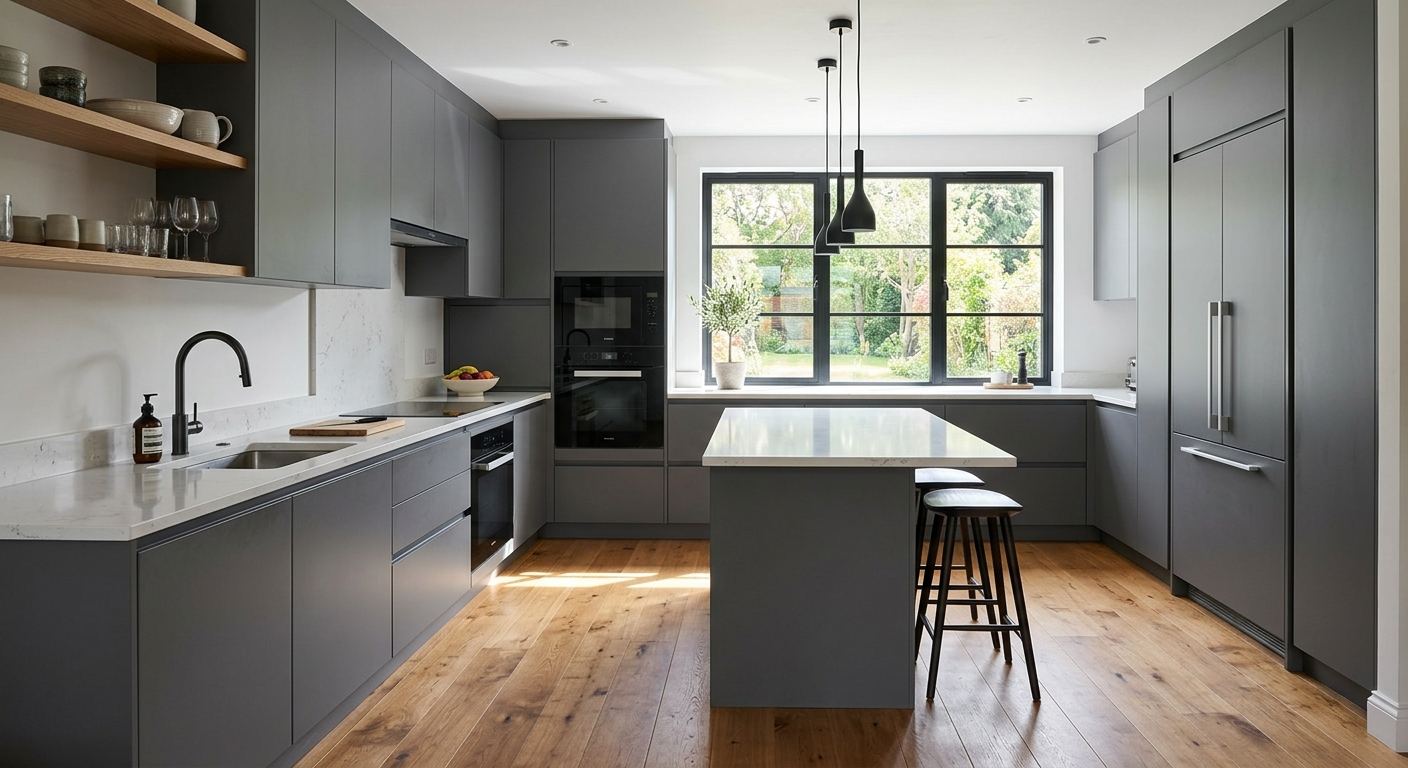
Kitchen renovation options and costs in Edmonton
Edmonton homeowners typically choose kitchen renovation options based on budget first, then finish level—and the market in Edmonton strongly influences that order. With a median household income of $90,000 (Statistics Canada, 2021 Census) and an older housing stock where 40.5% of homes were built before 1981 (Statistics Canada, 2021 Census), many projects start with wear-and-tear repairs and then expand once owners see what’s possible. In higher-value pockets of the Edmonton region, upgrades are more likely to be “resale-proof,” so you’ll see more quartz, upgraded hardware, and layouts that feel modern rather than merely tidy. In more price-sensitive areas, owners often prioritize efficiency—keeping cabinets in place, switching to durable surfaces, and upgrading lighting without moving plumbing or structural elements.
Edmonton’s winter doesn’t usually drive the cost as much as the renovation choices themselves, but it can affect scheduling and site conditions. Cold weather slows some finishes, extends curing times for flooring adhesives and sealants, and increases the importance of protecting work areas during early starts. Contractor availability also tightens around spring and early summer, so rush fees can show up when timelines are compressed. Demand is especially consistent in mature established areas such as Oliver and nearby inner-city neighbourhoods where homes are older and kitchen layouts are often due for an overhaul.
Below are the typical tiers you’ll see in Edmonton, with pricing aligned to the mid‑ to upper‑five‑figure realities of a full remodel when you include cabinetry, countertops, flooring, and updated lighting.
| Renovation Tier |
What's Included |
Typical Duration |
Price Range |
| Cosmetic refresh (paint, hardware, new appliances only) |
Cabinet paint or refinishing, new hardware/pulls, new appliances (like-for-like), basic lighting refresh, minor caulking and touch-ups |
1–2 weeks |
$7,500–$18,000 |
| Mid-range full renovation (new cabinets, counters, sink, tile) |
New semi-custom cabinets, quartz counters, new sink + faucet, backsplash tile, flooring replacement (LVP/tile as specified), updated lighting, disposal/trim-out |
3–6 weeks |
$25,000–$55,000 |
| High-end full renovation (custom cabinets, stone counters, island) |
Fully custom millwork, high-end stone (granite/marble/advanced stone), island with upgraded lighting, extended-height backsplash, premium flooring (tile), appliance package upgrade |
6–10 weeks |
$60,000–$90,000 |
| Cabinet refacing only (new doors + drawer fronts, same boxes) |
New doors/drawer fronts, new trim and hardware, paint or veneer system, labour for prep and install, basic re-caulking and alignment |
1–3 weeks |
$8,000–$25,000 |
| Countertop swap only (laminate to quartz or stone) |
Removal and install of countertops, template + fabrication coordination, new sink cut-out (if applicable), seam and edge finishing, sealing where required |
1–2 weeks |
$2,500–$12,000 |
| Backsplash tile installation only |
Tile supply and install, removal of existing backsplash (if needed), waterproofing/adhesives as required, grouting and caulking at edges |
4–7 days |
$2,000–$8,000 |
Prices are estimates only and vary by project scope, site access and material selection.
What affects the price of kitchen renovation in Edmonton
In Edmonton, two homeowners can receive quotes that differ by 30–50% for what looks like the “same” kitchen. The main driver is usually not climate—it’s finish tier, the likelihood of layout and service changes, and how quickly a contractor can source materials locally. In the Edmonton economic region, renovation budgets track closely to neighbourhood home values and household income, so mid‑ to upper‑five‑figure finishes (quartz counters, semi‑custom cabinets, upgraded lighting and flooring) become the default in higher-value pockets. With a typical household income around $90,000 (Statistics Canada, 2021 Census), many owners choose the upgrade path that’s easiest to justify on resale, rather than the cheapest option that only satisfies day-to-day use.
Here’s the practical reality: cabinet and countertop choices often set your baseline, while layout decisions determine your uncertainty. Moving a wall, adding an island, or relocating a gas line or plumbing usually adds labour, inspection requirements, and trade coordination—costs that can’t be “trimmed” by choosing a different cabinet colour. For example, a mid-range project in the $25,000–$55,000 band can expand quickly once you move plumbing or electrical, even if finishes stay mid-range. Meanwhile, a countertop-only swap that might land in the $2,500–$12,000 band becomes significantly higher if you also change sink position, add backsplash coverage, or replace flooring at the same time.
Concrete Edmonton-specific examples we commonly see: older pre‑1981 homes (40.5% of stock) often have service lines that don’t align cleanly with modern cabinet depths, creating added demo and patching. Also, homes with winter shutoff and seasonal humidity swings can show greater risk around adhesive-backed flooring or grouted surfaces if the project starts too late in the season. On the other hand, kitchens with straightforward access to shutoffs and existing chase walls can lower costs because trades can work without extensive openings.
| Price Factor |
Why It Matters |
Cost Impact |
| Cabinet tier — stock vs. semi-custom vs. fully custom millwork |
Custom sizing, door styles, internal layouts (soft-close, organizers), and manufacturing method affect material and install time |
Often shifts total by 20–45% depending on scope |
| Countertop material — laminate vs. quartz vs. granite vs. stone |
Material cost, fabrication complexity, and edge/seam choices change both material and labour |
Typically adds $1,500–$15,000+ across a full kitchen |
| Layout change — wall removal, island add, plumbing/gas move |
Requires more demolition, engineering where needed, trade coordination and potential permits |
Can raise costs by $5,000–$25,000+ |
| Appliance package tier — builder vs. mid-range vs. pro-grade |
Pro-grade appliances cost more and may require electrical/gas spec changes and tighter install tolerances |
Usually $1,000–$10,000+ difference |
| Flooring — refinish existing vs. full replacement |
Older subfloors may need prep; matching levels can add labour |
Can add $2,000–$12,000 depending on replacement scope |
| Backsplash — ceramic tile vs. marble vs. full-height slab |
Surface hardness, cut complexity, and waterproofing details influence time and waste |
Typically $500–$6,000+ beyond basic ceramic |
| Electrical — new circuits for island, under-cabinet lighting |
New outlets/lighting increases electrician time and possible permit/inspection steps |
Often $800–$4,500+ for typical kitchen adds |
| Permit fees and licensed trade requirements |
Work that changes plumbing, gas, structure, or electrical needs approvals and certified trades |
Varies, but can add $500–$3,000+ plus coordination time |
Permits & regulations in Alberta
In Alberta, not every kitchen change triggers a permit, and that’s where many homeowners get tripped up. Cabinet and countertop swaps usually do not require permits when the work is limited to replacing existing finishes and does not move services. However, if you move plumbing supply or drain lines, relocate gas (including the stove/range area and properly vented range hood connections where gas is involved), remove a load-bearing wall, or add new electrical circuits (for an island outlet run, additional lighting circuits, or new breakers), then permits and licensed trade involvement are typically required.
Step-by-step, here’s how a homeowner in Edmonton should verify a contractor before work starts. First, ask for the contractor’s Alberta licence details and scope confirmation in writing (what trades they will pull permits for, if any). Second, request a current certificate of insurance and verify the expiry date; for the trades, confirm they carry liability coverage appropriate to their work. Third, confirm WSIB/WCB coverage for workers—ask for documentation and match it to the trades performing the work. Fourth, require the contractor to specify who is responsible for permit pulling and inspections in the contract; don’t assume it’s included unless it’s written.
Finally, verify each licensed trade directly through their professional registry listings where applicable, and insist the contractor provide an inspection/approval plan once rough-in work begins.
Cabinets, countertops and layout decisions in Edmonton
The three biggest decisions in an Edmonton kitchen renovation are (1) cabinet tier, (2) countertop material, and (3) whether you change the layout. These choices affect cost predictability, resale appeal, and how your kitchen performs through Alberta’s long heating season and temperature swings. For cabinets, stock is fastest and cheapest, semi-custom is the most common mid-range balance, and custom is for unusual dimensions, integrated storage, and “built to fit” layouts.
Countertops are where you can visibly shift perceived value. Laminate is budget-friendly but can be more vulnerable to edge damage over time. Quartz is a strong Edmonton choice because it resists staining and doesn’t require sealing like natural stone. Granite/stone can deliver premium looks, but you’ll pay more for material and fabrication, and you’ll need to budget for care expectations. Butcher block adds warmth but demands more maintenance to keep it looking even under daily use.
Layout changes are the cost volatility. In mature Edmonton homes (including the older segment where 40.5% were built before 1981), moving services can mean cutting access openings and repairing finishes after rough-in. If you’re adding an island or removing a wall, the investment can be justified when it creates a clear traffic path and better seating or prep space—especially if you’re aiming for the $25,000–$55,000 mid-range band with resale-ready finishes. As a dollar example, upgrading from laminate to quartz often sits in the countertop band (commonly $2,500–$12,000), but adding a new island with moved electrical and plumbing can push you into the higher end of the full-renovation budget quickly. If the main goal is ROI without surprise costs, keep plumbing/gas where it is and spend on cabinetry, lighting, and quartz.
| Option |
Durability |
Maintenance |
Best For |
Price Range |
| Stock cabinets (big-box) |
Good for standard dimensions; hinges and organizers vary by line |
Low routine maintenance; may be less forgiving on installation tolerances |
Budget-first refreshes where layout matches common sizing |
$8,000–$20,000 |
| Semi-custom cabinets (local dealer) |
Very strong balance of construction and options; better internal organizers |
Low day-to-day care; soft-close and hardware updates improve longevity |
Most Edmonton renovations targeting a mid-range finish tier |
$15,000–$35,000 |
| Custom cabinets (local millwork shop) |
Highest fit/finish and storage optimization; ideal for awkward spaces |
Low maintenance; quality depends on door finish and hardware selection |
Families needing maximum storage or a unique layout integration |
$30,000–$60,000 |
| Laminate countertop |
Moderate; edges and seams are the most likely wear points |
Simple cleaning; avoid heavy impact at seams and protect edges |
Cost-controlled renos where the goal is a clean look quickly |
$2,500–$6,000 |
| Quartz engineered countertop |
High; resistant to staining and everyday wear |
Low maintenance; typically no sealing required |
Edmonton resale-minded upgrades in the mid- to upper-mid price range |
$4,500–$10,500 |
| Granite / natural stone countertop |
High; durable surface with natural character |
Moderate; sealing may be needed depending on stone and finish |
Premium look and uniqueness for high-end renovations |
$7,000–$12,000 |
| Butcher block countertop |
Good but can dent or scratch; needs care to avoid uneven dryness |
Regular oiling and gentle cleaning to keep it consistent |
Homes where homeowners cook often and accept maintenance |
$4,000–$9,000 |
| Marble countertop |
Premium and elegant; softer than quartz, can etch with acids |
Higher care (stone-safe cleaners, sealing approach varies by supplier) |
Statement kitchens where you want luxury appearance |
$8,000–$14,000 |
How to choose a kitchen renovation contractor in Edmonton
Choosing the right contractor in Edmonton is mostly about verifying the basics and forcing clarity into the quote. Start with Alberta compliance: ask for the contractor’s proof of liability insurance (and confirm the coverage limits and policy expiry date). Then confirm WSIB/WCB coverage for their workers and ask for documentation. Next, verify any specialty trade credentials they’re relying on—for example, gas work must be done by a licensed gas fitter and electrical by a licensed electrician; reputable contractors will coordinate this without you having to chase pieces.
When you request quotes, get 2–3 itemised written estimates rather than a single lump sum. A good quote separates labour and materials (cabinets, counters, flooring, demo/disposal, electrical, plumbing coordination, lighting) so you can compare apples to apples. Read the scope line-by-line: what’s excluded (old cabinet removal, drywall repair, subfloor leveling, appliance installation, permit pulling, disposal)? If the contractor doesn’t clearly state it, add it to the contract.
Warranty matters too. Ask for the workmanship warranty length, whether product warranties are included (manufacturer warranty), and if they’re transferable to future owners. Payment schedules should be practical: never pay more than 10–15% upfront, and hold back a portion until punch-list completion and final walkthrough. Finally, insist on a written timeline with a start date and a realistic completion estimate, including fabrication lead times for cabinets and stone.
- Confirm licence scope matches your project (kitchen remodel vs “general handyman” marketing).
- Request certificate of insurance and verify it covers renovation activities at your address.
- Ask for WSIB/WCB documentation for their workers (not just subcontractors).
- Get 2–3 itemised quotes with labour and material breakdowns.
- Ensure permit responsibility is explicitly written (who pulls, who pays, who schedules inspections).
- Confirm disposal details: is demolition debris hauling included?
- Clarify what happens to existing floors/cabinet backs during demo and repairs.
- Ask who installs appliances and whether warranties are affected by installation method.
- Check that the quote includes electrical/plumbing rough-in coordination if you add an island or outlets.
- Review warranty: workmanship duration, what triggers it, and how it’s handled for workmanship defects.
- Use a payment schedule with a small deposit and a holdback until final completion.
- Get everything in writing: selections, measurements, timelines, and change-order process.
Common Edmonton red flags: quotes that don’t list what’s included (especially disposal and permit responsibility), vague timelines without cabinet/counter lead times, missing insurance/WSIB proof or “we’ll email it later,” refusing to put warranty terms in writing, and requesting a large upfront payment without a signed contract and staged milestones.
Frequently asked questions — kitchen renovation in Edmonton
Should I reface or replace my cabinets?
If your cabinet boxes are solid and square (no sagging frames, water damage, or warped sides), refacing can be the smarter move in Edmonton because it preserves the existing structure and reduces demolition and re-install time. Refacing typically falls around $8,000–$25,000, which often frees budget for quartz counters or better lighting. However, if your current layout has issues (poor drawer function, outdated dimensions, or you’re trying to fix clearance problems around older plumbing chases), replacing cabinets is usually the better long-term solution. In homes built before 1981 (40.5% of Edmonton stock per Statistics Canada, 2021 Census), we commonly see box condition mixed—so we judge based on alignment, moisture history, and whether services need rerouting. If you’re unsure, ask for a box condition assessment before you commit.
Do I need a permit for a kitchen renovation in Alberta?
In Alberta, cabinet and countertop swaps typically do not require permits when you’re not moving services or structural elements. That said, you usually do need permits and licensed trade work if you’re moving plumbing supply/drain lines, relocating gas for the stove/range area, removing a load-bearing wall, or adding electrical circuits (for new outlets, island lighting, or extra breaker loads). Edmonton homeowners should treat permits as the dividing line between “finish-only” updates and “infrastructure” work. Even if your contractor handles it, confirm permit responsibility in your signed contract before work begins. For Edmonton’s older housing stock, service routing is sometimes less predictable, which can increase the likelihood you’ll touch plumbing or electrical once demolition starts—so plan for permits if your scope includes moves.
What's the ROI on a kitchen renovation?
ROI in Edmonton varies by neighbourhood home values and the finish tier you choose, but kitchens generally return value best when the renovation improves functionality and aligns with what local buyers expect. Industry rule-of-thumb guidance (often referenced through kitchen-and-bath remodel budgeting frameworks) commonly places full kitchen renos around 15–25% of the home’s value to balance cost and resale impact. In higher-value areas of the Edmonton region, homeowners more often choose quartz/stone counters and upgraded layouts, pushing many full projects into the mid‑ to upper‑five‑figure range (consistent with typical full renovation bands like $25,000–$90,000). If you’re aiming for ROI without overspending, prioritise visible upgrades (cabinets, counters, lighting) and avoid costly layout changes unless the space gain is meaningful.
How do I budget for a kitchen renovation?
Start by choosing a tier that matches your timeline and tolerance for surprises. Many Edmonton kitchens land in the $25,000–$55,000 mid-range full renovation band when you include new cabinets, quartz counters, sink, and tile, plus updated lighting and flooring. If you’re going high-end with custom cabinetry and stone counters and adding an island, budgeting closer to $60,000–$90,000 is more realistic. The most budget-risky items are layout changes: moving plumbing or gas lines and adding electrical circuits can raise costs quickly due to coordinated trades and potential permit steps. A practical approach is to set a baseline budget for finishes, then add a contingency for “unknowns” that often appear when demo reveals old subflooring, plumbing alignment issues, or drywall repairs—especially in older homes.
Can I move my kitchen sink or stove?
Yes, you can move a sink or stove in Edmonton, but it’s the type of change that most affects total cost. Moving a sink means changing plumbing supply and drain routes, which typically requires additional rough-in work, possibly permits, and coordination with a licensed plumber. Moving a stove can involve gas relocation (and sometimes venting considerations); gas work must be performed by the appropriate licensed gas professional, and inspections are commonly part of the process. Because these trades must coordinate timing, schedule risk and labour increase—even if your finishes stay mid-range. If you want the best value, consider moving only within the same service zone (where existing lines can be accessed with minimal openings), or keep the stove/sink where they are and upgrade cabinets, counters, and lighting.
What's the most cost-effective kitchen upgrade?
The most cost-effective upgrades are usually the ones that deliver a big visual change without triggering major demolition or service moves. In Edmonton, many homeowners get strong results with a countertop swap only (often $2,500–$12,000 depending on material and edges) paired with updated hardware and improved lighting. Another efficient option is a backsplash tile installation only (often $2,000–$8,000), because it transforms the kitchen’s focal wall without touching plumbing or electrical. If your budget is tight, avoid layout changes and focus on durability: quartz counters and quality under-cabinet lighting typically look modern for years. For older homes, consider whether cabinet boxes are solid first—if they are, refacing can be a cost-effective bridge before deciding on replacement later.