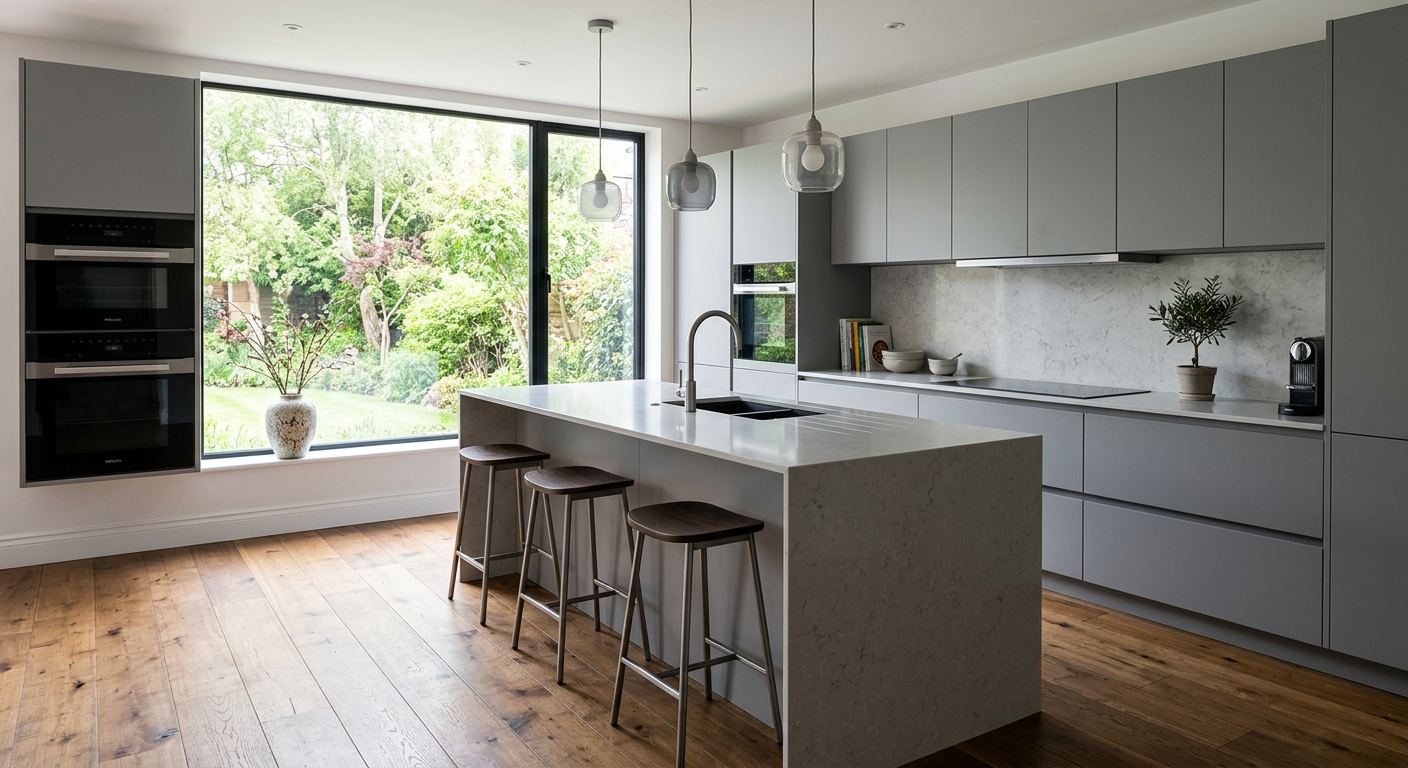
Kitchen renovation options and costs in Rundle
Rundle, Alberta is a growing pocket of the Calgary region, and that shows up in kitchen-reno expectations: homeowners want modern finishes that photograph well and hold up to everyday use. With a local population of 10,545 (Statistics Canada, 2021 Census), demand can be steady, but individual project costs still swing because finish level and scope vary a lot. In practice, Calgary-area homeowners tend to budget like their home values and buying expectations—when a property is higher-end, the renovation often targets “sell-ready” upgrades rather than only repairs. That’s why many kitchens shift toward quartz or natural stone and semi-custom cabinetry, even for renovations that don’t move walls.
In this part of Alberta, it’s less the climate and more the market that drives the budget. Calgary’s strong construction cycle keeps skilled labour widely available, but labour, design, and project management are a major share of the total—skilled trades commonly land around 90–140 per hour. For Rundle homeowners, that’s why a “like-for-like” upgrade can cost noticeably less than a full redesign. Neighbourhood activity is often especially concentrated around the newer infill corridors and commercial-serviced pockets near the core of Calgary’s south/east growth, where contractors get multiple concurrent jobs and schedule windows move quickly.
Below is a practical breakdown of common renovation tiers you’ll see in Rundle quotes, so you can compare apples to apples before you start negotiations.
| Renovation Tier |
What's Included |
Typical Duration |
Price Range |
| Cosmetic refresh (paint, hardware, new appliances only) |
Paint, new cabinet hardware, fixture swaps, appliance-only changes; no cabinet rebuild and no countertop replacement |
1–3 weeks |
$5,000–$15,000 |
| Mid-range full renovation (new cabinets, counters, sink, tile) |
New semi-custom or stock cabinets, new counters (quartz/stone or upgraded solid surface), sink and tap, backsplash tile, disposal/trim as needed |
4–8 weeks |
$25,000–$60,000 |
| High-end full renovation (custom cabinets, stone counters, island) |
Custom millwork, premium stone or higher-grade engineered stone, island cabinetry/lighting, full-height or designer backsplash, upgraded fixtures and finishes |
8–14 weeks |
$60,000–$100,000 |
| Cabinet refacing only (new doors + drawer fronts, same boxes) |
Refacing/door swap, new drawer fronts, hinges and pulls; counters may stay, with optional minor trim work |
2–5 weeks |
$8,000–$35,000 |
| Countertop swap only (laminate to quartz or stone) |
Remove existing surfaces, template, install new laminate/quartz/stone; may include basic seaming and sink cut-outs as required |
1–3 weeks |
$3,000–$12,000 |
| Backsplash tile installation only |
Tile layout and installation, grout/sealing where applicable, edging and caulking details around outlets |
3–7 days |
$2,500–$8,000 |
Prices are estimates only and vary by project scope, site access and material selection.
What affects the price of kitchen renovation in Rundle
Even when two homeowners describe the “same” kitchen, quotes across Calgary and Alberta can differ by 30–50% because the expensive parts aren’t obvious in the first conversation. The biggest drivers are finish tiers (cabinet and countertop choices), and whether the renovation stays strictly surface-level or changes layout and services. Local home values and typical household income expectations in the Calgary economic region strongly influence what homeowners choose: in higher-value areas, people more readily default to quartz or natural stone counters and semi-custom cabinetry because the cost is easier to justify on resale. In more budget-conscious markets, laminate and stock cabinets dominate, and contractors can keep timelines tighter. Either way, layout changes are the cost wild card.
For Rundle, expect quotes to jump most when you remove a wall, add an island, or relocate plumbing or gas lines. Moving a gas line (or even changing a range location) can trigger permit requirements and licensed work that increases both labour time and scheduling. Likewise, adding new circuits for island outlets or under-cabinet lighting tends to be a hidden cost that isn’t reflected in basic “cabinet + counter” estimates. If your project stays near the existing footprint, you’ll often see costs land closer to the mid-band where a full renovation may cluster around $25,000–$60,000. If you go custom with stone and island work, the budget frequently stretches toward the high end, where projects can reach $60,000–$100,000.
Two common Rundle examples I see: older homes sometimes have less consistent wall framing, so backsplash and cabinet rail alignment takes longer; and if existing floor flatness is off, tile and cabinet installation require extra prep, which affects both labour and material waste. Calgary-era demand also means shop drawings and stone templating slots can become a scheduling constraint, so a fast-start date can cost more if you’re working around lead times.
| Price Factor |
Why It Matters |
Cost Impact |
| Cabinet tier — stock vs. semi-custom vs. fully custom millwork |
Custom doors, internal storage layouts, and installation precision drive price and time |
Can swing the budget by $10,000+ on many mid-to-large kitchens |
| Countertop material — laminate vs. quartz vs. granite vs. stone |
Material cost and fabrication complexity (seams, edges, cut-outs) change labour and waste |
Typically adds several thousand dollars, with higher tiers rising quickly |
| Layout change — wall removal, island add, plumbing/gas move |
Unpredictable framing, service relocation, and inspection requirements extend timelines |
Often the largest variance; can push a mid project into high-end pricing |
| Appliance package tier — builder vs. mid-range vs. pro-grade |
Premium brands require better integration, ventilation planning, and sometimes electrical adjustments |
Can add $2,000–$10,000+ depending on selection |
| Flooring — refinish existing vs. full replacement |
Existing subfloor condition affects prep, underlayment, and transitions |
Can range from minor cost to several thousand dollars |
| Backsplash — ceramic tile vs. marble vs. full-height slab |
Slab installs demand higher precision and may require extra support/trim detailing |
Can double backsplash budgets when switching to full-height premium materials |
| Electrical — new circuits for island, under-cabinet lighting |
Licensed electrical work plus inspection scheduling adds cost and coordination time |
Often increases the project by a few thousand dollars |
| Permit fees and licensed trade requirements |
Permits, inspections, and scheduling with licensed trades affect total labour hours |
Variable; becomes significant when plumbing/gas/electrical scope expands |
Permits & regulations in Alberta
In Alberta, simple cabinet and countertop swaps are typically no-permit work, but the moment you change services or structural elements, permits and licensed trades usually come into play. Cabinet and countertop replacement (including removing old counters and installing new quartz/stone) is generally treated as finishing work and typically does not require a permit. Where projects in Rundle commonly require permits is when you: move plumbing supply or drain lines; relocate a gas stove or make changes that affect gas piping; remove a load-bearing wall; or add new electrical circuits/outlets—especially for an island with dedicated power and/or under-cabinet lighting that isn’t already wired.
Step-by-step, here’s how a homeowner in Rundle can verify your contractor properly before work starts. First, ask the contractor what scope triggers permits in your specific layout (plumbing/gas/electrical and structural). Next, verify the gas work: gas fitting must be done by a licensed gas fitter, and the contractor should provide the licence details and inspection pathway. For electrical, confirm the work will be performed by a licensed electrician and that an inspection is scheduled where required.
Then confirm coverage and accountability: request a Certificate of Insurance (liability) and proof of worker coverage as applicable (WSIB/WCB). Finally, ensure the contract states who pulls the permit and who is responsible for inspections; always confirm in writing before signing.
Cabinets, countertops and layout decisions in Rundle
In Rundle kitchens, the three decisions that most consistently determine your final price (and your resale appeal) are: (1) cabinet tier, (2) countertop material, and (3) layout changes. Cabinet tier is the difference between a fast, cost-controlled install and a kitchen that fits like built-in furniture. Stock cabinets are the quickest and cheapest, semi-custom is usually the sweet spot for function and style, and fully custom is best when you need unusual dimensions, premium storage, or a distinctive design language.
Countertops follow a similar pattern. Laminate is budget-friendly and performs well for light-duty households, but it can show wear and seam limitations over time. Quartz engineered countertops are a common Calgary-region choice because they’re durable, stain-resistant, and easier to maintain than many natural stones. Granite and other natural stones look premium but require more careful sealing and can carry higher fabrication variation. Butcher block can add warmth and is forgiving for scratches, but it needs regular sealing and mindful cleaning.
Layout changes—open-concept wall removal, island addition, or plumbing/gas relocation—are justified when they create meaningful space gains: better traffic flow, improved working triangle, or usable seating. They’re less justified when they simply change aesthetics without solving a functional pain point. For example, if you keep the sink and dishwasher where they are, you might target a mid-range refresh around $25,000–$60,000. If you move plumbing and add an island with new electrical outlets, the scope can push you toward $60,000–$100,000 even if cabinet finishes are mid-tier, because services and coordination dominate the budget.
In Alberta’s daily rhythm, kitchens also see winter-season usage spikes (more indoor cooking, more water and cleaning), so durable cabinet hardware, a resilient countertop, and a properly detailed backsplash matter. Don’t underestimate prep and alignment time on older wall surfaces—good installation details often cost less than replacing a bad tile or misaligned cabinet run later.
| Option |
Durability |
Maintenance |
Best For |
Price Range |
| Stock cabinets (big-box) |
Solid for daily use; limited customization |
Low—standard cleaning and tightening hardware as needed |
Budget-focused renos with straightforward dimensions |
$8,000–$20,000 |
| Semi-custom cabinets (local dealer) |
Good durability; improved storage and better fit |
Low to moderate; wipe-down and occasional hinge adjustment |
Most Rundle homeowners balancing cost and longevity |
$18,000–$40,000 |
| Custom cabinets (local millwork shop) |
Highest build quality; tailored storage and specialty features |
Low—same care as quality cabinet finishes |
Unique layouts, premium finish expectations, and long-term ownership |
$35,000–$70,000 |
| Laminate countertop |
Moderate; can chip at edges or around seams |
Low; avoid hot pans and moisture pooling at seams |
Quick refreshes where budget is the priority |
$3,000–$6,000 |
| Quartz engineered countertop |
High; very resistant to staining and everyday wear |
Low; routine cleaner and no sealing required |
Family kitchens and resale-oriented upgrades |
$6,000–$12,000 |
| Granite / natural stone countertop |
High; durable but varies by slab and finish |
Moderate; sealing and careful cleaning |
Premium look with a willingness to maintain |
$8,000–$16,000 |
| Butcher block countertop |
Moderate to high; scratches are part of the patina |
Moderate; regular oiling and drying after wet tasks |
Farmhouse warmth and households that like maintenance |
$5,000–$10,000 |
| Marble countertop |
Moderate; softer and more prone to etching |
High; sealing and careful acidic spill management |
Statement kitchens where aesthetics outweigh heavy wear |
$10,000–$20,000 |
How to choose a kitchen renovation contractor in Rundle
Choosing the right kitchen contractor in Rundle is mostly about proof, not promises. Start with Alberta licensing checks: ask who will be doing gas and electrical work and confirm they’re licensed for those scopes. Next, verify liability insurance by requesting a Certificate of Insurance showing active coverage and limits. If your project involves employees and trades under the contractor’s umbrella, ask for worker coverage evidence (WSIB/WCB) so you’re not left holding the risk.
Then get 2–3 itemised written quotes. You want a breakdown that separates labour and materials (cabinet install, cabinet supply, countertop supply and template/fabrication, tile, plumbing/electrical allowances, disposal and drywall/painting). Avoid lump sums that don’t show what you’re paying for. Read the scope line-by-line: what’s excluded (e.g., existing damage beyond demolition, subfloor flattening, appliance installation), is permit pulling included, and is waste disposal/haul-away covered? Warranty matters too: confirm workmanship warranty length, whether manufacturer warranties apply to cabinets and countertops directly, and whether warranties are transferable to future owners if you sell.
Payment schedule is another risk-control. For kitchen renos, never pay more than about 10–15% upfront. Use holdback until completion and sign-off of remaining punchlist. Finally, lock in timeline details: the start date, estimated completion date, and what happens if stone fabrication or inspections delay milestones should be written into the agreement.
- Request licence proof for gas/electrical scopes before demolition
- Confirm Certificate of Insurance and ask for an up-to-date copy
- Ask for WSIB/WCB coverage evidence (as applicable)
- Get 2–3 itemised quotes with labour + materials separated
- Ensure allowances are itemised (appliances, fixtures, trim)
- Ask who pulls permits and who pays permit-related costs
- Confirm waste disposal/haul-away is included
- Ask for a demolition-to-install schedule and staging plan
- Confirm countertop templating dates and stone lead-time assumptions
- Verify warranty terms: workmanship length and product warranty coverage
- Use progress payments with a holdback until final completion
- Make sure the scope states who handles punchlist and touch-ups
Red flags I see in Rundle: (1) quotes that won’t provide an itemised breakdown and only offer a single lump sum; (2) promises about “no permits needed” even when plumbing/gas/electrical is moving; (3) requests for large upfront payments without contract milestones; (4) no written warranty details; and (5) contractors who won’t provide proof of liability insurance or coverage documents.
Frequently asked questions — kitchen renovation in Rundle
Do I need a permit for a kitchen renovation in Alberta?
In Alberta, cabinet and countertop swaps typically do not require permits. However, in Rundle kitchens, permits are commonly required when the project changes plumbing supply/drain lines, relocates gas appliances (or makes changes that affect gas servicing), removes a load-bearing wall, or adds/changes electrical circuits (for example, new island outlets or significant new lighting runs). Gas work must be completed by a licensed gas fitter, and electrical work must be performed by a licensed electrician with inspections where applicable. Before you sign anything, ask the contractor to list the exact tasks that will be permitted and confirm in writing who is responsible for pulling the permits. This prevents surprises late in the schedule, especially when inspections affect countertop and cabinet install dates.
What's the ROI on a kitchen renovation?
ROI varies based on finish tier, layout changes, and whether the upgrade matches what local buyers expect in Calgary-area resale markets. In general, kitchens tend to perform well when they improve function (storage, workflow, lighting) and modernize durable surfaces rather than chasing purely trendy finishes. In practice, many homeowners use a “refresh budget” mindset—often roughly 10–15% of home value for a refresh in higher-value areas, and up to 20–25% for full redesigns in more upscale properties—because that aligns with the cost expectations buyers read when they walk in. If your plan is a mid-range full renovation (commonly around $25,000–$60,000), and you keep plumbing/gas mostly where it is, you’ll usually get a more predictable return than a project that relocates multiple services without clear functional gains.
How do I budget for a kitchen renovation?
Start by selecting the renovation tier that matches your goals: cosmetic refresh, mid-range full renovation, or high-end redesign. Then set aside a realistic contingency for Alberta schedules and unknown site conditions—especially with older framing, uneven subfloors, or inconsistent wall finishes. A common pitfall is budgeting for cabinets and counters but not for layout changes, electrical, or permit-triggering work. For a kitchen that stays within the existing footprint, many Rundle homeowners land in the mid five-figures; for example, mid-range full renos often cluster around $25,000–$60,000. If you add an island, relocate services, and move to custom millwork and premium stone, it’s not unusual to see budgets approach $60,000–$100,000. Ask for itemised allowances so you can see where your money is actually going.
Can I move my kitchen sink or stove?
Yes, you can move a sink or stove, but it’s where budgets and approvals can change quickly. Moving a sink usually means running new plumbing supply and drain lines, which typically triggers permits and requires licensed plumbing work. Moving a stove is even more sensitive if it’s gas: gas line relocation typically requires a licensed gas fitter and inspections. In Rundle and the Calgary area, the cost jump isn’t only material—it’s the labour time, coordination with licensed trades, and scheduling around inspections. If you’re trying to control cost, consider whether you can keep the sink and range positions and instead improve the workflow with cabinet storage changes, better lighting, and countertop layout. If a move creates meaningful space gain (for example, creating seating at an island), it can be justified; if not, you may pay a premium without improving daily usability.
What's the most cost-effective kitchen upgrade?
The most cost-effective upgrades are usually the ones with strong visual impact and minimal hidden scope: cabinet hardware and paint, upgrading lighting (especially under-cabinet LEDs), and replacing an outdated backsplash. If your cabinets are structurally sound, refacing doors and drawer fronts is often one of the best value moves because you avoid full cabinet removal. Another highly efficient choice is a countertop swap: moving from laminate to quartz often delivers a noticeable “modern kitchen” look with relatively contained project disruption. For example, countertop installation commonly falls around $3,000–$12,000, and backsplash-only tile work often lands around $2,500–$8,000. These options are also easier to schedule around stone templating and reduce the chance of uncovering extra demolition issues that can inflate full renos.
Custom vs stock cabinets — is custom worth it?
Custom cabinets are worth it when your kitchen layout is unusual, you need specialty storage (pantry systems, appliance garages, deep drawers, corner solutions), or you want a precise look that matches premium countertops and flooring. If your goal is speed and budget control, stock cabinets are usually the most cost-effective baseline. For most Rundle homeowners aiming for a resale-friendly upgrade, semi-custom is often the “best value” tier because you get better internal configurations and a more tailored fit than stock without the full cost jump of custom millwork. In practical budgeting terms, cabinetry tiers can swing quickly: stock often starts around $8,000–$20,000, while custom can climb well above that. The key is matching the cabinet tier to the rest of your finishes—spending on custom while keeping basic counters can undercut the visual payoff.