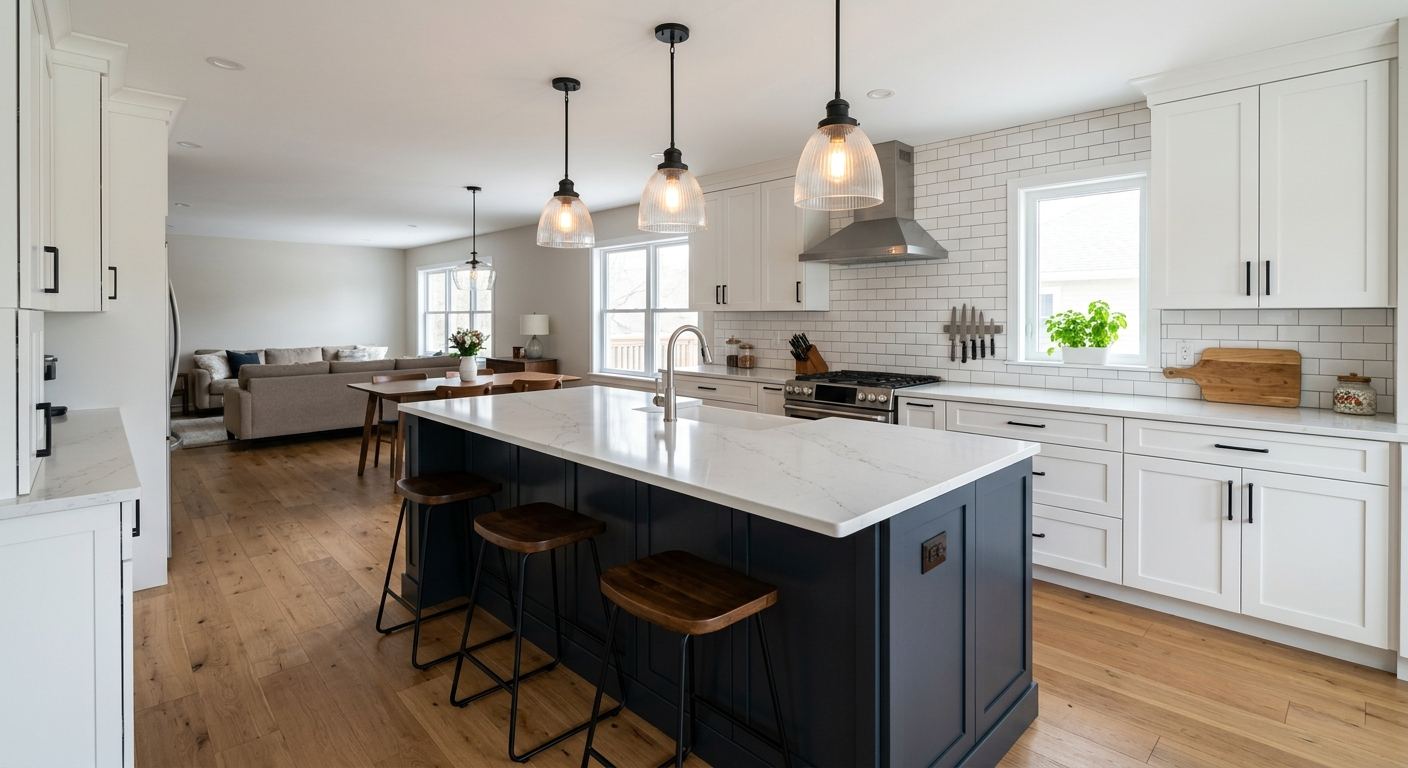
Kitchen renovation options and costs in Crossfield
Crossfield homeowners typically shop kitchen renovations with a clear goal: update the look without surprises. With a median household income of about $104,000 (Statistics Canada, 2021 Census), many families can afford a mid-range upgrade that still feels “end-of-street” current. Housing stock also matters in Crossfield—around 25.9% of homes were built before 1981 (Statistics Canada, 2021 Census), and those kitchens often have older layouts, dated plumbing rough-ins, and fewer modern electrical outlets for today’s appliances.
In the Calgary economic region, costs tend to track home value and buyer expectations more than climate. Labour is a major driver—skilled trades commonly run roughly $90–$140 per hour in Calgary—so design time, demo, installation, and project management substantially affect the final number. Calgary-area demand also pushes contractors toward popular, durable materials: quartz or natural stone counters and semi-custom cabinetry show up often in project bids, especially when the renovation is meant to last 10–15 years.
Even though Alberta’s climate doesn’t directly change cabinetry pricing, it influences how kitchens are executed: careful sealing around windows/doors, thoughtful humidity management, and using stable materials that won’t shift over seasonal swings. In Crossfield, trade demand tends to be strongest for renovations targeting resale appeal in the newer pockets near the east and north parts of town, where homeowners often want a modern “clean-lined” kitchen with better lighting and workflow. From there, the right next step is usually selecting a renovation tier—see the comparison table below.
| Renovation Tier |
What's Included |
Typical Duration |
Price Range |
| Cosmetic refresh (paint, hardware, new appliances only) |
Cabinet paint or stain refresh, new hardware/pulls, appliance swap, touch-up lighting/trim, minor caulking and cleanup |
3–7 days |
$6,000–$20,000 |
| Mid-range full renovation (new cabinets, counters, sink, tile) |
Semi-custom cabinets, new countertops, sink and faucet, backsplash tile, basic electrical allowance, disposal connections, flooring repair/section |
2–4 weeks |
$25,000–$60,000 |
| High-end full renovation (custom cabinets, stone counters, island) |
Custom cabinetry, quartz or natural stone counters, island build, upgraded lighting (including under-cabinet), tile/stone backsplash, premium sink/faucet, more complex plumbing/electrical |
4–8+ weeks |
$70,000–$100,000 |
| Cabinet refacing only (new doors + drawer fronts, same boxes) |
Door and drawer-front replacement, new veneer/finish on existing boxes, new hardware, coordinated paint/touch-ups |
1–3 weeks |
$8,000–$30,000 |
| Countertop swap only (laminate to quartz or stone) |
Remove old countertop, template and install new countertop, sink cut-out (if like-for-like), basic backsplash adjustment/edge finishing |
3–10 days |
$3,000–$12,000 |
| Backsplash tile installation only |
Tile supply and install, surface prep, waterproofing where needed, edge trims, grout/seal, caulking and finish cleanup |
2–5 days |
$2,500–$8,000 |
Prices are estimates only and vary by project scope, site access and material selection.
What affects the price of kitchen renovation in Crossfield
In Crossfield and across the Calgary economic region, the same “kitchen refresh” can land 30–50% apart between quotes. The usual reason isn’t the finish—it’s what’s hidden: electrical scope, plumbing access, wall conditions, cabinet customisation level, and how many days of skilled labour your project actually needs. Alberta market pricing also means contractors protect their scheduling and material risk; when demand is high, lead times and trade availability push costs upward, especially for stone and custom millwork.
Local home values and median income shape the typical finish tier far more than climate. In higher-value pockets around Calgary and nearby communities, homeowners often choose quartz or natural stone counters and semi-custom cabinetry because buyers expect that look and it can be justified on resale. In more modest budgets, laminate and stock cabinets dominate, offering a better ROI if you keep the layout. Regardless of finish, layout changes are where budgets swing: removing a wall, adding an island, or moving a gas line or plumbing chase adds labour hours and risk, and those unpredictable trades costs can outweigh a “downgrade” in materials.
In Crossfield specifically, a few conditions commonly raise the price. First, kitchens in older homes (25.9% built before 1981) often have outdated electrical runs, which can add cost when you’re adding under-cabinet lighting or moving outlets for a new island. Second, if your backsplash area includes older, uneven tile or damaged drywall, prep can add days. Third, homes with limited access—like narrow driveways or basement crawl access to supply lines—can increase time and cost. That’s why some projects that start near a $25,000–$60,000 mid-range tier can move toward higher-end totals when layout and electrical scope expand. Conversely, a targeted countertop swap in the $3,000–$12,000 band can deliver a dramatic visual lift without the demo-heavy costs of a full rebuild.
| Price Factor |
Why It Matters |
Cost Impact |
| Cabinet tier — stock vs. semi-custom vs. fully custom millwork |
Custom sizing, specialty doors/drawers, and stronger framing systems change material cost and installation time |
Can shift the cabinet portion by several thousand to tens of thousands |
| Countertop material — laminate vs. quartz vs. granite vs. stone |
Material pricing, fabrication complexity, and install difficulty drive cost; stone also needs careful templating |
Often the second-biggest variable after cabinets; largest jump typically from laminate to stone |
| Layout change — wall removal, island add, plumbing/gas move |
Triggers more demolition, structural reviews, more trade days, and permit scope |
Frequently adds the most budget uncertainty and can move you one tier up |
| Appliance package tier — builder vs. mid-range vs. pro-grade |
Installation requirements, venting needs, and finish specs vary by tier |
Can raise costs quickly if you upgrade to integrated or pro-grade features |
| Flooring — refinish existing vs. full replacement |
Demo damage, subfloor repairs, and matching finishes affect material and labour |
Partial repairs are cheaper; full replacement can add significant cost |
| Backsplash — ceramic tile vs. marble vs. full-height slab |
Prep, cutting complexity, and whether waterproofing/stonemason work is required |
Full-height or premium stone increases labour and trim detailing costs |
| Electrical — new circuits for island, under-cabinet lighting |
Additional circuits and fixture installs require licensed electrical work and inspection |
Commonly adds a noticeable premium vs. “like-for-like” wiring |
| Permit fees and licensed trade requirements |
Permits, inspections, and scheduling with licensed professionals add admin and labour coordination |
Costs vary by scope, but the licensed-trade hours are real and unavoidable |
Permits & regulations in Alberta
For most Crossfield kitchen projects, the permit question is really about how much you change the “services” and structure. In Alberta, a cabinet replacement or countertop swap by itself typically does not require a permit because you’re finishing surfaces rather than altering building systems. Likewise, changing paint, hardware, or adding a backsplash tile (without electrical/plumbing changes) is usually treated as interior finish work.
Permits and licensed trades are generally required when your plan includes moving plumbing supply or drain lines, relocating gas appliances/lines (for example, moving a stove or making changes around a range hood that involves gas), removing a load-bearing wall, or adding new electrical circuits—especially if you’re adding an island with power, changing the location of major appliances, or adding dedicated circuits for new lighting packages. Gas work must be done by a licensed gas fitter, and electrical work must be done by a licensed electrician; both require inspections as applicable.
To protect yourself before you sign, confirm responsibility for permits in the contract—don’t assume. Then verify the contractor’s Alberta licence and coverage step-by-step: (1) check the contractor’s trade licences through the applicable online registry/credential lookup; (2) request a Certificate of Insurance and ensure liability coverage is active; (3) ask for confirmation of WSIB/WCB coverage (or appropriate clearance documentation) before demo starts; (4) keep copies in your project file. If a contractor can’t provide documentation clearly and promptly, it’s a sign to slow down.
Cabinets, countertops and layout decisions in Crossfield
In Crossfield, the biggest kitchen renovation decisions usually come down to three choices: (1) cabinet tier, (2) countertop material, and (3) whether you change layout. Cabinet tier is where speed and fit diverge. Stock cabinets are typically fastest and cheapest, but semi-custom (a very popular mid-range option) balances better storage and more local sizing. Custom cabinets cost more, but they’re the best answer when you have awkward corners, older wall conditions, or want a tailored island layout for how your household actually cooks.
Countertop material is a durability-and-maintenance decision, not just a look. Laminate is budget-friendly and surprisingly practical for light household use, but it can be less resistant to heat and edge wear. Quartz is the common “safe bet” in Calgary-area renovations because it handles daily wear well with low maintenance and consistent colour. Granite/natural stone adds a unique, premium pattern, though it can require more attention to sealing depending on the stone. Butcher block is warm and forgiving for cooking, yet it needs sealing and routine care to stay looking sharp.
Layout changes are the most expensive variable. If you’re removing an interior wall or adding an island, you’re paying for demolition, framing/finishing, and likely additional electrical and plumbing coordination. That cost is justified when it meaningfully improves flow for entertaining or reduces bottlenecks. For example, if your current layout traps traffic and you’re moving from a narrow galley to a more open plan, the jump toward a full renovation budget (often in the $25,000–$60,000 range, depending on scope) can make sense because buyers in the Calgary resale market typically reward a layout that “feels bigger” and brighter.
Alberta’s seasonal temperature swings don’t usually change the raw material prices, but they do make good installation and ventilation more important—especially for older homes where subfloor and drywall conditions can shift over time. In those cases, durable cabinets set correctly and a well-finished counter system are worth prioritising over the cheapest surface option.
| Option |
Durability |
Maintenance |
Best For |
Price Range |
| Stock cabinets (big-box) |
Good day-to-day durability; may show wear sooner at edges and hinge areas if repeatedly loaded |
Low effort; keep hardware maintained and avoid excess water at sink areas |
Budget-first refreshes where the layout and measurements are straightforward |
$8,000–$20,000 |
| Semi-custom cabinets (local dealer) |
Very solid construction for typical family use; better storage options and stronger fit |
Low to moderate; clean as usual and check alignment after any seasonal movement |
Most Crossfield renovations where homeowners want a modern look without full custom cost |
$18,000–$40,000 |
| Custom cabinets (local millwork shop) |
Highest durability potential; tailored joinery and specialty storage withstand heavy use |
Low effort; long life when properly installed and kept dry |
Awkward spaces, high-end finishes, and island-focused designs |
$35,000–$70,000 |
| Laminate countertop |
Decent resistance to stains; can be vulnerable to heat and damage at seams/edges |
Easy daily cleaning; protect from hot pans and keep the edges sealed |
Cost-conscious upgrades where the budget prioritises cabinets and layout |
$3,000–$6,000 |
| Quartz engineered countertop |
Excellent daily durability; strong resistance to staining and normal wear |
Very low maintenance; wipe clean and use trivets for very hot items |
Most “best value” full renos targeting Calgary buyer expectations |
$6,000–$12,000 |
| Granite / natural stone countertop |
High durability and unique appearance; performance varies by stone type and finish |
Moderate maintenance; sealing schedules depend on the stone and finish |
Premium looks when you want a distinct pattern and are willing to maintain |
$8,000–$16,000 |
| Butcher block countertop |
Surprisingly resilient; can scratch and needs care to prevent water damage |
Regular oiling and prompt wipe-drying around sinks |
Home chefs who want warmth and repairability |
$5,000–$11,000 |
| Marble countertop |
Beautiful but more susceptible to etching/staining from acidic foods if not maintained |
Higher maintenance; careful cleaning and sealing routines required |
Statement kitchens where homeowners accept a more “lived-in” natural finish |
$10,000–$20,000 |
How to choose a kitchen renovation contractor in Crossfield
Choosing the right contractor in Crossfield means verifying credentials before you compare prices. Start with Alberta licensing: ask for the contractor’s trade credentials (where applicable) and confirm that the team bringing in plumbing, gas fitting, and electrical are licensed for their work. Next, request liability insurance and confirm the policy is active for the project duration. For coverage verification, ask how WSIB/WCB applies to their crews and request documentation/clearance information so you know the job is covered if there’s an incident on site.
Then collect 2–3 itemised written quotes, not one “all-in” number. A good quote breaks labour and materials separately so you can compare apples to apples: demolition labour, cabinet install labour, countertop templating and fabrication allowance, tile installation, electrical allowances, and disposal/haul-away. Confirm whether permits are included and who is responsible for pulling them. Also check inclusions: countertop edges, sink cut-outs, backsplash substrate/board, and whether waste disposal is included or billed separately.
Warranty matters too. Ask for the workmanship warranty length and what it covers (for example, cabinet alignment, tile cracking due to substrate, countertop seam issues). Confirm product/manufacturer warranty terms and whether the warranty is transferable if you sell the home. For payment, never pay more than 10–15% upfront; hold back a portion until the job is complete and deficiencies are addressed. Finally, get a start date and completion estimate in writing—timeline clarity is a practical indicator of how the contractor schedules trade work and stone fabrication.
- Request licence documentation and confirm licensed trades for gas/electrical are included where needed.
- Verify liability insurance certificate is current and names the correct insured parties.
- Ask for WSIB/WCB clearance or equivalent coverage documentation before demo.
- Get 2–3 itemised quotes with line-by-line labour and material breakdowns.
- Confirm what’s included for permits, inspections, and responsibility for follow-up corrections.
- Ensure the scope specifies demolition, disposal/haul-away, and protection of floors/doorways.
- Ask about cabinet installation details: shimming/level correction and fastening methods.
- Clarify countertop templating timing and who pays if measurements need rework.
- Confirm backsplash scope: substrate prep, waterproofing (where applicable), and grout/sealant.
- Review electrical scope clearly (new circuits, outlet changes, under-cabinet lighting allowance).
- Confirm payment schedule and include retainage/holdback terms in the contract.
- Ask for warranty details in writing (workmanship duration, product warranties, transferability).
Red flags to watch for in Crossfield: (1) a quote that’s mostly vague allowances with no breakdown, (2) refusing to provide insurance/coverage documentation, (3) promising stone or custom cabinet dates without acknowledging lead times, (4) skipping a written permit responsibility statement when plumbing/gas/electrical changes are involved, and (5) asking for large upfront payments beyond typical project mobilization.
Frequently asked questions — kitchen renovation in Crossfield
Should I reface or replace my cabinets?
In Crossfield, the best choice depends on box condition and how much you want to change the function. If your cabinet boxes are solid, straight, and level—and the layout works—refacing (new doors and drawer fronts over existing boxes) can be the smartest value. It’s often a good fit for homeowners who want a modern look without paying for full demolition and reinstallation. Typical refacing budgets in the Calgary region commonly land around $8,000–$30,000. If your boxes are sagging, the frames are water-damaged near the sink, or you need major internal changes (like deeper drawers or a full island redesign), replacement usually performs better over the long term and photographs better for resale. For homes built before 1981 (Statistics Canada, 2021 Census), it’s especially worth checking the older box stability before deciding.
Do I need a permit for a kitchen renovation in Alberta?
Often, simple updates in Alberta don’t require permits—countertop swaps and cabinet swaps typically fall under finish work, and they usually don’t trigger inspections. In Crossfield, you’re more likely to need permits when you change plumbing lines (moving supply/drain), relocate gas appliances or make gas-related changes, remove a load-bearing wall, or add new electrical circuits (for example, island power or upgraded lighting circuits). Gas work must be done by a licensed gas fitter, and electrical by a licensed electrician, with inspections as required. The practical step is to have your contractor confirm permit responsibility in writing before signing. If your scope includes anything beyond like-for-like—especially gas, wiring, or structural changes—ask directly what permits apply and who will pull them.
What's the ROI on a kitchen renovation?
Kitchen ROI in the Calgary area typically depends more on finish tier and layout than on whether it’s “high-end” or just “new.” Homeowners usually recoup more when the kitchen looks modern to today’s buyers: durable countertops (often quartz), solid storage improvements, and sensible lighting. In higher-value Calgary-region markets, renovations commonly align with expectations around 10–15% of home value for a refresh and up to 20–25% for full redesigns in more upscale properties. Crossfield sits in that same broader economic pull, but the exact return varies by neighbourhood micro-market and what the rest of the home already offers. A smart middle approach is to keep the layout if possible, target $25,000–$60,000 for a mid-range full reno, and spend on finishes that matter for resale photos and day-to-day use.
How do I budget for a kitchen renovation?
Start by choosing a tier that matches your goals. For many Crossfield households, a cosmetic refresh is the lowest-cost path, while a mid-range full renovation is the most common “value meets impact” plan. Typical full-kitchen project budgets in this tier commonly fall in the $25,000–$60,000 band, depending on cabinetry and whether you’re changing plumbing/electrical. If you want a countertop upgrade only, many homeowners budget around $3,000–$12,000 for laminate-to-quartz or stone. To avoid surprises, build a contingency for hidden conditions—especially in older homes (Statistics Canada, 2021 Census). Also request itemised quotes so labour (demo, install, project management) and materials are visible. Finally, plan for lead times for stone and cabinets so you’re not paying for extra site days or rushing workmanship.
Can I move my kitchen sink or stove?
Yes, you can often move a kitchen sink or stove in Crossfield, but it’s not “always worth it.” Moving plumbing supply/drain lines usually triggers additional labour, potential subfloor/wall opening, and typically requires permits and licensed plumbing work. Moving a stove involves even more complexity if gas is involved; gas-related changes must be done by a licensed gas fitter and will generally require permits/inspections. If you’re considering a move, the most cost-effective strategy is usually to keep the new sink location close to existing rough-ins or along the same wall run. That reduces demo and pipe rerouting. If the move creates a genuinely better workflow—like improving clearances for cooking and traffic—then the extra cost can pay off. Otherwise, sticking closer to the current layout tends to control the total budget.
What's the most cost-effective kitchen upgrade?
The most cost-effective upgrade is usually the one that creates the biggest visual change without triggering demolition-heavy scope. In Crossfield, countertop upgrades and backsplash updates are often the sweet spot. Replacing laminate with quartz, for example, can dramatically modernize the kitchen while keeping cabinet installation disruption minimal; many projects land around $3,000–$12,000 for countertop swap only, depending on size, edge profile, and cut-outs. A backsplash tile install can also be a high-impact change typically in the $2,500–$8,000 range, especially when the rest of the kitchen is already sound. If your cabinets are in good shape, refacing can also be cost-effective compared with full replacement. The key is verifying cabinet box condition and ensuring any electrical/plumbing changes are truly necessary before you expand scope.