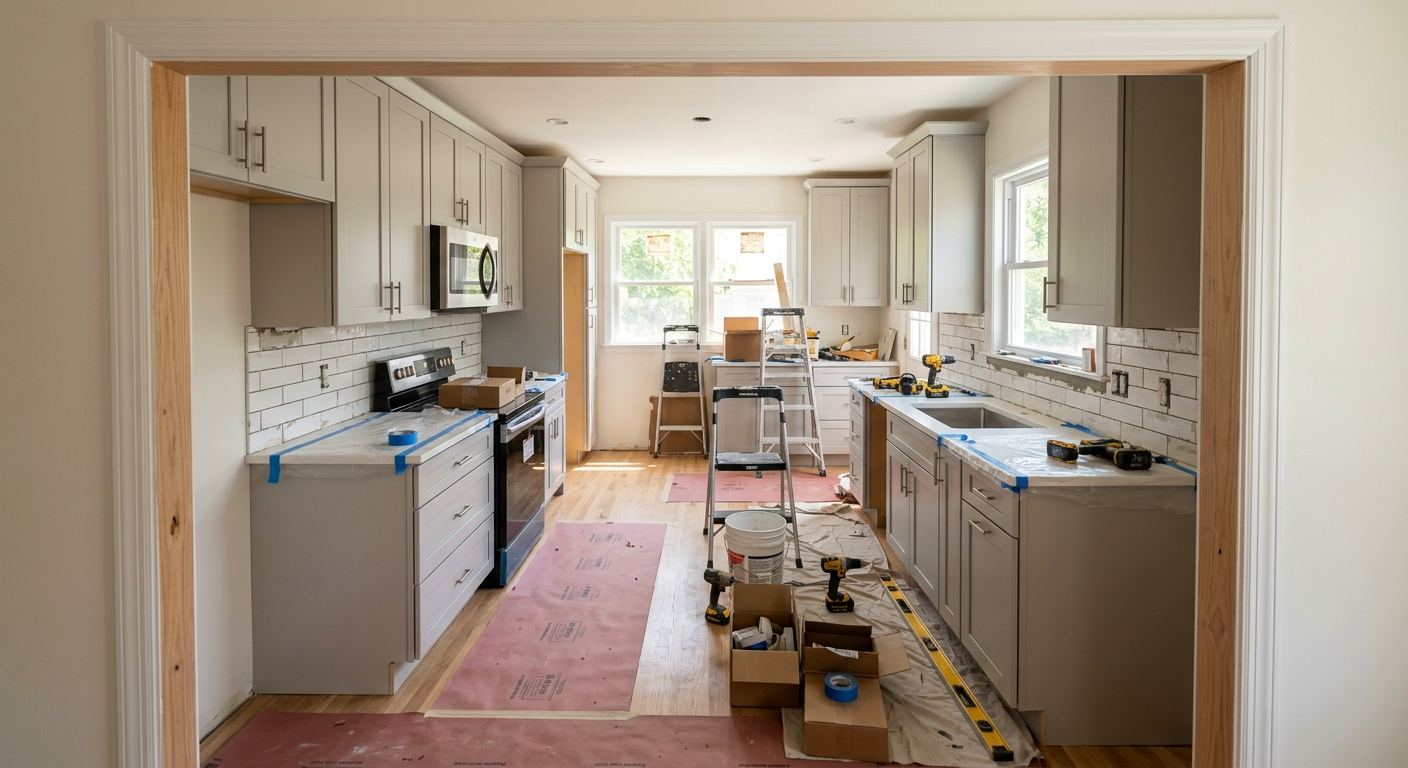
Kitchen renovation options and costs in Legacy
Legacy, Alberta is a small city, but its kitchen renovation pricing largely follows the Calgary economic region because trades, materials, and buyer expectations pull from the same pool of contractors. With a population of about 8,000 residents (Statistics Canada, 2021 Census), you’ll notice fewer truly “local-only” crews, which usually means projects get booked quickly once weather clears in spring. What drives the finish tier most isn’t the weather—it’s what homeowners are willing to spend based on local home values and household purchasing power. In higher-value pockets, renovations tend to lean into quartz or natural stone counters and semi-custom cabinetry because the upgrade is easier to recoup at resale.
In Calgary and nearby communities, bids can feel surprisingly consistent even when the product choices differ: skilled labour runs roughly $90–$140 per hour, so cabinet installation, countertop setting, design, and project management carry a big share of the budget. Alberta’s cold winters also influence scheduling and site conditions (e.g., waiting for freeze-thaw access, ventilation during interior work, and proper curing times for adhesives/finishes). When you’re working in older housing stock, you may also run into dated electrical, uneven subfloors, or original plumbing runs that affect lead times and add-on costs. In Legacy, demand is especially strong for kitchen work around established family-oriented residential areas where homes tend to be used hard and upgraded on shorter timelines—often before listing.
Below is a practical range of what most Legacy homeowners can expect, moving from a cosmetic refresh to full redesigns, and then narrowing to the most common single-scope upgrades.
| Renovation Tier |
What's Included |
Typical Duration |
Price Range |
| Cosmetic refresh (paint, hardware, new appliances only) |
Cabinet hardware swap, painting/staining touch-ups, appliance-only replacement (no plumbing/electrical changes), minor caulking & trim |
1–3 weeks |
$6,000–$18,000 |
| Mid-range full renovation (new cabinets, counters, sink, tile) |
New semi-custom cabinets, new countertops, sink & faucet swap, backsplash tile, flooring refresh or partial replacement, basic lighting refresh; plumbing typically refreshed but not relocated |
4–8 weeks |
$35,000–$70,000 |
| High-end full renovation (custom cabinets, stone counters, island) |
Custom cabinetry/millwork, premium stone counters, island build, upgraded lighting (e.g., under-cabinet + pendants), coordinated appliance package, more extensive tile/stone backsplash, layout changes common |
8–14 weeks |
$75,000–$120,000 |
| Cabinet refacing only (new doors + drawer fronts, same boxes) |
Refacing of existing cabinet boxes, new doors/drawer fronts, hardware, paint/stain of boxes (as needed), often includes new crown/trim |
3–6 weeks |
$8,000–$28,000 |
| Countertop swap only (laminate to quartz or stone) |
Template, removal, countertop install, basic sink cut-in adjustments, caulking & seam finishing (electrical/plumbing changes only if required) |
1–2 weeks |
$3,500–$12,000 |
| Backsplash tile installation only |
Tile supply & installation, surface prep, grout/seal, cutting for outlets and minor adjustments; excludes full countertop replacement |
3–7 days |
$2,500–$8,000 |
Prices are estimates only and vary by project scope, site access and material selection.
What affects the price of kitchen renovation in Legacy
In Legacy, Alberta, quotes for the “same” kitchen can still diverge by 30–50% because pricing follows labour intensity and material complexity more than it follows climate. In the Calgary economic region, builders and homeowners often choose finishes based on local home value and what buyers expect—so one contractor may assume a quartz-and-semi-custom standard while another designs around laminate and stock cabinetry. That finish-tier decision alone can shift the project from the mid five-figures into the upper band. Even within the same home, labour can change substantially when the layout is more demanding or when trades need to coordinate around existing electrical and plumbing.
Climate matters mostly for timing and site conditions, not for the cost of materials. In colder months, contractors plan around curing times for coatings, ventilation, and safe working temperatures inside. The bigger cost swings come from layout moves: removing a wall, adding an island, or relocating a gas line or plumbing run introduces demolition complexity, re-framing (if needed), and more trades. For example, if you stay in the $25,000–$100,000 full-renovation band with “like-for-like” plumbing, you’re usually budgeting for new cabinets, counters, sink, and tile. If you instead target a redesign that changes the workflow—like moving the sink to an island—labour and trade coordination can push you toward the upper end where stone counters and custom cabinetry become the norm.
Concrete Legacy examples that commonly raise cost: 1) older kitchens with limited shutoff access or outdated shutoffs that force additional plumbing work before cabinets go in; 2) uneven floors requiring additional levelling so cabinet installation doesn’t twist doors; 3) outlet and lighting placement that needs new circuits for under-cabinet lighting. Costs can lower when you reuse durable cabinet boxes in a refacing approach or when you choose a countertop swap that matches existing sink cut-outs closely.
| Price Factor |
Why It Matters |
Cost Impact |
| Cabinet tier — stock vs. semi-custom vs. fully custom millwork |
Custom shapes, faster-than-standard lead times, and upgraded hardware drive both material and install labour. |
Often the largest swing within a “full” reno (roughly $10,000–$40,000 difference project-to-project). |
| Countertop material — laminate vs. quartz vs. granite vs. stone |
Material cost, fabrication complexity, and seam planning change; heavier stone may require more careful install scheduling. |
Typical countertop install band moves by about $3,000–$12,000 depending on material and edges. |
| Layout change — wall removal, island add, plumbing/gas move |
Demolition, potential structural work, and coordinating licensed trades increase unpredictability. |
Can add tens of thousands even if finishes stay “mid-range.” |
| Appliance package tier — builder vs. mid-range vs. pro-grade |
Pro-grade units may need different clearances, ventilation options, and electrical readiness. |
Frequently shifts $2,000–$10,000+ within a renovation. |
| Flooring — refinish existing vs. full replacement |
Matching existing floors may require patching; full replacement simplifies coordination but raises material costs. |
Can swing $2,000–$8,000 depending on coverage and subfloor prep. |
| Backsplash — ceramic tile vs. marble vs. full-height slab |
Tile layout complexity and slab handling require different labour rates and more cutting time. |
Within backsplash & tile band, commonly $2,500–$8,000. |
| Electrical — new circuits for island, under-cabinet lighting |
New receptacles, dedicated circuits, and lighting upgrades require licensed work and inspection coordination. |
Often adds $1,500–$6,000+ depending on number of new points. |
| Permit fees and licensed trade requirements |
Major plumbing/electrical/gas changes typically trigger permits, inspections, and scheduling lead time. |
Usually a smaller line item, but delays and trade scheduling can increase total project cost. |
Permits & regulations in Alberta
In Alberta, many “swap-in-place” changes are straightforward, but the moment you move systems, permits and licensed trades usually enter the plan. Cabinet and countertop swaps typically do not require permits because you’re not altering building services—think of replacing cabinets/doors or installing new counters on the existing footprint. However, permits are typically required when you change plumbing supply or drain lines, relocate a gas appliance line (such as moving the stove/range location), remove a load-bearing wall, or add electrical circuits (for example, new island receptacles, vent hood circuits, or additional under-cabinet lighting that requires new wiring).
Step-by-step, Legacy homeowners should verify everything before signing:
- Ask the contractor what items in your scope require permits and who is responsible for pulling them.
- Verify the gas fitter for any gas relocation/connection work (gas work must be done by a licensed gas fitter).
- Verify the electrician for any new circuits, panel work, or rewiring (electrical work must be done by a licensed electrician).
- Request WSIB/WCB clearance documentation for the trades or the contractor’s coverage evidence.
- Request a current certificate of liability insurance and confirm the coverage dates match the project period.
- Confirm the contractor’s written plan includes inspection milestones where required (don’t rely on verbal assurances).
- Check licence validity through the appropriate Alberta online licence/registration resources and compare names on invoices to the certificate holders.
- Ensure the contract states that permit compliance is included (or clearly excluded) before you pay progress draws.
Before you approve a quote, make sure permit responsibility is explicitly written into the contract—this is where kitchen renovations can get costly if it’s left vague.
Cabinets, countertops and layout decisions in Legacy
The three decisions that most strongly shape your budget in Legacy are cabinet tier, countertop material, and whether you change layout. First, cabinet tier: stock cabinets are the fastest and typically lowest-cost, semi-custom is the most popular mid-range option (better sizing and interior options without “everything custom” lead times), and custom cabinetry is best when you need a precise fit around older walls, awkward corners, or a unique island plan. Second, countertop material: laminate is cost-effective and durable for everyday use but can show wear at seams or damage points over time. Quartz is a practical middle ground—low maintenance and consistent colour—while granite/natural stone offers premium look but requires more careful sealing and cleaning routines. Third, layout changes (open-concept wall removal, adding an island, or relocating plumbing/gas) are where cost becomes unpredictable because you’re not just buying materials—you’re re-engineering workflows and coordinating licensed trades.
Calgary-area resale expectations commonly reward clean lines and modern finishes. That means a mid-tier refresh often supports buyers better when you pair semi-custom cabinetry with quartz counters and an updated backsplash. As a dollar reality check: if you’re planning a $35,000–$70,000 mid-range full renovation, upgrading from laminate to quartz within that scope is often a justified spend because it improves appearance and daily usability without the major disruption of relocating plumbing. On the other hand, changing the sink location to “make room for an island” can push you toward the high-end band as you add demo, potential structural coordination, and new trade scheduling—especially when gas or electrical needs are involved.
Cold Alberta winters don’t damage cabinets directly, but moisture behaviour and household heating cycles can highlight workmanship details—caulking quality around sinks, proper ventilation around cooking, and tight countertop fits matter more when homes are closed up in winter. Choose finishes and installation details that will stay looking sharp through seasonal swings.
| Option |
Durability |
Maintenance |
Best For |
Price Range |
| Stock cabinets (big-box) |
Solid for everyday use; limited custom sizing can affect fit in older homes |
Low; wipe clean, maintain hardware and hinges |
Quick upgrades with a tighter budget and standard dimensions |
$8,000–$18,000 |
| Semi-custom cabinets (local dealer) |
Better material/hardware options; improved interior storage |
Low; regular cleaning and periodic hinge/hardware checks |
Most Legacy homeowners targeting resale-friendly upgrades |
$18,000–$35,000 |
| Custom cabinets (local millwork shop) |
Highest fit and finish; tailored storage and proportions |
Low; treat surfaces properly and avoid harsh abrasives |
Complex layouts, unique islands, and legacy homes needing exact fitting |
$35,000–$60,000 |
| Laminate countertop |
Good for impact resistance; seams and edges can show wear |
Easy daily care; protect edges and avoid standing water |
Budget-conscious refreshes where you want a new look fast |
$3,000–$6,000 |
| Quartz engineered countertop |
Very durable and consistent; resists staining well |
Low; wipe clean and avoid abrasive pads |
Best balance of looks, durability, and low fuss for families |
$6,000–$10,000 |
| Granite / natural stone countertop |
Excellent durability; unique veining and premium surface |
Moderate; requires sealing and careful cleaning |
High-end appearance and long-term kitchen upgrades |
$7,000–$12,000 |
| Butcher block countertop |
Durable but can dent; sensitive to prolonged moisture |
Higher—oil conditioning and prompt drying |
Warm, traditional looks and homeowners who maintain surfaces |
$5,000–$9,000 |
| Marble countertop |
Premium beauty; can be more vulnerable to etching/staining |
Higher—sealing and gentle cleaners are important |
Statement kitchens where maintenance routines are realistic |
$8,000–$12,500 |
How to choose a kitchen renovation contractor in Legacy
Choosing the right contractor in Legacy, Alberta comes down to proof: licensing, coverage, clear scopes, and realistic scheduling. Start with Alberta licensing and coverage evidence. Ask for the certificate(s) of insurance (liability coverage) and confirm WSIB/WCB coverage or clearance documentation for trades working on-site. For kitchen renovations, your scope often includes licensed gas fitting and electrical—so you should verify the name on the insurance matches the company doing the work, and that the electrician/gas fitter is appropriately licensed for the tasks in your plan.
Then get 2–3 itemised written quotes. You want breakdowns for labour and materials (cabinet supply, demo, carpentry, tile, electrical/plumbing line items where applicable), not a single “lump sum.” Pay attention to exclusions: is disposal included, is drywall patching included, who pulls permits (and are permit fees included), and does the quote cover subfloor/levelling if cabinets can’t sit flat? Warranties matter too—ask for the workmanship warranty length, the product/manufacturer warranties for cabinets/counters/appliances, and whether warranties are transferable to you as the homeowner (and to future buyers).
For payment schedule, don’t let the contract drift past 10–15% upfront. Use progress payments tied to milestones, and hold back the final amount until punch-list items are completed. Finally, insist on a start date and completion estimate in writing—especially in Alberta when scheduling depends on seasonal conditions and material lead times.
- Confirm Alberta licence status for the contractor and any listed subcontractors.
- Request liability insurance with project-period coverage dates.
- Verify WSIB/WCB coverage or clearance documentation.
- Get itemised quotes (labour + materials), not one total.
- Ensure permit responsibility is explicitly stated in the contract.
- Ask what disposal and dump fees are included (and what are excluded).
- Confirm demolition, drywall patching, and surface prep responsibilities.
- Check if cabinet installation includes levelling/shimming and adjustment.
- Verify countertop template and install dates (and who schedules the fabricator).
- Ask how plumbing/electrical changes are handled and inspected.
- Review warranty terms in writing: workmanship and product coverage.
- Set a payment schedule: max 10–15% upfront and retainage until completion.
In Legacy kitchens, watch for red flags: (1) quotes that lump everything together without line items; (2) vague answers about permits, licences, or which trades will do gas/electrical; (3) requests for large upfront payments; (4) no written timeline or no start/completion dates; and (5) missing warranty details (or warranties that only cover materials and not workmanship).
Frequently asked questions — kitchen renovation in Legacy
How do I choose a kitchen contractor in Legacy?
Choose a Legacy contractor based on evidence and clarity, not just price. Ask for their Alberta licensing details, liability insurance certificate, and WSIB/WCB clearance or proof of coverage for the crew and subcontractors. Then request 2–3 itemised quotes so you can compare cabinet lines, countertop selections, and the labour steps (demo, rough framing where needed, tile prep, and installation). A good contractor should clearly explain what’s included in your scope—like disposal, permit responsibility, and whether electrical for island receptacles is included or excluded. If your target is a mid-range reno around $35,000–$70,000, the quotes should show where that spend goes (cabinet tier and countertop material usually make the biggest difference).
What order do kitchen renovation steps happen in?
Typically, demolition and rough-ins come first, followed by structural or framing adjustments, then drywall repairs and surface prep. Next is the order that saves time: floor prep, cabinet installation, then countertop templating and install, and finally backsplash and trim finishing. Plumbing and electrical changes (like new circuits for an island or upgraded under-cabinet lighting) should be completed before cabinets go in so trades can work without blocking access. In Alberta schedules, contractors also coordinate curing times for adhesives and finishing coats to avoid delays. Once counters are set, you finish the backsplash and do final caulking, touch-up paint, and a safety check on appliances. A well-sequenced job helps you avoid rework—especially important when you’re targeting the $25,000–$100,000 full-kitchen band where timelines are tightly managed.
Can I live at home during a kitchen renovation in Legacy?
Often yes, but it depends on how disruptive the scope is. In Legacy, many homeowners stay home during cosmetic updates or limited-scope projects like refacing or a countertop swap, because the kitchen can be partially functional. For mid-range full renovations, plan for temporary kitchen access—usually a microwave/coffee station and a safe prep area—while work happens around cabinets and tile. If you’re moving plumbing/gas lines or removing a load-bearing wall, the project usually requires more downtime for safety and coordination, and you may need to arrange alternate cooking for certain weeks. Contractors will usually set up dust control and protect flooring when you remain in the home. If you’re staying in place during a high-end redesign (commonly closer to the upper end of the $75,000–$120,000 band), ask your contractor for a daily access plan and staged completion schedule.
Should I renovate my kitchen before selling in Legacy?
Usually, you renovate before selling when the updates address buyer-visible issues and don’t over-invest beyond what the market can absorb. In the Calgary economic region, homeowners often favour modern, clean finishes—especially quartz or natural stone counters and updated cabinetry—because buyers can feel the difference quickly during showings. If your current kitchen is dated or poorly laid out, a mid-range refresh that lands in the $35,000–$70,000 range is often the sweet spot: it can modernize without changing the whole footprint. However, avoid “premium-only” decisions that don’t match your home’s overall condition. A full redesign that moves plumbing/gas lines and creates a new island may be justified if it meaningfully improves usability, but it also carries scheduling and cost risk. A reputable contractor can help you align choices with resale expectations by explaining what buyers typically notice most during viewings.
What's the most popular kitchen style in Legacy right now?
In Legacy, the most requested direction typically blends modern functionality with durable finishes that work for Alberta family life. That usually means semi-custom cabinetry (or well-fitted stock upgraded with better hardware), slab or quartz-look surfaces, and a backsplash that provides contrast without being overly busy. Many homeowners also choose an island layout or expanded peninsula when space allows, because it improves prep space and keeps the kitchen usable for everyday routines. From a cost standpoint, that aligns with mid-range kitchen renovations where you can pair cabinets and countertops efficiently. In terms of budget, homeowners often start around the mid five-figures—within the $35,000–$70,000 band—and then adjust upward when stone counters, upgraded lighting, or additional layout work (like opening sightlines) are added.
How do I know if I need to update my kitchen plumbing in Legacy?
Look for the “signals” that your plumbing needs attention during renovation: slow drains, recurring under-sink leaks, rusted or corroded shutoff valves, inconsistent water pressure, or supply lines that are old and hard to replace safely. If you’re keeping plumbing in the same location, you may only need targeted updates like new shutoffs or refreshed connections—often cheaper than relocating lines. If you’re moving the sink, adding a dishwasher, or changing the island layout, you should expect more plumbing work because drain/supply routing must be planned correctly. In Alberta’s winter conditions, good leak prevention matters because small issues can become bigger once the home cycles heat and humidity. Ask your contractor to include a plumbing inspection step during demo so you can decide whether you’re staying in a simpler countertop/cabinet swap or moving into a fuller project closer to the $25,000–$100,000 full renovation band.