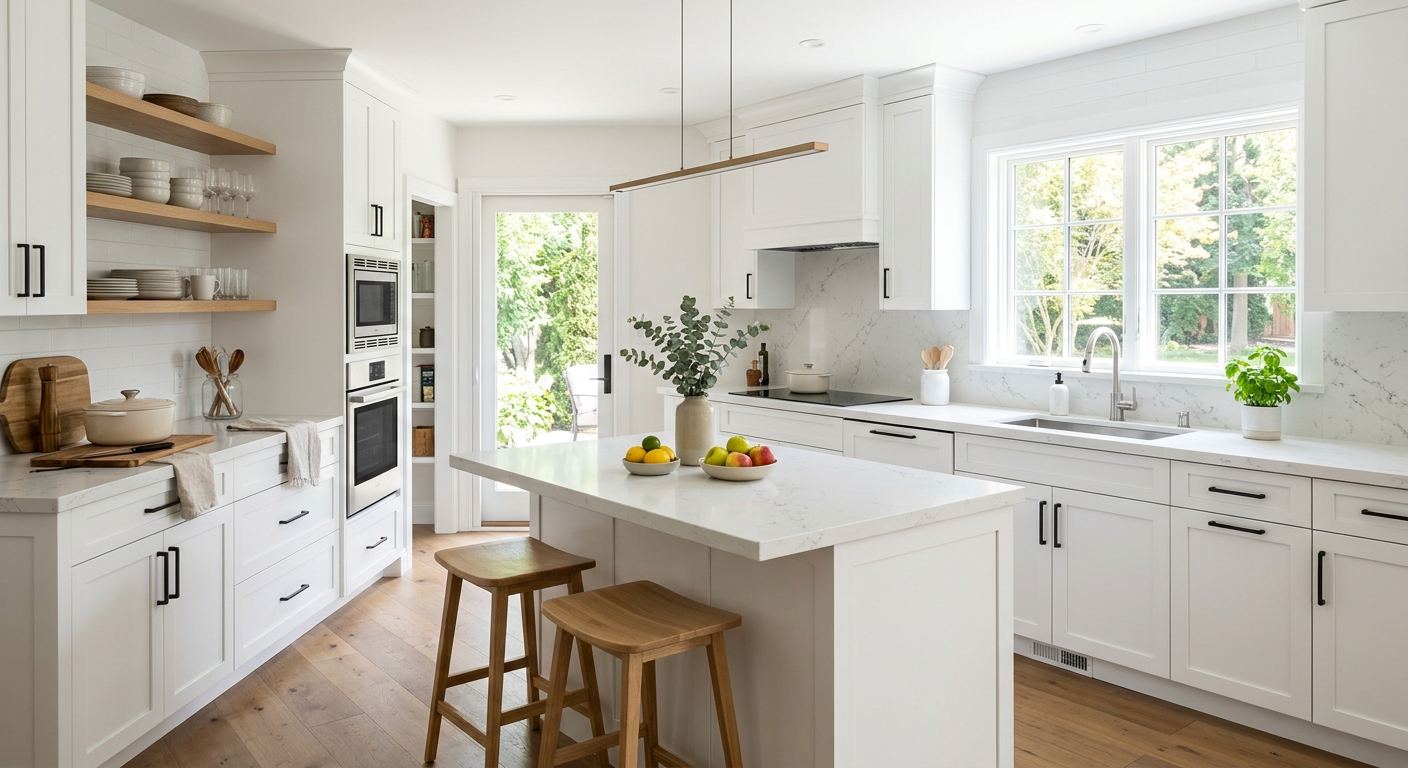
Kitchen renovation options and costs in Olds
Kitchen renovation in Olds typically follows the same “decision ladder” as the rest of the Calgary economic region: homeowners start with what they can see daily, then move toward higher-end materials once the layout and cabinetry are settled. In Olds (population 9,209; median household income $82,000), many families still choose durable, resale-friendly upgrades rather than strictly luxury finishes. That’s consistent with the area’s housing mix too—about 34.9% of homes in the region were built before 1981, so older kitchens often need at least electrical updates and sometimes plumbing refreshes alongside new cabinets.
Calgary-area market expectations also shape what contractors recommend. In higher-value Calgary-style pockets, homeowners often plan to spend roughly 10%–15% of the home value for a refresh and up to 20%–25% for a full redesign, which pushes more projects toward quartz or natural stone counters and semi-custom cabinetry. Labour availability matters as well: skilled trades in the Calgary region commonly run around $90–$140 per hour, so design time, demolition coordination, and project management become significant shares of the budget.
Weather plays a secondary role in cost. Alberta’s cold winters don’t directly change cabinet pricing, but they do affect scheduling and site conditions—fall protection, dust control, and keeping work areas dry during drying/curing. Builders are especially in demand around the town’s established residential corridors and near older housing pockets where updates to dated plumbing/electrical are common.
Below are practical budget bands you can use when comparing quotes—then you can select the scope that matches your priorities in Olds.
| Renovation Tier |
What's Included |
Typical Duration |
Price Range |
| Cosmetic refresh (paint, hardware, new appliances only) |
Cabinet paint or stain refresh, new pulls/hinges, appliance swap (no major plumbing/gas changes), new sink tap (if applicable), basic countertop cleaning/spot sealing where needed |
3–7 days |
$5,000–$15,000 |
| Mid-range full renovation (new cabinets, counters, sink, tile) |
Semi-custom or quality-stock cabinets, new countertop (quartz or laminate), new sink + faucet, backsplash tile, disposal/lighting tweaks, flooring patching or selective replacement as needed |
3–5 weeks |
$25,000–$55,000 |
| High-end full renovation (custom cabinets, stone counters, island) |
Custom cabinetry and built-ins, natural stone or premium engineered stone, island with upgraded base/overhead details, integrated lighting, upgraded appliance package, often includes more extensive electrical and plumbing coordination |
6–12 weeks |
$70,000–$100,000 |
| Cabinet refacing only (new doors + drawer fronts, same boxes) |
Remove/replace doors and drawer fronts, new crown/capping, new hardware, re-seal/prepare existing boxes, optional cabinet interior upgrades, limited prep painting |
1–2 weeks |
$8,000–$25,000 |
| Countertop swap only (laminate to quartz or stone) |
Remove existing tops, fabricate/install new engineered quartz or stone, new sink cut-outs (where feasible), caulking and basic finishing, backsplash touch-ups if required |
3–7 days |
$3,500–$12,000 |
| Backsplash tile installation only |
Tile supply/installation, prep and leveling, grout/seal, caulking at edges, outlet trimming, limited drywall repair |
2–5 days |
$2,500–$8,000 |
Prices are estimates only and vary by project scope, site access and material selection.
What affects the price of kitchen renovation in Olds
In Olds, you can see quoted kitchen renovation costs swing by 30%–50% for what sounds like the “same” job because contractors price risk and coordination—not just materials. Across the Calgary and Alberta market, differences in home value expectations drive finish tiers: in higher-value areas, many homeowners default to quartz or natural stone counters and semi-custom cabinetry because the renovation cost is more easily recovered on resale. Where budgets are tighter, laminate tops and stock cabinetry usually dominate because they deliver a visible refresh without the premium spend. However, climate isn’t the main cost driver—Alberta’s winter conditions mainly affect scheduling and protection, while layout, electrical, and plumbing changes drive the true variability.
Concrete examples in Olds often look like this. First, older homes (including a sizable 34.9% built before 1981 in the profile) may have wiring or shutoffs that don’t meet current expectations, so upgrading circuits for under-cabinet lighting or a new vent hood can add both labour and inspection time. Second, if you’re moving plumbing for a new island sink or relocating a dishwasher, you may need additional drain slope planning and subfloor remediation—cost rises quickly even with the same countertop choice. Third, if you’re aiming for a mid-range full renovation around the $25,000–$55,000 band, you can usually keep costs controlled by limiting layout moves; once you start changing walls or relocating gas/plumbing, many projects shift toward the $70,000–$100,000 end due to the coordination burden and extended timelines.
| Price Factor |
Why It Matters |
Cost Impact |
| Cabinet tier — stock vs. semi-custom vs. fully custom millwork |
Higher tiers increase fit, finish details, and lead time; custom also adds bespoke sizing, mouldings, and interior organisers |
Typically +$5,000 to +$35,000 depending on span and complexity |
| Countertop material — laminate vs. quartz vs. granite vs. stone |
Material cost + fabrication demands; harder stones can require tighter templating and more careful install tolerances |
Often +$1,000 to +$12,000 when upgrading materials and edges |
| Layout change — wall removal, island add, plumbing/gas move |
Structural work, mechanical rerouting, and extra labour trades increase uncertainty and inspection coordination |
Commonly +$5,000 to +$30,000 compared to “like-for-like” layouts |
| Appliance package tier — builder vs. mid-range vs. pro-grade |
Pro-grade appliances may require different electrical/venting clearances and premium integration |
Often +$2,000 to +$15,000 |
| Flooring — refinish existing vs. full replacement |
Kitchen renovations often need subfloor fixes after demolition; matching existing materials can be impossible |
Typically +$1,500 to +$8,000 |
| Backsplash — ceramic tile vs. marble vs. full-height slab |
Higher-end materials add cutting complexity, layout planning, and install time (especially on full-height runs) |
Commonly +$500 to +$6,000 |
| Electrical — new circuits for island, under-cabinet lighting |
New receptacles, dedicated circuits, and lighting upgrades add inspection steps and licensed electrician time |
Often +$1,000 to +$6,000 |
| Permit fees and licensed trade requirements |
Permits add administrative steps; licensed work can affect sequencing and lead times |
Typically +$500 to +$3,000, plus scheduling impacts |
Permits & regulations in Alberta
In Alberta, not every kitchen change needs a permit, but many homeowners are surprised by how quickly “cosmetic” becomes “regulated” once plumbing, gas, walls, or electrical circuits are involved. In most cases, a cabinet and countertop swap done without changing plumbing/drain/gas lines typically does not require a permit. Likewise, a backsplash installation or paint refresh is usually permit-free, assuming no hidden structural or electrical work is altered.
What does typically require permits and licensed trades includes moving or altering plumbing supply/drain lines, relocating a gas stove/range or making changes related to gas venting (including range hood changes when gas-fired components or venting are involved), removing a load-bearing wall, and adding or moving electrical circuits—especially dedicated circuits for an island, new receptacles, or under-cabinet lighting that requires new wiring. Gas work must be done by a licensed gas fitter; electrical work by a licensed electrician, both with required inspections.
Step-by-step verification for homeowners in Olds:
- Ask for licence numbers and check the contractor’s Alberta licence online before work starts.
- Request a Certificate of Insurance showing liability coverage; confirm the policy is active for the project dates.
- Ask whether they hold WSIB/WCB coverage (where applicable) for their workers; obtain proof documentation.
- Make sure permit responsibility is clearly stated in the written contract (who pulls it, what scope triggers it, and who pays fees).
- Confirm timelines for inspections, since approvals can affect cabinet and countertop install scheduling.
Cabinets, countertops and layout decisions in Olds
For a kitchen renovation in Olds, three decisions usually determine 80% of your long-term satisfaction and resale appeal: (1) cabinet tier, (2) countertop material, and (3) whether you change layout. Start with cabinet tier. Stock cabinets are the fastest and typically cheapest because they’re built to standard sizes. Semi-custom cabinets are the most popular mid-range choice in the Calgary economic region because you get better sizing and options (better drawer systems, finishes, and internal organisers) without the lead time and cost jump of full custom millwork. Custom cabinets bring the best fit for older homes with uneven walls and tricky ceilings, but they can push budgets upward quickly.
Countertops matter next. In Alberta kitchens, durable, low-maintenance surfaces are valued because busy households cook year-round and wipe down often in winter. Laminate is budget-friendly but can be more vulnerable to seam swelling if edges are mishandled. Quartz and engineered stone are popular because they resist staining and handle daily wear well. Granite/natural stone is also durable, but it typically needs periodic sealing and can vary by slab availability. Butcher block looks warm and is great for certain households, but it demands regular conditioning to avoid drying issues over time.
Layout is the “cost multiplier.” If you add an island or open an awkward wall, the space gain can be worth it—especially in homes where buyers expect a more open flow—but moving plumbing and/or gas can be expensive regardless of countertop choice. For example, if you keep a largely like-for-like layout, you might land in the $25,000–$55,000 mid-range renovation band; once you relocate plumbing/gas for an island sink or rework venting, many projects realistically trend toward the $70,000–$100,000 range because coordination and licensed trade work expand.
| Option |
Durability |
Maintenance |
Best For |
Price Range |
| Stock cabinets (big-box) |
Good everyday durability; limited customisation and fewer interior options |
Low—use standard cleaning; minor adjustments may be needed for older wall conditions |
Quick refreshes and tighter budgets |
$8,000–$20,000 |
| Semi-custom cabinets (local dealer) |
High durability with better drawer/hinge upgrades and more sizing flexibility |
Low—consistent care; better build quality reduces long-term warping risk |
Most Olds homeowners targeting strong resale appeal |
$15,000–$35,000 |
| Custom cabinets (local millwork shop) |
Excellent fit and build detail for irregular spaces; highest hardware/fit quality |
Low—designed to last; ongoing care like any quality finish |
Older homes with quirks, statement storage, unique layouts |
$30,000–$60,000+ |
| Laminate countertop |
Moderate durability; seams and edges need careful treatment |
Low daily care; avoid prolonged standing water and protect cut edges |
Budget-conscious renovations with minimal layout changes |
$3,000–$6,000 |
| Quartz engineered countertop |
Very durable; resists staining and everyday impacts well |
Low—typical soap-and-water cleaning; no sealing needed |
Busy family kitchens wanting “set and forget” performance |
$6,000–$10,000 |
| Granite / natural stone countertop |
High durability and heat resistance; variation by slab |
Moderate—often requires periodic sealing depending on the stone and finish |
Homeowners prioritising natural look and premium appearance |
$8,000–$12,000 |
| Butcher block countertop |
Good durability but can scratch; sensitive to moisture if not maintained |
Higher—regular oil/conditioning and careful drying after wet tasks |
Families who love a warm, hands-on prep surface |
$5,000–$9,000 |
| Marble countertop |
Premium look; softer than quartz, more susceptible to etching |
Higher—requires careful cleaning and sealing discipline |
Low-traffic kitchens or homeowners who accept patina |
$10,000–$16,000+ |
How to choose a kitchen renovation contractor in Olds
Choosing the right contractor in Olds starts with verification: confirm Alberta licensing where required for the work, check liability insurance, and ensure workers are covered under WSIB/WCB (where applicable). Practically, you’ll want three documents: (1) a valid licence number for the contractor/company for relevant scopes, (2) a current Certificate of Insurance showing liability coverage for the job, and (3) proof of WSIB/WCB coverage for their employees (or subcontractors, if they’re using them). If a contractor can’t or won’t provide these clearly, that’s a major warning sign.
Next, insist on 2–3 itemised written quotes. You want a labour + materials breakdown, not just a lump sum. Ask whether permits are included (and who pulls them), whether disposal/dump fees are included, and how demolition dust control is handled. Review the scope line by line: what’s excluded (e.g., drywall patching after plumbing moves, subfloor repairs, caulking at countertop-to-cabinet joints, appliance hookups, or electrical outlet changes)?
For warranty, confirm both workmanship warranty length and the manufacturer/product warranty, and ask whether warranties are transferable to a new owner (important for resale). On payment, never pay more than 10%–15% upfront; hold back a portion until completion and punch-list items are finished. Get a written start date and completion estimate, and ensure the schedule accounts for typical lead times for cabinets, countertops and any custom millwork.
- Licence and insurance proof provided before signing
- Itemised quote with labour/material breakdown (no single “mystery number”)
- Clear scope exclusions listed in writing
- Permit responsibility stated (who pulls, who pays, who schedules inspections)
- Disposal and dump fees included or explicitly excluded
- Electrical/plumbing/gas scopes assigned to licensed trades
- Detailed demolition and patching expectations
- Countertop template and fabrication process described
- Appliance hook-up included or quoted separately
- Warranty terms for workmanship and products in writing
- Payment schedule with holdback for punch-list
- Written timeline with lead-time contingencies
Red flags in Olds kitchen renovations: (1) contractor avoids licence/insurance questions or offers only verbal confirmation; (2) no permit discussion despite layout/plumbing/gas changes; (3) quote is not itemised and changes scope “after you sign”; (4) unusually low pricing that lacks clear inclusions (often leading to change orders); and (5) vague timelines like “about a month” without a start date and completion target.
Frequently asked questions — kitchen renovation in Olds
How do I know if I need to update my kitchen plumbing in Olds?
In Olds and surrounding Alberta communities, plumbing updates often become necessary when you change the layout or notice aging supply/drain performance. A practical trigger is corrosion, slow drains, recurring under-sink leaks, or shutoffs that aren’t reliable. If you’re moving a dishwasher, adding a sink in an island, or relocating plumbing, you should plan for at least supply/drain verification and possibly new lines to meet current best practices. Homes built before 1981 (a large portion of older housing stock in the region) sometimes have older pipe materials and drainage routing that are harder to work with once walls open. Even if your budget is mid-range (for example, $25,000–$55,000), plumbing changes can shift costs—so have the contractor check access points before finalising cabinet measurements.
What is the difference between a galley and open-concept kitchen?
A galley kitchen is typically narrow and has counters along two parallel walls, often with a doorway pattern that keeps sight lines controlled. An open-concept kitchen removes or modifies walls so the kitchen blends into the living/dining space, which usually improves traffic flow and visibility. In the Calgary region, open layouts are common in higher-end refreshes, but they require more careful coordination in older homes—especially if a wall is load-bearing or if you need electrical/plumbing/gas rerouting. Climate in Alberta doesn’t change the definition, but it can affect how quickly you can proceed with trades because indoor work needs to stay protected in colder months. If you’re targeting a refresh-style renovation, you can often keep within a tighter band like the $25,000–$55,000 range; open-concept changes can push projects toward higher end five-figures due to structural and mechanical work.
How do I get accurate kitchen renovation quotes in Olds?
Accurate quotes start with a clear scope and site checks, not just photos. In Olds, ask for 2–3 itemised written quotes that separate labour and materials (cabinets, counters, tile, demolition, electrical/plumbing coordination, and disposal). Confirm what’s included and excluded: permit pull responsibility, drywall patching, subfloor repairs, appliance hookups, and whether any tile/backer prep is assumed. Provide the contractor with measurements and note your goals—such as whether you’re keeping the layout or adding an island—because a “like-for-like” swap can be materially different from a redesign. Also ask when they’ll template countertops and how changes are handled. If you’re comparing price bands, remember that a mid-range full renovation commonly sits in the $25,000–$55,000 range, while full redesigns with custom millwork and island work more often land higher (for example, $70,000–$100,000).
What's the best countertop material for a busy Olds kitchen?
For a busy household in Olds, quartz is often the best balance of durability, stain resistance, and low maintenance. It handles everyday messes well without the periodic sealing that natural stone may require, and it doesn’t demand the same routine conditioning as butcher block. Laminate can work for budget-focused refreshes, but you must be careful with seams and edges, especially where water can sit near sinks. Natural stone like granite is durable and looks premium, but you’ll want to confirm sealing expectations and care requirements. In many Calgary-area buyer profiles, quartz and stone are popular because they look contemporary and hold up visually over time—key for resale. Budget-wise, quartz often aligns with mid-to-upper five-figure kitchen plans, while countertop-only swaps frequently fall within about $3,500–$12,000 depending on material and sink/edge complexity.
How do I add an island to my Olds kitchen?
Adding an island is one of the biggest layout decisions because it changes circulation space and often triggers plumbing and electrical considerations. First, confirm clear walking space: you typically want enough room for doors and traffic flow without crowding. Next, decide if the island is purely for seating/prep (no plumbing/gas moves) or if you want a sink, dishwasher, or cooktop—those features dramatically increase scope and likely require permits and licensed trade work in Alberta. If your design needs a new water line, drain tie-in, or dedicated electrical circuits, costs can rise quickly even if your countertop choice stays the same. Practically, many Olds homeowners find that keeping the island “electrical/prep only” helps maintain budgets, while island sink/gas features often push toward higher renovation bands (commonly approaching $70,000–$100,000 in full redesign scenarios). A good contractor will map these trades early before cabinets are ordered.
How much does a kitchen renovation cost in Olds?
In Olds, kitchen renovation costs typically depend on whether you’re staying cosmetic, replacing key finishes, or changing the layout. For a cosmetic refresh—paint, new hardware, and appliance swaps—budgets often start around $5,000–$15,000. If you’re doing a mid-range full renovation with new cabinets and countertops plus sink and tile, many projects land around $25,000–$55,000. High-end full renovations that include custom cabinetry, stone counters, and an island frequently fall in the $70,000–$100,000 range, especially when walls move or plumbing/gas/electrical are reworked. Local housing and income expectations also influence finish choices: with a median household income of $82,000 and homeowner households making up 72.4% of households (Statistics Canada, 2021 Census), many buyers in the Calgary economic region select durable, resale-friendly materials rather than purely budget finishes.