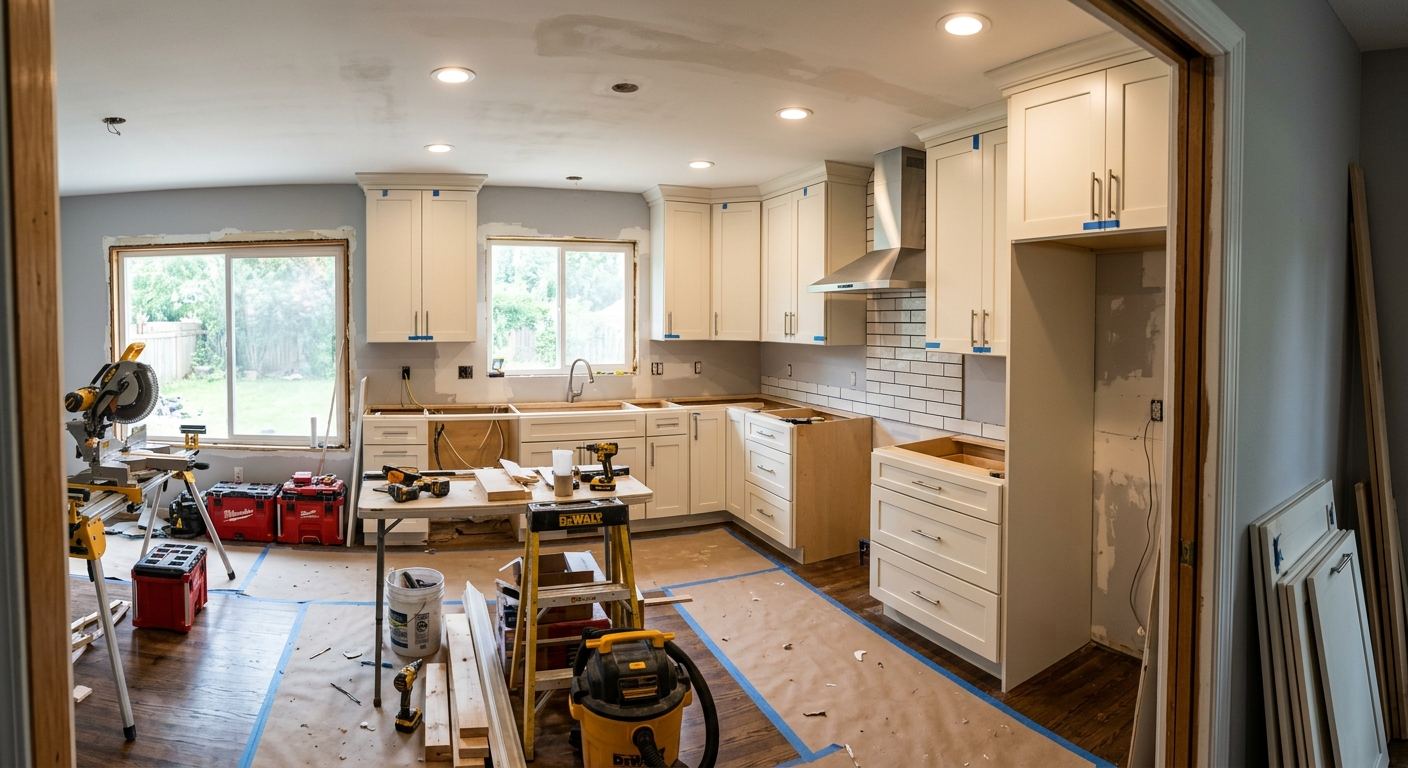
Kitchen renovation options and costs in Glengarry
Kitchen renovations in Glengarry are shaped as much by local expectations as by the province’s building market. With a population of 2,906 (Statistics Canada, 2021 Census), Glengarry tends to see fewer large rebuilds and more steady “value-preserving” upgrades—especially in established pockets where homeowners want a modern look without a full structural overhaul. In the Calgary economic region, kitchen budgets also track to what buyers will pay at resale; across the broader area, higher household purchasing power supports a shift toward quartz or natural stone counters and semi-custom cabinetry. That aligns with typical project ranges that cluster in the mid five-figures for full redesigns, and can climb much higher when layouts change or walls move. (Statistics Canada, 2021 Census)
Alberta’s construction tempo matters too. Skilled labour in the Calgary region often runs around $90–$140 per hour, so design time, project management, and trade coordination can be a major portion of your total. Weather can affect scheduling and drying times, but it’s usually the product choices and scope (new gas/electrical runs, plumbing moves, and demolition complexity) that drive the biggest cost swings. Demand is especially noticeable around Calgary-area established residential clusters where contractors are frequently booked for active, lived-in renovations—meaning dust control, staged installs, and faster counter turnarounds become part of the planning.
Below is a practical way to compare the most common renovation tiers—then you can pick the option that fits your goals and budget before calling for quotes.
| Renovation Tier |
What's Included |
Typical Duration |
Price Range |
| Cosmetic refresh (paint, hardware, new appliances only) |
Paint/stain, new cabinet hardware, caulking/trim touch-ups, swap in matching appliances, minor countertop refinishing only if applicable |
3–7 days |
$5,000–$18,000 |
| Mid-range full renovation (new cabinets, counters, sink, tile) |
Remove/replace cabinets, install new countertops, sink + faucet, backsplash tile, new flooring transitions as needed, basic plumbing/electrical make-up to match existing locations |
2–4 weeks |
$25,000–$65,000 |
| High-end full renovation (custom cabinets, stone counters, island) |
Custom/semi-custom cabinetry, natural stone or premium engineered stone, island design, upgraded lighting and appliance package, detailed tile/backsplash, possible plumbing/gas relocation |
4–8 weeks |
$70,000–$110,000 |
| Cabinet refacing only (new doors + drawer fronts, same boxes) |
Reface doors/drawers, new hardware, re-skin where required, optional new countertop re-use or limited swap, fresh backsplash starter work if within scope |
1–2 weeks |
$8,000–$35,000 |
| Countertop swap only (laminate to quartz or stone) |
Remove existing countertop, install new quartz/stone, new sink cut-outs as needed, seam refinishing, basic backsplash touch-up allowance |
2–7 days |
$3,000–$12,000 |
| Backsplash tile installation only |
Tile supply and install, surface prep, grout/caulk detailing, electrical outlet edging as needed |
2–5 days |
$2,500–$8,000 |
Prices are estimates only and vary by project scope, site access and material selection.
What affects the price of kitchen renovation in Glengarry
In Glengarry and the wider Calgary economic region, it’s common to see quotes for the “same” kitchen land 30–50% apart. The biggest drivers aren’t usually climate—they’re the finish tier, how much work must be opened up behind the walls, and whether the renovation stays in the existing plumbing/electrical footprint. Local home values and household incomes influence the finish expectations buyers reward at resale, so many homeowners gravitate toward higher-end options even when a renovation could be done cheaper. In higher-value areas across the Calgary region, it’s typical to budget for quartz or stone counters and semi-custom cabinetry because the cost is more easily recovered on resale. In more modest scenarios, laminate and stock cabinets still dominate because they deliver a strong refresh for less of the total budget.
Layout changes create the most unpredictable swing in cost, regardless of finish: removing a wall, adding an island, or moving a gas line or drain can trigger new framing, venting, and licensed trade work. For example, a mid-range full renovation in the $25,000–$65,000 band can jump toward the next tier when the plan requires gas or plumbing relocation. Conversely, a countertop-only project might stay in the $3,000–$12,000 range if you keep the sink and cooktop in place and simply swap materials.
Two practical Glengarry examples: (1) older homes may have inconsistent subfloor or wall alignment, adding labour for cabinet leveling and filler panels; (2) if your kitchen is on the north side or lacks ventilation, installers may spend more time correcting airflow and clearance around the range hood to meet safe installation requirements. Even with Alberta’s cold snaps, the schedule impact is usually about curing/drying for finishes—not about sustained weather damage—so planning around product lead times matters just as much as winter prep.
| Price Factor |
Why It Matters |
Cost Impact |
| Cabinet tier — stock vs. semi-custom vs. fully custom millwork |
Higher tiers include better hardware, internal components, and tighter fit/finish—plus longer lead times |
Often the largest single line item; can shift budgets by tens of thousands |
| Countertop material — laminate vs. quartz vs. granite vs. stone |
Materials differ in cost per square foot, fabrication complexity, and seam planning |
May move a project from “refresh” pricing into mid five-figures |
| Layout change — wall removal, island add, plumbing/gas move |
Trigger structural work, new rough-ins, and more inspections |
Typically adds the most unpredictability; can add a major premium over base scope |
| Appliance package tier — builder vs. mid-range vs. pro-grade |
Installation is more complex with integrated units and higher-end ventilation requirements |
Can swing thousands to tens of thousands depending on brand and features |
| Flooring — refinish existing vs. full replacement |
Matching subfloor transitions and underlayment affects time and material |
Lower when you protect existing; higher when you replace throughout |
| Backsplash — ceramic tile vs. marble vs. full-height slab |
Premium surfaces raise fabrication risk and require more exacting prep/handling |
Full-height coverage increases labour and material waste |
| Electrical — new circuits for island, under-cabinet lighting |
New lighting and outlets require proper routing and permitted work when extending circuits |
Commonly adds mid-scope cost even when cabinets are “only” replaced |
| Permit fees and licensed trade requirements |
Complex work must be completed by licensed trades with documentation |
Costs rise with scope complexity; can be minimal for cosmetic-only work |
Permits & regulations in Alberta
In Alberta, many straightforward kitchen updates do not require permits, but several high-impact tasks do. For example, cabinet swaps and countertop replacements typically do not require permits when you’re staying within the existing footprint and utilities. However, permits (and licensed trades) are generally required when you move plumbing supply or drain lines, relocate gas components (such as a range location or certain ventilation configurations), remove a load-bearing wall, or add new electrical circuits. If your project includes under-cabinet lighting on a new circuit, island receptacles, or any reconfiguration of kitchen power distribution, plan on permit and inspection involvement.
Gas work is especially sensitive: a licensed gas fitter must handle any relocation or modification involving gas lines and safe appliance connection. Likewise, electrical work needs a licensed electrician, with inspections to verify safe installation and code compliance.
Step-by-step, here’s how a homeowner in Glengarry should verify a contractor: (1) ask for their Alberta licence numbers and confirm them using the appropriate online registries; (2) request a certificate of liability insurance and confirm it’s current; (3) verify WSIB/WCB coverage (or the applicable coverage proof) before work starts; (4) insist that permit responsibility and inspection scheduling are clearly written into the contract—who pulls permits, who pays, and what’s included.
Do this early and you’ll avoid delays that can stall counter fabrication, drywall repairs, or appliance installs.
Cabinets, countertops and layout decisions in Glengarry
For most Glengarry homeowners, three decisions determine both your final cost and how “future-proof” the kitchen feels: (1) cabinet tier, (2) countertop material, and (3) whether you change the layout. Cabinet tier affects install speed, fit, and resale appeal. Stock cabinets are the fastest and cheapest, but they often look less tailored. Semi-custom cabinets are the mid-range sweet spot—popular in the Calgary resale market because they balance interior storage upgrades and style with controllable pricing. Fully custom cabinets create the best fit, but they can push budgets into the high end of the $70,000–$110,000 band when you also change openings, add crown details, or reconfigure storage.
Countertops drive visible “value cues” for buyers. Laminate is budget-friendly and fine for light-use homes, while quartz offers excellent durability with lower maintenance. Granite/natural stone offers prestige and unique patterning but requires careful sealing habits. Marble looks premium and reads high-end, yet it’s more sensitive to acidic spills. Butcher block can be beautiful in Alberta kitchens, but it needs ongoing sealing and mindful care.
Layout changes are where the space gain can justify the expense. If you can open an interior wall or add an island that improves circulation and seating, that can be worth the labour and licensed trade costs. But if the goal is only appearance, a countertop swap with preserved plumbing/gas locations can keep you near the $3,000–$12,000 countertop band rather than pushing a full redesign.
As a simple dollar example: upgrading from laminate to quartz on existing base cabinets and keeping the sink and cooktop in place typically costs far less than a redesign that relocates plumbing or gas—often by several thousand dollars to tens of thousands depending on how much wall opening is required. In the Calgary market, buyers expect modern finishes; the trick is to spend the premium where it’s visible, not where it creates unnecessary rough-in work.
| Option |
Durability |
Maintenance |
Best For |
Price Range |
| Stock cabinets (big-box) |
Good for everyday use; durability depends on door style and hardware |
Low; replacement parts often easy to source |
Fast refreshes and tighter budgets |
$8,000–$22,000 |
| Semi-custom cabinets (local dealer) |
Very good; better internal components and better fit/finish |
Low to moderate; finish care as with most painted/laminated cabinetry |
Most homeowners aiming for resale-friendly upgrades |
$20,000–$45,000 |
| Custom cabinets (local millwork shop) |
Excellent; tailored joinery and layouts |
Low; built for longevity when installed correctly |
Hard-to-fit spaces and “designed” kitchens |
$40,000–$75,000 |
| Laminate countertop |
Moderate; can chip or wear at edges if abused |
Low; avoid prolonged heat and sharp impacts |
Budget-conscious refreshes |
$3,000–$6,500 |
| Quartz engineered countertop |
High; resistant to staining and everyday wear |
Low; routine cleaning only |
Busy households wanting “set it and forget it” |
$6,000–$12,000 |
| Granite / natural stone countertop |
High; durable but varies by stone |
Moderate; periodic sealing and careful spill handling |
Premium look with a natural pattern |
$8,000–$15,000 |
| Butcher block countertop |
Good with maintenance; can dent but can be sanded |
Moderate; regular oiling/sealing required |
Warm, traditional designs and light-to-medium use |
$5,000–$10,000 |
| Marble countertop |
Moderate to high; softer than quartz, can etch |
Higher; sealing and careful cleaning needed |
Showpiece kitchens where beauty is the priority |
$10,000–$18,000 |
How to choose a kitchen renovation contractor in Glengarry
Choosing the right contractor in Glengarry is less about fancy brochures and more about proof: licensing, insurance, itemised scope, and a realistic schedule. Start by verifying Alberta licensing for trades involved in your scope. Ask for licence numbers and confirm them through the relevant Alberta registries. Request a current certificate of liability insurance—this protects you if a worker damages your property. Also verify WSIB/WCB coverage (or the applicable coverage evidence) before work begins, so you’re not exposed if an injury occurs on site.
Next, get 2–3 itemised written quotes instead of one lump sum. You want a labour and materials breakdown that clearly separates demolition, cabinet supply/install, countertop fabrication/setting, tile/backsplash, plumbing/electrical allowances, and disposal. Read the scope carefully: what’s excluded (for example, drywall patching beyond a defined allowance, moving existing ducting, or upgrades to ventilation)? Is permit pulling included, if required? Is waste removal/disposal included? A good contractor will answer those questions without slipping into vague language.
For warranty, check workmanship warranty length and whether it’s backed in writing. Confirm product/manufacturer warranty coverage for cabinets, hardware, and countertops, and whether warranty claims transfer if you sell the home. Payment schedule matters too: never pay more than 10–15% upfront, and keep a holdback until key milestones are complete. Finally, get a start date and completion estimate in writing, with lead-time assumptions for cabinets and stone.
- Ask which permits are required for your exact scope and who pulls them.
- Confirm Alberta licences for each trade category involved (gas/electrical/plumbing as applicable).
- Request liability insurance certificate and confirm coverage limits.
- Verify WSIB/WCB coverage documentation before any work starts.
- Get quotes with line items for labour, demolition, and material supply—not just totals.
- Ensure disposal/dump fees are included or clearly excluded.
- Check whether drywall repairs, re-levelling floors, and trim are included.
- Ask how existing cabinet boxes (if refacing) will be evaluated for condition and alignment.
- Confirm countertop lead times and template/fabrication process.
- Review warranty terms for workmanship and whether warranties are transferable.
- Verify payment milestones (10–15% max upfront; holdback until completion).
- Require a written start date, schedule plan, and contingency for material delays.
Red flags to watch for in Glengarry: (1) a quote that lumps “kitchen work” without itemised breakdown; (2) refusal to provide licence/insurance/coverage proof; (3) promising a start date without accounting for countertop and cabinet lead times; (4) vague warranty language (no written workmanship coverage terms); and (5) asking for large upfront payments beyond 10–15%.
Frequently asked questions — kitchen renovation in Glengarry
How long does a kitchen renovation take in Glengarry?
A typical cosmetic refresh in Glengarry is often done in about 3–7 days, especially if you’re only swapping appliances and updating paint/hardware. A mid-range full renovation (new cabinets, counters, sink, and tile) commonly takes around 2–4 weeks depending on cabinet and countertop lead times. High-end jobs with custom millwork, stone counters, and layout changes are more often 4–8 weeks. In Alberta, winter weather can slow site drying and finishing, but the bigger timeline risk is material availability—especially stone templating and fabrication. If your scope includes licensed electrical additions or gas-related changes, inspections can also add a few days. For budgeting, plan on realistic “busy trade” scheduling in the Calgary economic region rather than assuming immediate start dates.
Quartz vs granite countertops — which is better?
Quartz is usually the more practical “better overall” choice for most Glengarry homes. It’s engineered for consistent performance, resists staining well, and typically needs only routine cleaning—no routine sealing schedule. Granite (natural stone) is also durable and can be gorgeous, but it’s more variable by slab and generally benefits from periodic sealing and more careful spill management. If you’re choosing based on daily life (coffee, cooking oils, family messes), quartz often wins because maintenance is lighter. If you’re choosing based on rarity and visual uniqueness, granite can be worth the maintenance effort. In the local budget bands, countertop-only quartz upgrades generally land within the $6,000–$12,000 range, while natural stone selections may push toward the upper end depending on slab and edging details.
Should I reface or replace my cabinets?
Refacing is a strong option when your existing cabinet boxes are solid, level, and not suffering from water damage or major sagging. If your boxes are in good shape, you can refresh the look without the demolition intensity of a full replacement—often giving faster turnaround and lower cost. Replacement is usually the better move when you need major layout changes, want deeper storage, or your current boxes have humidity-related issues (warped sides, failing shelves, or worn drawer mechanisms). In Glengarry and the Calgary market, many homeowners choose refacing to keep budgets controlled, while upgrading only doors/drawer fronts and hardware. If you’re starting fresh—especially with new counters and tile—or your storage plan is changing, replacement often aligns better with resale expectations. Typical refacing budgets sit in the $8,000–$35,000 range, while full cabinet replacement can be materially higher depending on the cabinet tier.
Do I need a permit for a kitchen renovation in Alberta?
In Alberta, cabinet and countertop swaps typically do not require permits when you’re not altering plumbing/gas routes or electrical capacity. But you generally need permits (and licensed trades) for work such as moving plumbing supply or drain lines, relocating gas appliances or lines, removing a load-bearing wall, or adding electrical circuits (for example, new island receptacles or significant lighting power changes). Gas work must be done by a licensed gas fitter, and electrical work by a licensed electrician, with inspections. The most important step for Glengarry homeowners is to confirm permit responsibility in writing before signing: who pulls the permit, who schedules inspections, and which parts of the scope are covered. Ask your contractor to list permit-required tasks explicitly in the contract so you don’t discover it mid-job when inspections delay installation.
What's the ROI on a kitchen renovation?
ROI depends heavily on what you change and the finish tier you choose, and in Glengarry it typically mirrors broader Calgary resale expectations. Kitchens are one of the most scrutinised spaces, so updates that improve storage, modernise finishes, and keep layouts functional usually hold value better than purely “trend-driven” styling. That said, ROI isn’t just money back—it’s also how quickly you can sell and how competitive your offer looks. Higher-value regions of the Calgary economic area often see homeowners invest more (quartz/stone and semi-custom or custom cabinetry) because the renovation cost is more recoverable on resale. If you stick to upgrades that avoid costly rough-ins, you generally protect your budget: for example, a countertop swap or backsplash upgrade can be far more ROI-friendly than moving gas or plumbing. Full kitchen renovations commonly land in the $25,000–$100,000 range, and the projects that “pay back” best are usually those that balance durable materials with sensible layouts.
How do I budget for a kitchen renovation?
Start by choosing your renovation tier, then build a budget that matches the scope—not just the aesthetics. For many Glengarry homeowners, a cosmetic refresh can be planned as a smaller project, while a full redesign tends to sit in the mid five-figures to higher depending on layout changes. Use realistic bands: cabinet work and refacing commonly falls in the $8,000–$35,000 range, countertop-only swaps are often $3,000–$12,000, and full renovations frequently fall within $25,000–$100,000. Then add a contingency for surprises when walls open (older electrical/plumbing, flooring flatness, or hidden water staining). Finally, require 2–3 itemised quotes so labour vs materials is clear, and confirm what’s included for permits, disposal, and electrical/gas requirements. Keeping plumbing and gas in place is one of the most reliable ways to control budget risk in Alberta.