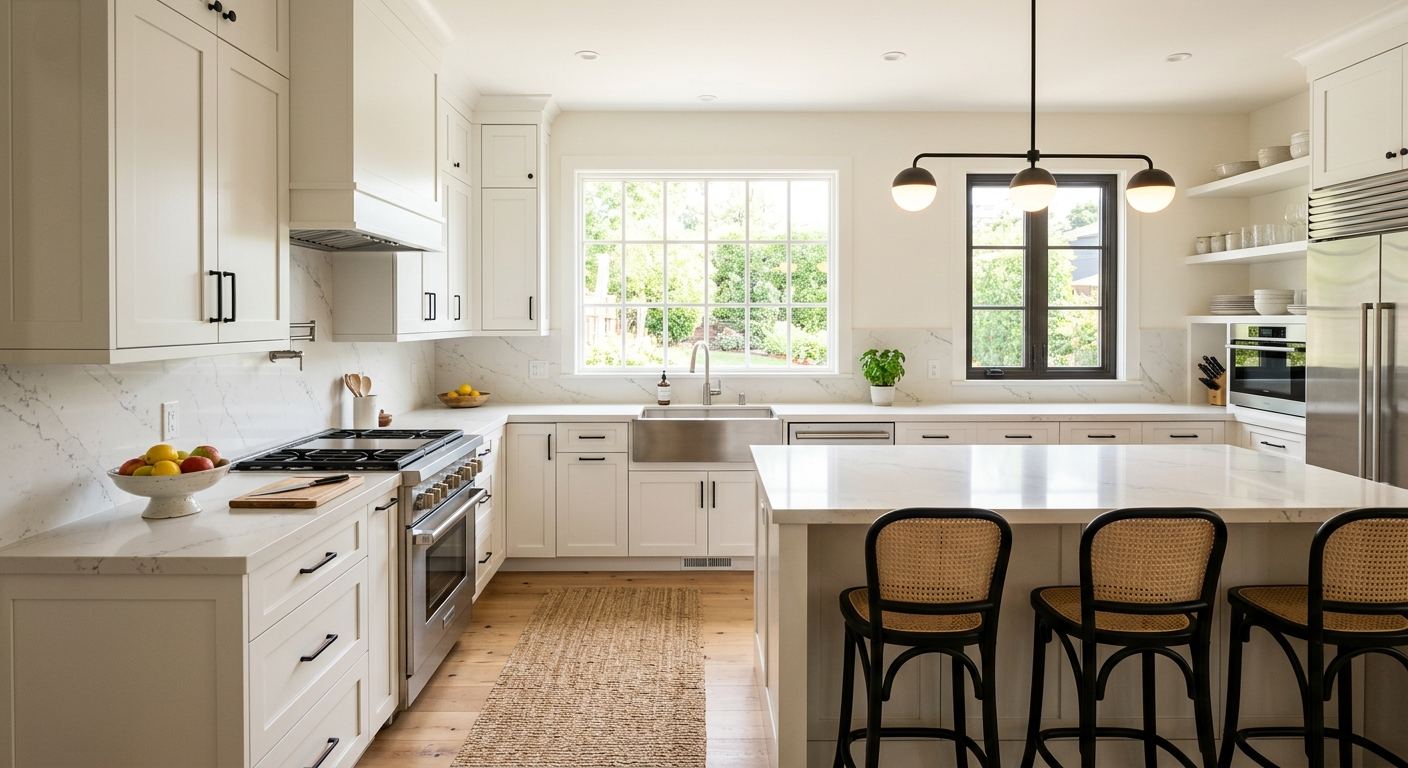
Kitchen renovation options and costs in High Prairie
Kitchen renovations in High Prairie tend to follow a practical ladder: first you decide how “new” you want the room to feel, then you match that to your materials and any layout moves. With High Prairie’s median household income sitting around $88,000 (Statistics Canada, 2021 Census), many homeowners plan a renovation that looks updated and durable without necessarily going fully custom. That’s especially true in a community where 60.3% of households are owner households (Statistics Canada, 2021 Census), meaning people often weigh resale value and day-to-day comfort over experimenting with luxury finishes.
In the Athabasca–Grande Prairie–Peace River region, contractor pricing is shaped more by household income and typical finish expectations than by kitchen size alone. We also see supply-and-demand effects: as building activity shifts in and around Grande Prairie and neighbouring service centres, labour availability can tighten, and quotes can move—particularly for cabinet installs and countertop fabrication slots. Climate matters too. High Prairie’s long, cold winters and wide seasonal swings mean kitchens take more thermal stress than people expect, so homeowners lean toward quality caulking at seams, better backer boards behind tile, and cabinetry that’s built for stable indoor humidity. Homes built before 1981 make up 56.2% of the local housing stock (Statistics Canada, 2021 Census), which often means older electrical panels, dated plumbing runs, and layouts that need careful evaluation before anyone assumes a simple swap.
For neighbourhoods with more older housing pockets—commonly around the central residential areas near main service corridors—kitchen refresh demand stays steady because homeowners prioritize functional upgrades before winter. Below are common renovation tiers you can use to compare proposals, then we’ll break down what typically drives the biggest swings in cost.
| Renovation Tier |
What's Included |
Typical Duration |
Price Range |
| Cosmetic refresh (paint, hardware, new appliances only) |
Prep/paint (walls/trim), new cabinet hardware, new appliances (install only), minor caulking, basic cleanup |
3–7 days |
$3,000–$12,000 |
| Mid-range full renovation (new cabinets, counters, sink, tile) |
New semi-custom or higher-quality stock cabinets, countertop install, sink/faucet, backsplash tile, floor protection/repair, trade labour for plumbing/electrical touch-ups as needed |
2–4 weeks |
$20,000–$55,000 |
| High-end full renovation (custom cabinets, stone counters, island) |
Custom cabinetry, premium countertop (quartz/stone), island (often with added electrical/plumbing), upgraded tile (full height options), coordinated trade work, finishing details |
4–8 weeks |
$55,000–$80,000 |
| Cabinet refacing only (new doors + drawer fronts, same boxes) |
Reface doors/drawer fronts, new hardware, adjust/refresh existing boxes, veneer prep, basic touch-up paint and finish work |
1–2 weeks |
$6,000–$25,000 |
| Countertop swap only (laminate to quartz or stone) |
Remove old counters, fabricate/install new (quartz/stone), seam placement, sink cut-out/adapter work, caulking and backsplash interface finishing |
3–10 days |
$3,500–$15,000 |
| Backsplash tile installation only |
Surface prep, tile layout/setting, grout/seal where needed, finishing edges and silicone seals |
2–5 days |
$2,000–$9,000 |
Prices are estimates only and vary by project scope, site access and material selection.
What affects the price of kitchen renovation in High Prairie
Two quotes for the “same” kitchen renovation in High Prairie can differ by 30–50% even when the cabinets and counters look similar, because the scope inside the walls varies. In the Athabasca–Grande Prairie–Peace River region, pricing tracks local household income and typical resale expectations more than climate alone. Where homeowners anticipate stronger resale demand, upgrades like quartz counters and semi-custom cabinetry show up more often; where budgets are tighter, laminate counters and stock cabinet systems dominate because they deliver a clean look at a better cost-to-impact ratio. With a median household income around $88,000 (Statistics Canada, 2021 Census), many projects land in the mid-range finish tier—often in the $20,000–$55,000 band for full renovations—rather than pushing into the $55,000–$80,000 upper range.
Layout changes are the most unpredictable driver regardless of finish level. Removing a wall, adding an island, moving a sink, or relocating a gas line tends to trigger extra framing, new plumbing/gas/electrical rough-ins, and patching/finishing work that can’t be guessed accurately from photos. Material changes matter too, especially countertops and cabinet tier: cabinetry is usually the largest line item, while countertops and tile can swing budgets quickly when you move from entry-level to premium materials. In older homes (56.2% built before 1981), you can also hit “hidden” costs like undersized wiring, older shut-offs, or walls that aren’t as plumb as modern installs assume.
Here are a few High Prairie examples that regularly push costs up or down: (1) switching from laminate to quartz can move you from a lower countertop-only budget to a higher install cost within the $3,500–$15,000 band because of fabrication complexity and seam planning; (2) adding an island often requires an electrical circuit and sometimes a hood vent strategy, which increases trade time; (3) choosing full-height backsplash tile instead of standard runs can materially raise labour and material quantities. Those are the kinds of choices that make a renovation feel “worth it,” but they’re also where quotes need careful comparison.
| Price Factor |
Why It Matters |
Cost Impact |
| Cabinet tier — stock vs. semi-custom vs. fully custom millwork |
Tier affects material quality, finish options, internal features, lead times and installation detail |
Often the biggest swing; can move a full reno by tens of thousands |
| Countertop material — laminate vs. quartz vs. granite vs. stone |
Material price + fabrication complexity (seams, edge profiles) + weight handling |
Can shift countertop-only budgets from the lower to upper end of the $3,500–$15,000 range |
| Layout change — wall removal, island add, plumbing/gas move |
Creates rough-in work, potential structural considerations, and more patching/finishing |
High variability; commonly adds the most cost uncertainty to any quote |
| Appliance package tier — builder vs. mid-range vs. pro-grade |
Installation clearances, ventilation requirements and upgrade electrical/gas coordination |
Often moderate on paper, but can escalate with venting and electrical needs |
| Flooring — refinish existing vs. full replacement |
Access affects cabinet install; subfloor issues can add time and materials |
Can add thousands if floors need replacement after demo |
| Backsplash — ceramic tile vs. marble vs. full-height slab |
Labour intensity, cutting complexity, and grout/seal requirements |
Can move the backsplash line from lower to upper end of the $2,000–$9,000 range |
| Electrical — new circuits for island, under-cabinet lighting |
Requires licensed electrician work; load and placement planning affects cost |
Often material/moderate labour plus trade scheduling and patch work |
| Permit fees and licensed trade requirements |
Permits and inspections depend on work scope (plumbing, gas, electrical, structural) |
Not usually the largest cost, but can add direct fees and scheduling time |
Permits & regulations in Alberta
In Alberta, a simple cabinet or countertop swap typically does not require a building permit, because you’re not changing plumbing, gas, structural load paths, or electrical circuits. However, once you move beyond “like-for-like,” permits and licensed trades are usually required. Examples that do require permits (or at minimum trigger the need for permit/inspection depending on scope) include: moving or adding plumbing supply/drain lines for a new sink location; relocating a gas line or changing the stove/range hood configuration when gas is involved; removing a load-bearing wall or making structural changes; and adding new electrical circuits (for example, for an island with outlets, or adding under-cabinet lighting that requires circuit changes beyond existing capacity).
Work that typically does not require a permit includes: swapping cabinets in the same footprint without changing rough-ins; replacing countertops over existing cabinetry; installing a backsplash (as long as you’re not altering electrical wiring or making structural changes); and replacing fixtures when no new supply/drain runs are created.
To verify a contractor in High Prairie, do these steps before signing: (1) Check their Alberta business registration and licence status where applicable, and confirm they use licensed electricians/gas fitters when required; (2) Ask for a current certificate of liability insurance—ensure the policy is active for your project dates; (3) Request proof of WCB coverage (or clearance letter) for the company and workers; and (4) confirm who pulls permits in the contract. In kitchen renos, “who is responsible for permits” must be in writing, not just discussed.
Cabinets, countertops and layout decisions in High Prairie
The three decisions that change both the look and the total cost of a High Prairie kitchen renovation are cabinet tier, countertop material, and whether you change the layout. Start with cabinet tier. Stock cabinets are the fastest and usually the cheapest because they’re standardized and readily available. Semi-custom is the most popular mid-range option because it balances door styles, better interior organization, and realistic lead times. Custom cabinets fit odd angles and can maximize storage, but they carry the highest material and shop labour costs.
Next, countertop material. In our climate, kitchens see more seasonal movement in indoor air—more expansion/contraction at seams and more attention required at sinks and backsplash interfaces. Laminate is durable for the budget, but seams and edging are where wear shows over time. Quartz offers consistent appearance and is easier to maintain than natural stone in day-to-day life. Granite/natural stone can be very durable and premium-looking, but it’s heavier and can increase fabrication and install complexity. Butcher block adds warmth and works well in family kitchens, yet it needs more ongoing care to stay protected.
Finally, layout. Removing a wall, adding an island, or relocating plumbing/gas is where costs can jump into the $55,000–$80,000 range because rough-in trades and sometimes additional ventilation or electrical work get involved. The cost is justified when you’re gaining real function—like better traffic flow, a larger prep zone, or a practical sink location—rather than just chasing a trend. For example, many homeowners who stay in the $20,000–$55,000 band can upgrade from laminate to quartz and refit a backsplash while keeping plumbing in place, which avoids the most unpredictable labour and permit-driven work.
Builders and resale buyers in the Athabasca–Grande Prairie–Peace River region often expect clean lines, durable counters, and modern lighting. Matching your cabinet tier and countertop choice to your planned budget is the quickest way to get a kitchen that looks “finished” and holds up through Alberta winters.
| Option |
Durability |
Maintenance |
Best For |
Price Range |
| Stock cabinets (big-box) |
Good for everyday use; limited customization can show if your layout is irregular |
Low; wipe-clean finishes with occasional hardware tightening |
Fast timelines and entry budgets |
$10,000–$22,000 |
| Semi-custom cabinets (local dealer) |
Very good; better interior organization and finish options |
Low; follow manufacturer care for finishes |
Most High Prairie kitchens aiming for strong value |
$16,000–$35,000 |
| Custom cabinets (local millwork shop) |
Excellent fit and long-term build quality when designed properly |
Low to moderate; depends on finish system |
Unique layouts, full-height storage, and premium upgrades |
$30,000–$55,000 |
| Laminate countertop |
Good; surface resists staining but can be vulnerable at seams/edges |
Low; avoid standing water at cut edges and keep seals intact |
Budget-focused renovations |
$3,500–$7,500 |
| Quartz engineered countertop |
Very good; consistent, hard surface with fewer maintenance concerns |
Low; wipe-clean, protect from heat extremes |
High-traffic family kitchens and mid-range-to-premium upgrades |
$6,500–$12,000 |
| Granite / natural stone countertop |
Excellent; durable but can vary in porosity by stone type |
Moderate; may require periodic sealing and careful stain management |
Premium look when you want natural variation |
$8,000–$15,000 |
| Butcher block countertop |
Good; strong but can scratch and dent |
Moderate; oil/condition regularly and protect from prolonged moisture |
Warm, cottage or farmhouse style kitchens |
$5,500–$11,000 |
| Marble countertop |
Moderate; prone to etching and can stain if not cared for |
Higher; requires disciplined cleaning and sealing |
Low-to-moderate use kitchens or premium design statements |
$10,000–$18,000 |
How to choose a kitchen renovation contractor in High Prairie
Choosing the right contractor matters as much as the materials, because kitchen renos are a coordination job: trades, scheduling, demolition control, and protection of finishes all affect the final quality. In Alberta, confirm licensing and coverage up front. Ask for proof that any electrical or gas work is performed by licensed trades (not just subcontracted “by someone”). Request the company’s certificate of liability insurance and verify it’s active for your project dates and includes renovation work. For workplace coverage, ask for WCB/WCB clearance documentation (or evidence they’re registered and covered) before work starts.
Then get 2–3 itemised written quotes. You want a labour-and-materials breakdown, not a lump sum. Look for line items for demolition, cabinet install, countertop install, backsplash tile, plumbing/electrical coordination (and who pays the trades), disposal/haul-away, patching/painting, and any allowances for materials. A good quote is clear about exclusions: what’s not included (for instance, subfloor repairs, drywall patching beyond a set amount, or replacing damaged waterlines discovered during demo).
Warranty also matters. Ask for workmanship warranty length, and separate product/manufacturer warranties for cabinets, countertops and tile. Confirm whether warranties transfer if you sell your home. On payment, follow a homeowner-friendly schedule: typically no more than 10–15% upfront, then progressive payments tied to milestones. Hold back a portion until the job is complete and deficiencies are corrected. Finally, request a start date and completion estimate in writing—kitchen timelines can drift if countertop lead times or trade scheduling gets delayed, especially in smaller markets.
- Verify insurance certificate is current and match your project address.
- Confirm WCB coverage/clearance letter for the renovation company.
- Ask which licensed trades are used for electrical and gas (name the trades, not just the scope).
- Get 2–3 itemised quotes with a clear labour/material breakdown.
- Ensure permits responsibility is written into the contract (who pulls permits and who pays fees).
- Confirm disposal/haul-away is included and identify what isn’t included (e.g., cabinetry recycling rules).
- Check what drywall, subfloor or plumbing repairs are covered after demo.
- Review countertop template/measurement responsibility—who measures, who corrects errors.
- Confirm cabinet installation includes shimming/leveling and floor/wall alignment adjustments.
- Ask about backsplash water-resistant backer requirements near sinks and under windows.
- Get a written warranty for workmanship and separate manufacturer warranty terms.
- Use a payment schedule with holdbacks; avoid large upfront deposits.
Red flags to watch for in High Prairie: (1) a quote that’s one number with no allowances for tile labour, countertop fabrication and trade coordination; (2) refusing to provide insurance or WCB proof; (3) saying permits “aren’t needed” when moving plumbing/gas or adding electrical circuits; (4) no written timeline or no cabinet/countertop lead-time plan; and (5) asking for a large upfront payment without milestone-based progress.
Frequently asked questions — kitchen renovation in High Prairie
How do I budget for a kitchen renovation?
Start by choosing your renovation tier, then budget for the “hidden” work that often appears in older High Prairie homes—especially those built before 1981, where electrical or plumbing realities don’t always match what you planned on day one (56.2% of the local housing stock). For most full renos, Athabasca–Grande Prairie–Peace River projects commonly land in the $20,000–$55,000 band when you keep layout changes limited and choose semi-custom cabinets with quartz or a step-up countertop. If you add an island and relocate plumbing/gas, plan closer to the $55,000–$80,000 range. Also reserve a contingency amount for trade coordination and small drywall/floor repairs. Get an itemised quote so you can separate cabinet, countertop, tile, and trade labour rather than judging only the final total.
Can I move my kitchen sink or stove?
Yes, you can move a sink or stove in Alberta, but the cost and permitting requirements can change quickly based on what “moving” means. Moving a sink usually involves new plumbing supply/drain lines, which typically requires a proper permit process and licensed plumbing work, and it’s often where quotes diverge most. Relocating a stove that uses gas also requires careful gas-line work and typically involves licensed gasfitting. From a cost perspective, if you’re moving the plumbing/gas just a short distance within existing walls it can stay nearer the mid-range, but if you’re adding longer runs, opening floors, or changing ventilation strategy, budgets can move into the higher end. In High Prairie, older home framing and winter-proofing details can add time—so always confirm the exact route and who owns permit responsibility before signing.
What's the most cost-effective kitchen upgrade?
Usually the most cost-effective upgrade is the one that delivers a big visual change with minimal demolition. Many homeowners in High Prairie get strong value from a cabinet hardware refresh plus repainting, especially if the boxes are solid, paired with a practical backsplash update. If you want a more “new kitchen” feel without full demolition, consider a countertop swap first—going from laminate to quartz can noticeably lift the look while staying within a common $3,500–$15,000 countertop install range, depending on size and edge/seam complexity. Another cost-smart move is backsplash tile installation only, often in the $2,000–$9,000 range. The key is to avoid unnecessary layout changes early; layout changes are the most unpredictable part of the budget across the region, regardless of finish tier.
Custom vs stock cabinets — is custom worth it?
Custom cabinets are “worth it” when you have a layout that stock can’t optimize—odd wall lengths, difficult corners, ceiling height opportunities (full-height storage), or a need for specific internal organization. In High Prairie, where 56.2% of homes were built before 1981, older measurements can be less consistent, and a semi-custom or custom approach can reduce awkward gaps and improve fit. If you’re aiming for a mid-range full renovation, semi-custom is often the best balance between cost and appearance, and many projects stay around the $20,000–$55,000 band. If you want to push to the $55,000–$80,000 range, custom millwork plus an island and premium countertops is where the premium is most visible. But if your layout is straightforward and your budget needs control, semi-custom usually delivers the strongest value-per-dollar.
How do I choose a kitchen contractor in High Prairie?
In High Prairie, choose a contractor who can prove coverage and coordinate licensed trades correctly. Ask for their certificate of liability insurance and proof of WCB/WCB clearance (or equivalent coverage documentation). For any electrical or gas work, confirm licensed electricians and gas fitters will be used and that inspections are handled where required. Next, get 2–3 itemised quotes showing labour and materials separately—cabinet install, countertop fabrication/install, backsplash tile, demolition/disposal, and patching. Confirm permit responsibility in writing, particularly if you’re moving plumbing/gas or adding electrical circuits. Finally, check warranty terms: workmanship warranty length, manufacturer warranties for cabinets/counters/tile, and whether warranties transfer if you sell. Avoid contractors who request large upfront deposits without milestone-based payment scheduling.
What order do kitchen renovation steps happen in?
A typical kitchen renovation sequence starts with measuring and finalizing cabinet/countertop selections, then planning rough-in work (plumbing/electrical/gas) if any changes are being made. Once the layout is confirmed and permits (when needed) are handled, demo begins—removing old counters, cabinets, and backsplash materials while protecting surrounding finishes. Next comes any framing/repair work, subfloor fixes, and the rough trades (plumbing/drain/supply runs, electrical circuits, and gas line adjustments if applicable). Then cabinets go in (leveling and securing), followed by countertop template/installation. After counters are set, installers complete sinks and related plumbing connections, then backsplash tile goes on and is sealed/finished. Finally, you wrap with trim/paint touch-ups, appliance installation, and a punch-list walkthrough and sign-off with warranty paperwork.