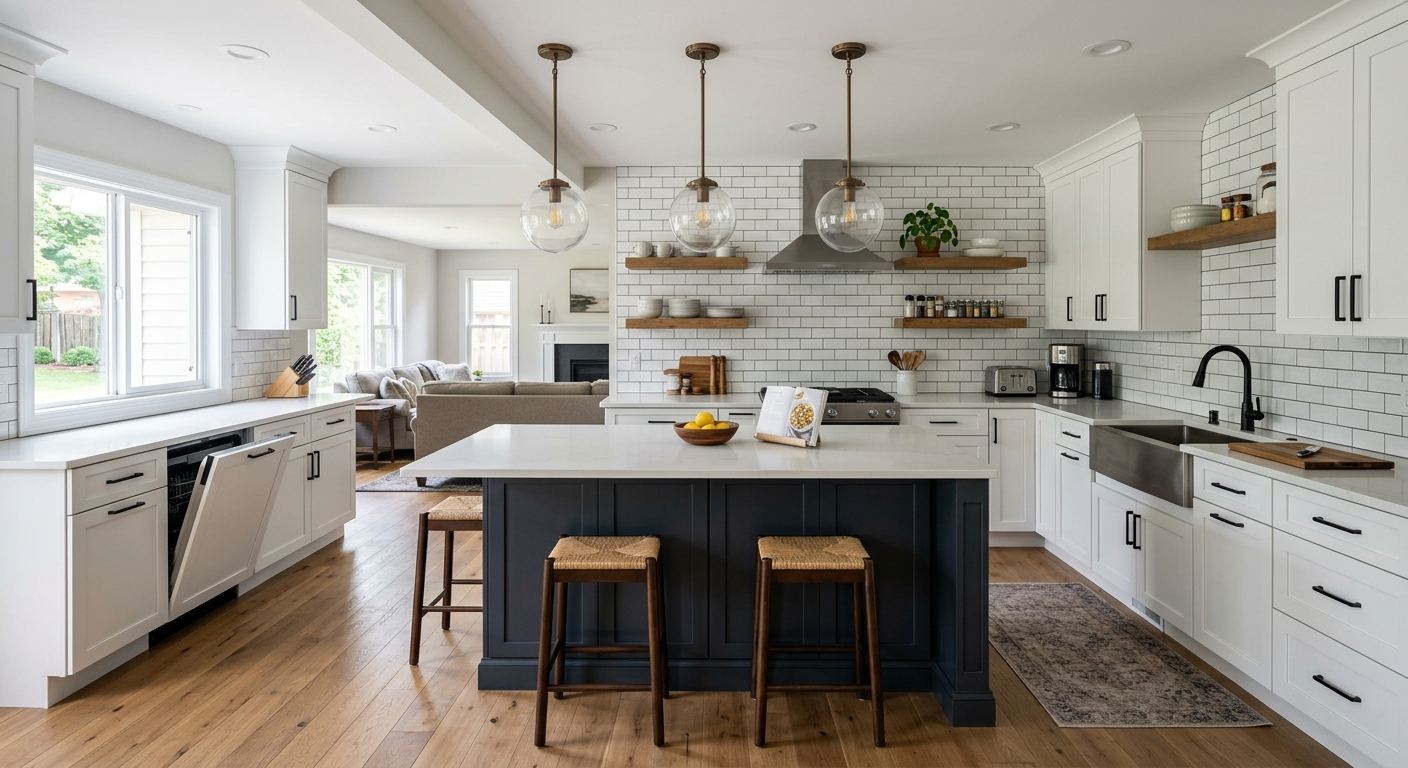
Kitchen renovation options and costs in Carter Crest
Carter Crest homeowners typically start their kitchen project because the home’s day-to-day layout or finish is dated—not because Alberta’s weather directly “wears out” cabinetry. That said, Carter Crest (population 1,716; Statistics Canada, 2021 Census) is part of the Calgary economic region, where buyers and trades expect a certain finish level, and that drives scope and pricing. In practical terms, higher-value areas tend to push more projects toward quartz or natural stone counters and semi-custom cabinetry, while lower-budget refreshes lean on laminate and stock components.
Across Calgary, market-driven expectations are one reason kitchen budgets can land anywhere from the mid five-figures to the top of the six-figure range. In many households, the renovation decision is also tied to affordability and confidence in resale value—especially when the neighbourhood’s housing stock is older and needs updating sooner. Labour availability and scheduling matter too: skilled trades in Calgary commonly run about $90 – $140 per hour, so design time, project management, demolition planning, and installation labour become a bigger share of the total budget than homeowners expect.
In Carter Crest, demand is especially strong for renovations involving appliance upgrades and island layouts in pockets of the community where homes were built with more separated kitchens (a layout type that buyers often want opened up). Once you decide how far you’re going—cosmetic refresh versus a full redesign—your next step is matching your plan to a realistic price tier in the comparison below.
| Renovation Tier |
What's Included |
Typical Duration |
Price Range |
| Cosmetic refresh (paint, hardware, new appliances only) |
Cabinet paint or refinish where feasible, new hardware pulls/knobs, appliance swap (no plumbing/gas relocation), simple lighting refresh |
1–3 weeks |
$8,000–$22,000 |
| Mid-range full renovation (new cabinets, counters, sink, tile) |
New semi-custom or upgraded stock cabinets, new countertop, sink + faucet, backsplash tile, flooring touch-ups or limited replacement, basic electrical updates |
4–8 weeks |
$25,000–$60,000 |
| High-end full renovation (custom cabinets, stone counters, island) |
Custom millwork or full-height cabinetry, natural stone or upgraded engineered stone, island with integrated lighting, tile/stone backsplash, appliance package, upgraded electrical and layout changes |
8–14 weeks |
$70,000–$100,000 |
| Cabinet refacing only (new doors + drawer fronts, same boxes) |
New doors/drawer fronts, matching hardware, trim updates, typically reinstalled existing boxes, optional interior upgrades (shelves/pull-outs) |
2–5 weeks |
$8,000–$35,000 |
| Countertop swap only (laminate to quartz or stone) |
Remove/install countertop, new sink cutout if needed, disposal haul-away, basic resealing at backsplash edges |
1–3 weeks |
$3,000–$12,000 |
| Backsplash tile installation only |
Tile supply and install, substrate prep, grout/seal, optional removal of old backsplash and caulking around edges |
1–2 weeks |
$2,500–$8,000 |
Prices are estimates only and vary by project scope, site access and material selection.
What affects the price of kitchen renovation in Carter Crest
For the same-looking kitchen job, quotes in Calgary-area communities can swing by 30–50% because contractors price uncertainty: how much demolition surprises them find, how many trades must coordinate, and whether your scope triggers “hidden” work like electrical rerouting or subfloor reinforcement. While Alberta’s cold winters can contribute to heat-loss (and sometimes moisture-control details in older homes), the real driver of kitchen renovation costs here is market finish expectations: homeowners in higher-value parts of the Calgary region often upgrade to quartz or natural stone and semi-custom cabinetry because those materials are more easily recovered on resale. In more modest budgets, laminate and stock cabinets stay popular because they deliver a refreshed look without carrying the same upfront premium.
Two local examples I see in Carter Crest: (1) older homes with out-of-square cabinet walls can add time for shimming and cabinet alignment, which pushes labour upward even when the material tier stays the same; (2) basements or kitchen soffits that hide older wiring can require additional electrical planning before under-cabinet lighting or island outlets are installed. These aren’t “climate costs” as much as they’re housing-stock realities combined with Alberta’s active construction labour market, where skilled hours are valuable.
Price bands reflect those realities. A basic refresh might sit around $8,000–$22,000, but once you move into a mid-range full renovation, clients typically need $25,000–$60,000 to cover cabinetry, counters, plumbing/sink work, and tile prep. Layout changes—removing a wall, adding an island, or moving a gas line—add the most unpredictable cost regardless of finish level, because they increase permit and coordination requirements and create more demolition and rebuild scope.
| Price Factor |
Why It Matters |
Cost Impact |
| Cabinet tier — stock vs. semi-custom vs. fully custom millwork |
Higher tiers cost more in hardware, finishing, and build time; custom also increases lead times |
Can add roughly $5,000–$40,000 depending on scope |
| Countertop material — laminate vs. quartz vs. granite vs. stone |
Material price, fabrication complexity, and edge profiles change total cost |
Often shifts budget by $2,000–$10,000+ |
| Layout change — wall removal, island add, plumbing/gas move |
Major rebuild scope; triggers coordination and more labour trades |
Commonly adds $10,000–$35,000+ |
| Appliance package tier — builder vs. mid-range vs. pro-grade |
Installation complexity rises with premium venting, integrated features, and electrical demands |
Can add $2,000–$15,000+ |
| Flooring — refinish existing vs. full replacement |
Subfloor conditions and matching finishes matter after cabinet bases are installed |
Typical swing of $1,500–$8,000 |
| Backsplash — ceramic tile vs. marble vs. full-height slab |
Premium materials increase cutting waste, install time, and substrate prep |
Often adds $1,000–$6,000+ |
| Electrical — new circuits for island, under-cabinet lighting |
New circuits require licensed electrician work and sometimes panel capacity review |
$1,500–$8,000+ |
| Permit fees and licensed trade requirements |
Permits and inspections add admin time and require specific licensed scopes |
Often $500–$3,500+ depending on complexity |
Permits & regulations in Alberta
In Alberta, not every kitchen change triggers permits, but the ones that do are the ones homeowners most often underestimate. A cabinet swap, countertop swap, or installing a new backsplash generally does not require a permit—because you’re not changing plumbing, gas, load conditions, or adding new electrical work. The work that does typically require permits and licensed trades includes: moving plumbing supply/drain lines, relocating a sink position, relocating a stove or any appliance that ties into gas, removing a load-bearing wall, and adding or changing electrical circuits (for example, new island receptacles or under-cabinet lighting circuits).
Gas work must be carried out by a licensed gas fitter, and electrical work by a licensed electrician. Both trades generally require inspections as part of the compliance process.
For a homeowner in Carter Crest, here’s a practical verification flow before you sign: (1) ask for the contractor’s licence information and confirm it through the appropriate online registry for the trade (for contractors and—where applicable—subcontractors); (2) request a certificate of insurance and verify coverage limits; (3) confirm workers’ compensation coverage (WSIB/WCB) for anyone working on your site—don’t rely on “verbal confirmation”; and (4) ask who is responsible for pulling permits. In the contract, insist that the permit responsibility is clearly assigned to the party doing the work, and get any inspection/closeout expectations in writing.
Cabinets, countertops and layout decisions in Carter Crest
In Carter Crest, the “three big decisions” that most affect cost and long-term satisfaction are cabinet tier, countertop material, and whether you change the layout. First, cabinet tier: stock cabinets are the fastest and cheapest, semi-custom is the most popular mid-range option (better storage and fit without the longest lead times), and fully custom millwork is the highest cost but offers the best fit for odd wall angles and ceiling heights. Second, countertop material: laminate is cost-effective and easy to maintain day-to-day, while quartz is the common mid-to-upgrade choice for stain resistance and consistent look. Granite/natural stone and marble deliver premium appearance, but they require more care and better sealing routines for everyday wear.
Third, layout changes: removing a wall, adding an island, or relocating plumbing/gas is where budgets grow fastest. Even if you want “premium finishes,” layout work drives the labour complexity—subfloor reinforcement, new electrical points, updated venting clearances, and additional demo/rebuild. From a Calgary resale perspective, buyers tend to expect clean, modern storage layouts and durable counters at mid-to-high price points; that’s why a mid-range renovation around $25,000–$60,000 often pairs semi-custom cabinets with quartz and a tiled backsplash, while higher-end projects around $70,000–$100,000 commonly include an island with integrated lighting and stone-grade counters.
Concrete dollar example: if you keep the plumbing where it is but upgrade countertops, you might stay closer to the countertop-only tier; however, if you move the sink to center a view toward the island, you’re typically paying for drain/supply rework plus patching and finishing. In that scenario, the cost jump is usually justified only if the new layout materially improves work flow and adds usable seating or clearance—otherwise, it’s better spent upgrading cabinets or investing in better appliance integration.
| Option |
Durability |
Maintenance |
Best For |
Price Range |
| Stock cabinets (big-box) |
Good for everyday use; limited customization for out-of-square walls |
Low—standard cleaning, hardware adjustments if settling occurs |
Budget-conscious refresh with minimal layout changes |
$8,000–$20,000 |
| Semi-custom cabinets (local dealer) |
Very solid; better internal storage options and fit/finish |
Low—wipe-clean finishes; maintain pulls/soft-close hardware |
Most Carter Crest remodels that aim for a resale-ready look |
$20,000–$45,000 |
| Custom cabinets (local millwork shop) |
Excellent; tailored details for your exact kitchen dimensions |
Low to moderate—finish care like any premium cabinet paint/laminate |
Homes with unusual layouts, full-height walls, or signature storage |
$45,000–$75,000 |
| Laminate countertop |
Solid for daily use; seams and edge wear can show over time |
Easy—avoid cutting on edges; keep water from swelling seams |
Maximizing budget efficiency while refreshing the kitchen |
$3,000–$6,500 |
| Quartz engineered countertop |
High resistance to staining and cracking; consistent finish |
Low—clean with standard products; avoid extreme heat directly |
Calgary-area buyers wanting a durable “set it and forget it” surface |
$6,500–$10,500 |
| Granite / natural stone countertop |
Very durable and heat-tolerant; variety depends on stone |
Moderate—requires periodic sealing and careful maintenance |
Premium look with natural character |
$8,000–$12,000 |
| Butcher block countertop |
Durable but can scratch; needs proper care to prevent drying cracks |
Moderate—oil/condition regularly; manage moisture around sink |
Warm, traditional style and light daily wear |
$5,000–$9,000 |
| Marble countertop |
Beautiful but softer; can etch or stain if not protected |
Higher—sealing and careful cleaning habits required |
Statement kitchens where homeowners are willing to care for stone |
$10,000–$15,000 |
How to choose a kitchen renovation contractor in Carter Crest
When you’re hiring for a Carter Crest kitchen renovation, start by verifying Alberta compliance and then tighten the paperwork. Confirm that the contractor (and any subcontractors they use) carry liability insurance and workers’ compensation coverage (WSIB/WCB). You can ask for a certificate of insurance and current clearance/coverage documentation, and you should also verify trade licences through the relevant Alberta online listings where applicable. Don’t accept “we’re covered” without documentation—if there’s an incident, you want coverage that responds.
Next, get 2–3 itemised written quotes instead of a single lump sum. The best quotes break labour and materials into categories (demo, framing/carpentry, electrical, plumbing, cabinetry installation, counter fabrication/installs, tile/backsplash prep, disposal, and project management). Read the scope carefully for what’s excluded: permit pulling, site protection, cabinet lead-time allowances, and waste disposal/haul-away. Warranty matters too—ask for workmanship warranty length, product/manufacturer warranty details, and whether warranties transfer if you sell your home.
Finally, keep payment terms protective. For renovation projects, a safe rule is never paying more than 10–15% upfront, then using milestone payments with a holdback until substantial completion and punch-list items are done. Put your start date and completion estimate in writing so the plan matches the cost.
- Request proof of liability insurance (and ensure the certificate lists your project address where possible).
- Confirm workers’ compensation coverage (WSIB/WCB) with current documentation.
- Ask for the project schedule and expected cabinet/counter lead times.
- Use itemised quotes (labour + materials) rather than “one number.”
- Confirm whether permits are included and who pulls them.
- Check that electrical/gas/plumbing scopes are performed by licensed trades.
- Ensure disposal/haul-away is included (or clearly priced).
- Verify warranty: workmanship duration and manufacturer coverage for counters/cabinets.
- Clarify who handles damage to floors/adjacent finishes during demo.
- Confirm a structured change-order process in writing.
- Limit upfront deposit to 10–15% and hold back a portion until completion.
- Get dates and milestone payments in the contract, not just in emails.
Red flags I see in Carter Crest: (1) quotes that don’t break down labour vs materials; (2) vague scopes like “kitchen installation” with no allowances for tile prep, countertop cut-outs, or plumbing connections; (3) refusal to provide insurance/WSIB/WCB documentation; (4) asking for large deposits immediately; and (5) no written timeline or no clear warranty language.
Frequently asked questions — kitchen renovation in Carter Crest
How do I budget for a kitchen renovation?
Budgeting for a Carter Crest kitchen starts with choosing your renovation tier before you pick finishes. If you’re only refreshing surfaces and appliances, many homeowners plan for a range like $8,000–$22,000, but once you swap cabinetry and counters (plus a sink and backsplash), you’re usually in the $25,000–$60,000 zone. In Calgary-area markets, quotes can vary because labour coordination and permit/inspection steps differ by layout changes—not because of weather. Build your budget with a small contingency for demolition surprises (older wiring, out-of-square walls, or flooring matching). A good contractor will show an itemised breakdown and explain what’s included, rather than hiding uncertainty in one lump-sum number.
Can I move my kitchen sink or stove?
You can often move a kitchen sink or stove, but in Alberta the permit/licensed-trade requirements change depending on what you move. Moving a sink typically involves plumbing supply and drain rerouting, which commonly requires permits and licensed plumbing work. Relocating a stove tied into gas needs licensed gas-fitting work, and any change to ventilation or gas connections must be done to code. If you only change countertops and keep your sink in the same location, you usually avoid the bigger compliance steps. In Carter Crest, I recommend getting the contractor’s plan in writing first: what’s staying put, what’s being moved, what permits are required, and which trade is responsible for each scope.
What's the most cost-effective kitchen upgrade?
The most cost-effective upgrade is usually the one that delivers the biggest visual change with minimal demolition. In practice, that often means a backsplash tile installation only, or a countertop swap only—those projects can sit around the $2,500–$8,000 backsplash band or the $3,000–$12,000 countertop band depending on material. Another cost-effective option is upgrading hardware and lighting, or doing a cabinet refacing if the cabinet boxes are sound. If you’re considering quartz or stone, be aware that material upgrades alone don’t trigger the same cost explosion as moving plumbing or gas lines. In Carter Crest, the “best value” move is often to keep the layout and invest in surfaces buyers can see immediately.
Custom vs stock cabinets — is custom worth it?
Custom cabinets can be worth it in Carter Crest when your kitchen has constraints that stock can’t solve well—like out-of-square walls, unusual ceiling heights, or a need for specialized storage. Stock cabinets are typically the fastest and cheapest route, while semi-custom is the most common mid-range compromise for resale-ready kitchens. Fully custom millwork usually costs more and can add lead time, so you’ll want to confirm the “why” beyond aesthetics. If your main goal is ROI and a clean, modern look, many homeowners land in the mid-range approach using semi-custom cabinets and quality counters. Custom is usually most justified when it improves function (pull-outs, pantry layouts, integrated charging areas) and when you plan a higher-end full renovation.
How do I choose a kitchen contractor in Carter Crest?
Choose a contractor by verifying documents and comparing itemised scope, not just by price. Ask for proof of liability insurance and workers’ compensation coverage (WSIB/WCB), and confirm licences for any licensed trades involved. Get 2–3 written quotes with labour and materials broken down, and ensure the scope lists inclusions like disposal/haul-away, permit responsibility, and whether electrical/gas/plumbing changes are included. Review warranty language: workmanship warranty length, product/manufacturer warranty terms, and whether warranties transfer if you sell. Keep payment terms protective: don’t pay more than about 10–15% upfront and use holdbacks until completion. In Alberta, a reputable contractor should also give you a clear timeline with start and completion estimates in writing.
What order do kitchen renovation steps happen in?
A typical sequence for a kitchen renovation in Carter Crest is: (1) design finalization and measurements (including verifying cabinet/counter lead times); (2) permits/approvals if you’re moving plumbing/gas or adding electrical circuits; (3) demolition and site protection; (4) rough-in for electrical/plumbing/gas (only after the plan is approved); (5) framing/cabinet base preparation and flooring adjustments; (6) cabinet installation; (7) countertop templating/fabrication and then install; (8) sink/faucet and appliance hookups; (9) backsplash tile installation; (10) trim/paint/finish work; (11) final electrical checks, inspection scheduling as required, and punch-list corrections. The exact order varies by scope, but layout changes always come early so the trades can rough-in before cabinets and counters go in.