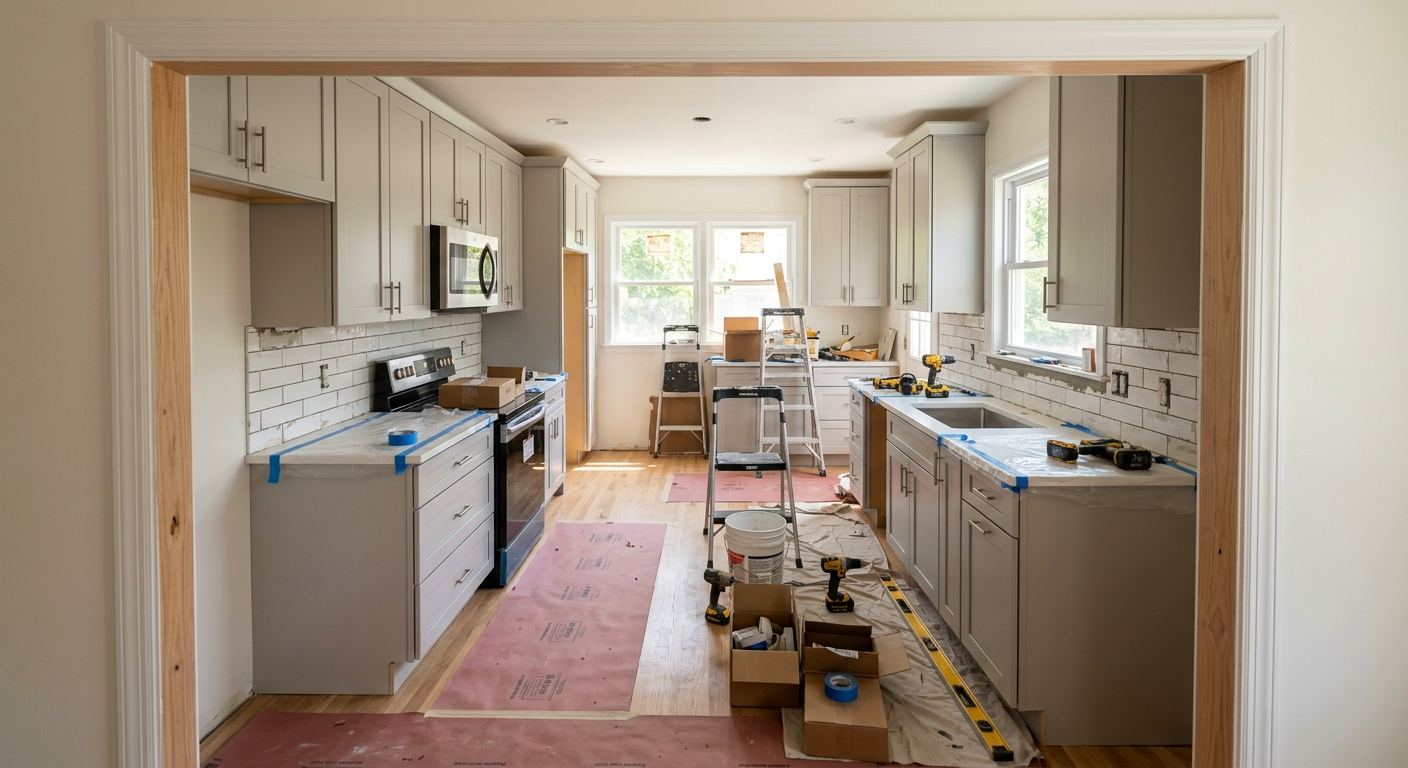
Kitchen renovation options and costs in Capitol Hill
In Capitol Hill, Alberta, homeowners typically start by picking a renovation “tier” that matches how long they plan to stay in the home and what buyers will expect when they resell. With a population of 4,670 in 2021 (Statistics Canada, 2021 Census), the local market moves steadily, and kitchen upgrades are one of the most visible value drivers. In the Calgary economic region, renovations also track strongly with income and home values—those higher-value areas tend to push people toward quartz or natural stone counters and semi-custom cabinetry rather than basic laminate and stock boxes.
Calgary’s weather doesn’t usually dictate the total labour hours the way roofing or siding does, but it does affect scheduling. You’ll see trade availability tighten in peak construction months, and on older homes around established pockets of Capitol Hill, contractors often spend extra time on hidden issues: dated electrical, uneven subfloors, and plumbing that doesn’t line up perfectly with modern drawer-and-pull layouts. That’s why two projects that “look the same” can differ significantly once demolition begins.
Demand is especially strong near established shopping and transit corridors—many homeowners in the Capitol Hill–Bowness area (and the broader west Calgary commuter belt) want kitchens designed for entertaining, with better lighting, more efficient storage, and cleaner sightlines. From there, you’ll usually land somewhere between a cosmetic refresh and a full redesign, depending on whether walls move or utilities get relocated. Use the table below as your baseline before you compare itemised contractor quotes.
| Renovation Tier |
What's Included |
Typical Duration |
Price Range |
| Cosmetic refresh (paint, hardware, new appliances only) |
Cabinet paint or touch-up (no new cabinetry), new hardware/pulls, appliance-only swap, minor caulking/trim, standard backsplash patching if needed |
1–2 weeks |
$7,000–$18,000 |
| Mid-range full renovation (new cabinets, counters, sink, tile) |
New stock or semi-custom cabinets, countertop install, sink + plumbing tie-ins, backsplash tile, flooring refresh where needed, electrical updates for typical outlets/hood controls |
3–6 weeks |
$25,000–$65,000 |
| High-end full renovation (custom cabinets, stone counters, island) |
Fully custom cabinetry, premium natural stone (or upgraded engineered stone), island build with upgraded lighting, improved ventilation, extended tile work, upgraded appliance package, possible wall/partition work |
6–12 weeks |
$70,000–$100,000 |
| Cabinet refacing only (new doors + drawer fronts, same boxes) |
Refacing doors/drawer fronts, new hardware, profile updates, repaint or finish of existing frames (if salvageable), basic cleaning/prep, selective trim replacement |
2–4 weeks |
$8,000–$35,000 |
| Countertop swap only (laminate to quartz or stone) |
Removal and disposal of existing counters, new quartz/stone fabrication and install, sink cut-out allowance, new sealing/finishing, basic caulking at backsplash line |
1–2 weeks |
$3,000–$12,000 |
| Backsplash tile installation only |
Tile supply and install (standard layouts), substrate prep, waterproofing where required, grout/caulk finish, patching to blend with existing finishes |
4–7 days |
$2,500–$8,000 |
Prices are estimates only and vary by project scope, site access and material selection.
What affects the price of kitchen renovation in Capitol Hill
In Capitol Hill, it’s common to see quotes for the “same” kitchen land 30–50% apart across Calgary and across Alberta. The main reason isn’t climate—it’s finish tier choices, how much the contractor has to rework the existing rough-in, and whether you’re changing layout or just refreshing surfaces. In higher-value Calgary-region neighbourhoods, homeowners often default to quartz or natural stone counters and semi-custom cabinetry because the added cost is easier to justify on resale. In more modest markets, laminate and stock cabinets dominate because the renovation delivers a better payback per dollar.
Layout changes are the wildcard regardless of finish. Removing a wall, adding an island, or moving plumbing for a new sink line can multiply labour time quickly. Even if the materials stay mid-range, moving a gas line or adding a new circuit for island outlets/undercabinet lighting can shift your project into permit-and-trade territory—those steps add schedule and cost.
Concrete Capitol Hill examples: first, if you upgrade from laminate to quartz, you might add only the countertop-and-install scope (often closer to the $3,000–$12,000 band for a straight swap), but if the new slab requires a sink relocation, budget closer to a mid-range full renovation process (often $25,000–$65,000) because plumbing tie-ins and rework become part of the job. Second, older homes on deeper lots sometimes have harder site access for demolition and waste hauling, which can raise labour and disposal costs. Lastly, kitchens with dated knob-and-tube or undersized panels may force electrical upgrades, turning a “simple” refresh into a more comprehensive renovation.
| Price Factor |
Why It Matters |
Cost Impact |
| Cabinet tier — stock vs. semi-custom vs. fully custom millwork |
Higher tiers add custom sizing, better hardware options, stronger build quality, and more finish/detailing. |
$8,000–$60,000 difference across projects depending on scope |
| Countertop material — laminate vs. quartz vs. granite vs. stone |
Material thickness, fabrication complexity, and installation labour vary widely between surfaces. |
$3,000–$20,000 swing |
| Layout change — wall removal, island add, plumbing/gas move |
Layout work triggers demolition, structural considerations, and trades coordination. |
$5,000–$35,000 incremental cost |
| Appliance package tier — builder vs. mid-range vs. pro-grade |
Pro-grade brands may require different power/venting setups and add premium pricing. |
$2,000–$12,000 difference |
| Flooring — refinish existing vs. full replacement |
Kitchen demo often damages subfloor and adjoining finishes; matching can be difficult. |
$1,500–$9,000 variation |
| Backsplash — ceramic tile vs. marble vs. full-height slab |
Large-format slabs and premium stone increase material cost and careful alignment work. |
$2,500–$18,000 range |
| Electrical — new circuits for island, under-cabinet lighting |
New circuits require licensed work, inspection, and added labour for cable routing. |
$1,000–$8,500 typical swing |
| Permit fees and licensed trade requirements |
Any permitted scope adds administrative time and licensed contractor scheduling. |
$500–$4,000 plus scheduling impacts |
Permits & regulations in Alberta
For Alberta homeowners in Capitol Hill, the key is separating “like-for-like” swaps from anything that changes building systems. In general, cabinet and countertop replacements typically do not require permits. Swapping cabinets, changing counter materials, and installing a backsplash are usually straightforward—no permit is typically needed as you’re not altering services or structure.
Where permits usually are required is when you alter plumbing, gas, electrical, or load-bearing structure. That includes: moving plumbing supply or drain lines (for example, changing where a sink or dishwasher sits), relocating a gas stove or making changes related to gas-fired appliances/venting, removing a load-bearing wall (or making structural changes), and adding new electrical circuits (such as dedicated island outlets or under-cabinet lighting that requires added wiring).
How to verify before you sign: (1) confirm the contractor’s Alberta business licence details and ask for their proof of liability insurance (certificate of insurance), (2) confirm coverage for workplace safety/workers’ compensation by requesting their WSIB/WCB clearance documentation, and (3) for gas work, require a licensed gas fitter and for electrical, require a licensed electrician—both should provide their own permit/inspection workflow where applicable. A reliable contractor will also confirm in writing who pulls permits and who is responsible for inspections—don’t assume it; verify it in the contract.
For gas and electrical work, never rely on “we’ll handle it” without documentation. You want the permit responsibility clear on paper before any demolition starts.
Cabinets, countertops and layout decisions in Capitol Hill
Your best results in Capitol Hill come from making three decisions early: cabinet tier, countertop material, and whether you’ll change the layout. (1) Cabinet tier: stock cabinets are fastest and usually cheapest, semi-custom is the most popular mid-range choice because sizing flexibility improves storage and alignment, and custom cabinets cost the most but deliver the best fit for odd corners, tall pantry solutions, and built-in fridges. (2) Countertop material: laminate is budget-friendly and looks great right away, but it’s easier to chip and can stain if not maintained. Quartz is a strong Alberta choice for busy kitchens because it’s durable, low-maintenance, and handles daily cleaning well. Granite and other natural stones can be beautiful and resilient, but they may require periodic sealing and more careful stain management. (3) Layout changes: removing a wall for open concept, adding an island, or relocating plumbing/gas is justified when it improves traffic flow, adds seating, or creates a functional triangle. If you’re only updating finishes, a full layout change often isn’t worth it.
Calgary resale expectations lean toward cleaner lines, brighter lighting, and storage efficiency at higher price points. That’s why a mid-range full renovation (often $25,000–$65,000) commonly includes semi-custom cabinetry plus quartz counters—buyers see the “complete kitchen” look, not just a refreshed surface. If you’re considering a high-end redesign with an island and stone counters (often $70,000–$100,000), the extra cost is justified when the space gain is real—like adding seating, improving circulation, or creating a proper pantry wall.
Example: If you upgrade laminate to quartz only, you might stay closer to the countertop swap band (often around $3,000–$12,000). But if you also move the sink for a new layout, you’re paying for plumbing rework and trade coordination—your project frequently climbs into mid-range full renovation scope because the work is no longer “surface-only.” In Alberta homes, those rework steps are where budgets most often drift.
| Option |
Durability |
Maintenance |
Best For |
Price Range |
| Stock cabinets (big-box) |
Solid for daily use; durability depends on door quality and installation level |
Low—wipes clean; fewer custom parts reduce fine-fitting issues |
Fast turnarounds, tighter budgets, standard kitchen dimensions |
$8,000–$20,000 |
| Semi-custom cabinets (local dealer) |
Improved build quality; better interior options and sizing flexibility |
Low; higher-quality hardware and finishes hold up well |
Most Capitol Hill renovations aiming for value + fit |
$18,000–$45,000 |
| Custom cabinets (local millwork shop) |
Best structural fit and premium detailing; ideal for unique layouts |
Low to moderate—depends on finish, but generally easy to care for |
Built-ins, high-end storage design, difficult spaces |
$40,000–$90,000 |
| Laminate countertop |
Good day-to-day performance; can chip at edges |
Simple cleaning; avoid prolonged standing water at seams |
Budget-first upgrades where you keep layout unchanged |
$3,000–$6,500 |
| Quartz engineered countertop |
High durability; resists stains and daily wear better than laminate |
Low—typical household cleaners, no sealing required for most quartz |
Busy families and resale-friendly finishes |
$6,000–$12,000 |
| Granite / natural stone countertop |
Very durable and heat-tolerant; performance varies by slab |
Moderate—may require sealing and stain-care habits |
Premium look with natural variation |
$8,000–$18,000 |
| Butcher block countertop |
Durable with care; sensitive to cuts and standing moisture |
Moderate to high—regular oiling and mindful cleaning |
Farmhouse warmth, food-prep kitchens, lower-gloss style homes |
$5,000–$10,500 |
| Marble countertop |
Beautiful but softer; can etch or stain without careful use |
Higher maintenance—gentle cleaners, sealing schedule, rapid wipe-ups |
Low-traffic show kitchens or premium design statements |
$10,000–$22,000 |
How to choose a kitchen renovation contractor in Capitol Hill
Choosing the right kitchen contractor in Capitol Hill is mostly about proof: licensing/coverage, clear scope, and realistic timelines. In Alberta, you should verify that the company can legally perform the work and that they’re insured for the job. Ask for (a) liability insurance (certificate of insurance showing current coverage), (b) WSIB/WCB clearance or documentation confirming workplace coverage, and (c) confirmation that subcontracted licensed trades—electrical and gas—will be engaged where required. If your quote includes these trades, the contractor should coordinate them and explain inspection steps in the plan, not just at the end.
Get 2–3 itemised written quotes. You want labour and materials broken out (cabinet supply vs install, countertop fabrication vs install, tile supply vs set, disposal/haul-away), not a single lump sum. Carefully review exclusions: Are permits included? Is demolition included? Is disposal included? Are materials allowances realistic (especially for quartz, tile, and appliances)? Also confirm the warranty in writing: workmanship warranty length (for install), manufacturer warranties for products, and whether warranties are transferable if you sell your home.
Payment scheduling matters. In Alberta renovations, a safe approach is never more than 10–15% upfront, then progress payments that align with completed milestones. Hold back a portion until the job is complete and deficiencies are corrected. Finally, demand a start date and a completion estimate in writing—kitchens often slow down due to cabinet and countertop fabrication lead times, so a credible schedule accounts for that.
- Provide certificate of insurance with coverage limits that match your project scale
- Show WSIB/WCB clearance documentation (or equivalent proof of coverage)
- Include a permit plan: what will be pulled, by whom, and when inspections occur
- Use itemised quoting: labour, materials, allowances, and taxes clearly separated
- Confirm disposal/haul-away is included (or listed as a separate line item)
- Detail demolition scope: what gets removed, who patches openings, and how debris is managed
- Specify cabinet installation method and who handles leveling/shimming
- Lock in countertop measures and the templating timeline to prevent fabrication surprises
- Verify tile scope: waterproofing, backer board, and grout/caulk specifications
- Ask about electrical/lighting inclusions for under-cabinet and island outlets
- Require a written change-order process (pricing and timing for extras)
- Confirm warranty terms for workmanship and whether manufacturer warranties transfer
Red flags in Capitol Hill kitchens: vague “turnkey” estimates that don’t separate labour/materials, refusal to provide insurance/WSIB/WCB proof, unclear permit responsibility, a payment request beyond 10–15% upfront, and no written timeline tied to cabinet/counter fabrication lead times.
Frequently asked questions — kitchen renovation in Capitol Hill
Custom vs stock cabinets — is custom worth it?
In Capitol Hill and across Alberta, custom cabinets are worth it when your layout has “problem areas” (tight corners, unusual ceiling heights, or you want a built-in pantry/fridge wall that makes storage feel seamless). If your kitchen is close to standard dimensions and you’re primarily improving finishes, stock or semi-custom often delivers better value. Most homeowners who want a resale-friendly upgrade land in semi-custom because it balances fit with cost—especially when pairing with quartz counters (often within the $6,000–$12,000 countertop band). A key point: custom pays off most when it reduces wasted space, improves accessibility, and creates a layout that photographs well. If you’re unsure, start by deciding your layout, then let the cabinet tier follow.
How do I choose a kitchen contractor in Capitol Hill?
Choose a contractor in Capitol Hill by verifying Alberta coverage and reading the quote like a scope document. Ask for liability insurance (certificate of insurance) and request WSIB/WCB clearance documentation before work starts. Then get 2–3 itemised quotes with labour and materials broken out—cabinet supply and install, countertop fabrication and install, tile supply and set, and disposal/haul-away should each be visible. Confirm permit responsibility in writing: moving plumbing/drain lines, changing gas connections, load-bearing wall work, or adding electrical circuits typically requires licensed trades and inspections. Finally, ask about warranty: workmanship duration and whether manufacturer warranties transfer if you sell. A good contractor will also explain lead times for cabinets and stone so your schedule stays realistic.
What order do kitchen renovation steps happen in?
A typical kitchen sequence in Capitol Hill is demolition first, followed by rough-in work, then installation and finishing. Generally: (1) confirm measurements and protect adjoining areas, (2) demolish existing cabinets/counters (and disconnect appliances safely), (3) complete plumbing/electrical/gas rough-in if any is changing, including any required permits and inspections, (4) install cabinets and level/shim properly, (5) template and fabricate countertops, (6) install countertops and sinks, (7) set backsplash tile, (8) reinstall appliances and trim, then (9) final caulking, punch-list corrections, and final walkthrough. If you’re doing only a countertop swap, the sequence compresses significantly—often within the countertop-only window (commonly around $3,000–$12,000 depending on material and sink cut-outs).
Can I live at home during a kitchen renovation in Capitol Hill?
Yes, many homeowners in Capitol Hill live at home during renovations, but it depends on how much of the kitchen is being opened up. For a cosmetic refresh or a countertop swap, you can often keep a functional kitchen elsewhere (like a temporary prep area) because the disruption is short. For a mid-range or high-end full renovation, demolition and trades work often make it harder to cook normally, so you’ll want a plan: a microwave/coffee station, a temporary sink setup if needed, and clear access for contractors. In Alberta’s winter, temperature control matters for adhesives, tile set, and curing timelines—contractors typically keep work zones conditioned to protect installations. If you’re changing plumbing or gas, expect a brief period where access to cooking is limited until licensed work is completed and inspected.
Should I renovate my kitchen before selling in Capitol Hill?
Often, yes—if the renovation is targeted to what buyers notice: clean cabinetry lines, modern counters, and updated lighting/outlets. In Calgary’s market, homeowners commonly invest in kitchens because buyers expect a cohesive finish package. That said, timing and scope matter. If your current layout is workable and only needs surface improvements, staying in a lower-cost tier (for example, a refresh or backsplash-only project) can offer better ROI than a full redesign. If you’re planning to sell soon, consider a mid-range full renovation approach (commonly $25,000–$65,000) rather than pushing to a premium redesign with extensive structural/layout changes. If you’re moving walls or relocating utilities, make sure the cost aligns with your expected sale price—those projects can exceed typical homeowner budgets and should be justified by clear buyer appeal.
What's the most popular kitchen style in Capitol Hill right now?
Right now in Capitol Hill and the wider Calgary area, the most requested styles tend to be modern transitional: warm neutral cabinetry, simple shaker or clean-panel doors, and bright, practical lighting (often with under-cabinet LEDs). Quartz counters dominate because they stay low-maintenance and look consistent. Many projects also include upgraded hardware and a backsplash that feels “seamless” with the counters—either textured tile in subtle tones or larger-format ceramic laid for clean lines. For higher-value properties, homeowners often push toward natural stone accents and more integrated appliance packages. The overall trend is less “decorative” and more functional: better storage, better sightlines, and fewer visual breaks. If you’re budgeting, that style direction usually fits well within mid-range full renovations (often $25,000–$65,000) rather than only cosmetic refreshes.