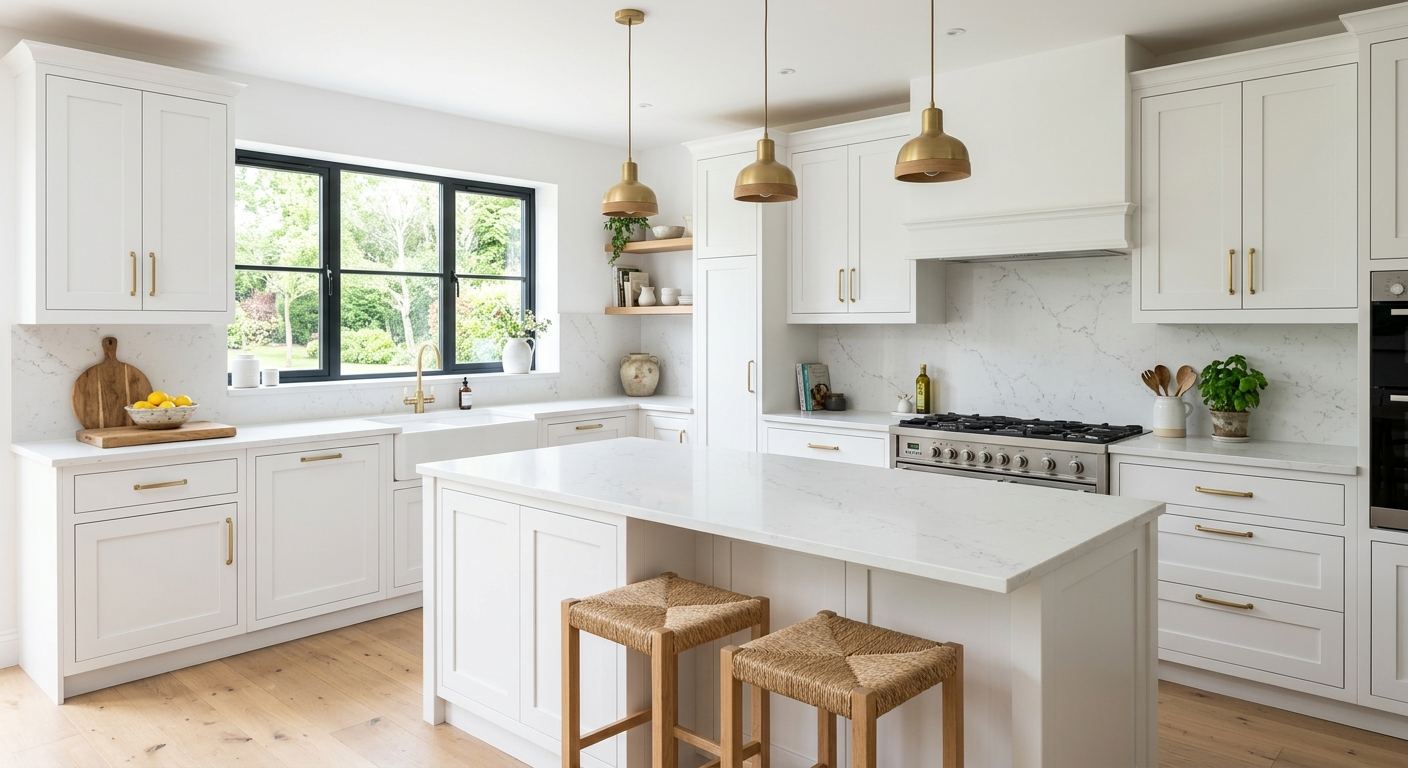
Kitchen renovation options and costs in Banff
Banff homeowners typically start with a budget conversation, then choose between stock, semi-custom and custom cabinetry once they see the options side-by-side. In Banff–Jasper–Rocky Mountain House, the market is supported by solid household finances—median household income was $88,000 in 2020 (Statistics Canada, 2021 Census)—and about 42.0% of households are owner-occupied, which often translates into longer plans for “staying in” a home and investing in durable finishes. With only 8,305 residents (Statistics Canada, 2021 Census), trade capacity is tight in peak season, so availability can influence timelines and sometimes labour rates.
In this region, kitchen renovation costs are driven less by climate “premiums” and more by buyer expectations shaped by property values and resale confidence. Alberta-wide guidance holds that cosmetic or partial work commonly falls around $10,000 to $40,000, while full renovations with major reconfiguration more often land $40,000 to $90,000+—and Banff frequently sits near the upper end of that band when quartz/stone and an island are included. The longer-run cost is influenced by how old the home is too: with 38.1% of dwellings built before 1981 (Statistics Canada, 2021 Census), you’ll often see dated electrical, older plumbing runs, and less flexible framing, which can add both labour and inspection time.
In Banff, that demand is especially visible around Quarry/Fairmont and central tourism-linked neighbourhoods where homes are updated for repeatable buyer appeal. Next, compare the common renovation tiers in the table below so you can align scope with realistic pricing.
| Renovation Tier |
What's Included |
Typical Duration |
Price Range |
| Cosmetic refresh (paint, hardware, new appliances only) |
Cabinet hardware, paint/refinish, appliance swap (no plumbing/gas moves), minor touch-ups |
1–3 weeks |
$10,000–$20,000 |
| Mid-range full renovation (new cabinets, counters, sink, tile) |
Stock or semi-custom cabinets, countertop installation, new sink/faucet, backsplash tile, basic electrical refresh |
4–7 weeks |
$40,000–$65,000 |
| High-end full renovation (custom cabinets, stone counters, island) |
Custom millwork, quartz/granite or stone counters, island build, upgraded backsplash (including feature tile), deeper electrical scope |
7–12 weeks |
$70,000–$90,000 |
| Cabinet refacing only (new doors + drawer fronts, same boxes) |
Refaced doors/drawer fronts, hardware, align/adjust, repaint/stain as required, reuse of existing boxes |
2–5 weeks |
$6,000–$22,000 |
| Countertop swap only (laminate to quartz or stone) |
Remove old top, template, install quartz/stone, new undermount sink or minor adjustments as needed |
1–2.5 weeks |
$7,000–$15,000 |
| Backsplash tile installation only |
Prep, tile supply/installs, grout/seal as applicable, minor trim/caulking only (no cabinetry changes) |
3–7 days |
$1,500–$8,000 |
Prices are estimates only and vary by project scope, site access and material selection.
What affects the price of kitchen renovation in Banff
In Banff–Jasper–Rocky Mountain House, the same kitchen job can come in 30–50% apart depending on finish tier, how much of the layout changes, and which trades are needed—not primarily because of winter weather. Alberta-wide market pricing is strongly tied to homeowner purchasing power and resale expectations: with a median household income of $88,000 (Statistics Canada, 2021 Census), many Banff owners choose upgrades that hold visual value, such as quartz or stone counters and semi-custom cabinetry. In lower-value pockets of Alberta, laminate and stock cabinets are more common, keeping totals closer to mid-market budgets (often in the $40,000–$65,000 range for a full renovation, versus $70,000–$90,000+ when higher-end elements are selected).
Climate affects the “how,” not the “how much,” for most budgets. Banff winters can slow interior work if drying times are extended (especially when drywall patches, paint, and thin-set tile work overlap), and older houses built before 1981 (38.1% of dwellings, Statistics Canada, 2021 Census) may have uneven walls that require more shimming and cabinet leveling. However, the biggest cost swings are usually layout changes: removing a wall, adding an island, or moving a gas line or plumbing run changes the scope of electrical and rough-in trades more than countertop or backsplash choices do.
Concrete Banff examples we see often: (1) a “simple” island add can require re-routing plumbing or relocating a vent hood, pushing labour and inspection time beyond the $40,000–$65,000 mid-range; (2) selecting quartz instead of laminate shifts the per-surface cost, but if you’re already doing a full cabinet refresh, it can be a more predictable upgrade than moving plumbing; (3) refitting to older window soffits or sloped ceilings can raise cabinet installation hours even when cabinet boxes are reused. With those drivers in mind, use the factors below to understand where your quote is likely to move.
| Price Factor |
Why It Matters |
Cost Impact |
| Cabinet tier — stock vs. semi-custom vs. fully custom millwork |
Determines materials, construction quality, fit-and-finish tolerances, and lead times |
Often shifts total budget by $10,000–$25,000 on full renovations |
| Countertop material — laminate vs. quartz vs. granite vs. stone |
Material cost and fabrication complexity; impacts thickness, edges, seams and maintenance expectations |
Commonly $3,000–$12,000 difference for the same footprint |
| Layout change — wall removal, island add, plumbing/gas move |
Triggers demolition, framing, rough-in work, additional trades, and more inspections |
Frequently the largest swing: $8,000–$20,000+ depending on services |
| Appliance package tier — builder vs. mid-range vs. pro-grade |
Higher tiers cost more and may require electrical/gas readiness and trim |
Typically $2,000–$10,000+ difference |
| Flooring — refinish existing vs. full replacement |
Surface prep, subfloor condition, matching height transitions and underlayment |
Often adds $1,500–$8,000 depending on replacement extent |
| Backsplash — ceramic tile vs. marble vs. full-height slab |
Material type drives labour, cutting complexity and finish quality requirements |
$1,500–$8,000+, with full-height features pushing higher |
| Electrical — new circuits for island, under-cabinet lighting |
New circuits and lighting layouts require licensed electrician time and permitting where applicable |
Commonly $1,000–$6,000+ depending on scope |
| Permit fees and licensed trade requirements |
Certain work must be performed/inspected by licensed trades, affecting scheduling and documentation |
Can add hundreds to several thousand, plus time for inspections |
Permits & regulations in Alberta
For most Banff kitchen upgrades in Alberta, swapping cabinets or countertops is straightforward from a permitting standpoint: cabinet and countertop replacements (even with appliance swaps that don’t move gas/plumbing) typically do not require a building permit. The work that usually does require permits and licensed trades is the work that changes life-safety systems or structural conditions. Examples include moving plumbing supply or drain lines, relocating or adding gas lines (for a stove/range or gas-ready range hood), removing a load-bearing wall, adding new electrical circuits (like for an island receptacle cluster or new vent fan wiring), and any major rework to existing wiring runs.
To verify a contractor properly in Banff, do it step-by-step before signing:
- Check the Alberta contractor’s licence/registration details through the appropriate online registry resources (ask the contractor for their licence number and confirm it matches on documents).
- Request a Certificate of Insurance (liability) showing active coverage for the project dates.
- Ask whether their workers are covered under WCB/WSIB equivalents used in Alberta (and request documentation/clearance letter where applicable).
- For gas work, confirm a licensed gas fitter is named for the scope; for electrical, confirm a licensed electrician will do and sign off on the circuits.
- Make sure permit responsibility (who pulls, who pays, who schedules inspections) is written into the contract.
Finally, keep everything itemised. If the quote says “permits included,” it should specify what permits and which trades are engaged, so you’re not surprised mid-job.
Cabinets, countertops and layout decisions in Banff
The three most consequential decisions in a Banff kitchen renovation are cabinet tier, countertop material, and whether you change the layout. Your choices should match the reality of your home type (many in Banff are older, with 38.1% built before 1981 per Statistics Canada, 2021 Census) and the expectations buyers bring when they tour in a high-demand mountain setting. In practice, stock cabinets are the fastest and least expensive option, but they can look “less built-in” on older walls that aren’t perfectly square. Semi-custom cabinets are the most popular mid-range choice because you get better sizing and finishes without fully custom lead times. Custom cabinets are best when you want an exact fit around awkward ceiling lines, stonework, or existing windows—and they usually align with a higher full-renovation budget.
Countertops follow a similar logic. Laminate is cost-effective and forgiving, while quartz engineered counters deliver strong stain resistance and consistent appearance, and natural stone (granite/other stone) adds a premium look with different maintenance routines. The realistic price difference matters: for example, upgrading countertops during a mid-range full renovation (often $40,000–$65,000) is frequently easier to absorb than changing a layout later. If your plan is to add an island, though, you may justify moving plumbing/gas only if it creates true work space and storage—because rough-in and inspection costs can outweigh the cosmetic savings from choosing laminate.
Banff resale-minded buyers tend to expect crisp lines, durable surfaces and clean hardware execution. That’s why many homeowners who move from a cosmetic refresh into a full renovation choose quartz and semi-custom cabinets rather than stopping at laminate. Make the layout work first, then upgrade materials where they deliver the best day-to-day experience and resale confidence.
| Option |
Durability |
Maintenance |
Best For |
Price Range |
| Stock cabinets (big-box) |
Good everyday durability; limited size flexibility |
Low; occasional hardware tightening and minor caulk touch-ups |
Fast timelines and straightforward layouts |
$6,000–$22,000 |
| Semi-custom cabinets (local dealer) |
Very good durability with more options and better fit |
Low; handle wear points with regular cleaning |
Most mid-range full renovations seeking better alignment and styling |
$22,000–$45,000 |
| Custom cabinets (local millwork shop) |
Highest durability potential with precise detailing |
Low, but depends on finishes (paint/stain/clearcoat care) |
Complex spaces, angled walls, built-ins, and premium aesthetics |
$45,000–$70,000 |
| Laminate countertop |
Moderate durability; can chip at edges if impacts occur |
Easy; avoid prolonged heat and excessive standing water at seams |
Budget-conscious upgrades and cosmetic-focused renovations |
$3,000–$7,000 |
| Quartz engineered countertop |
High durability with good stain and wear resistance |
Very low; wipe-clean finish, no sealing required in most cases |
Resale-friendly performance for active households |
$7,000–$12,000 |
| Granite / natural stone countertop |
High durability; varies by stone and edge detailing |
Moderate; may require periodic sealing depending on the stone |
Premium look with unique veining |
$10,000–$15,000 |
| Butcher block countertop |
Good for warmth and impact tolerance; edges matter |
Higher care; periodic oiling and moisture management |
Homey style and families who want a natural surface |
$6,000–$12,000 |
| Marble countertop |
Elegant but softer; can etch or stain more easily |
Higher maintenance; careful cleaning and sealing approach |
Low-abuse entertaining kitchens and premium design goals |
$12,000–$18,000 |
How to choose a kitchen renovation contractor in Banff
Choosing the right contractor in Banff starts with checking Alberta licensing, liability insurance and worker coverage. First, ask for proof of current liability insurance and confirm the certificate covers “general liability” for renovation work; then request the contractor’s worker coverage documentation (WCB/clearance as applicable in Alberta). For your specific kitchen scope, insist on identifying which parts require licensed trades: gas work should be carried out by a licensed gas fitter, and any new or altered electrical circuits must be done by a licensed electrician. A good contractor won’t treat these as paperwork—they’ll explain the steps and inspections clearly.
Next, get 2–3 itemised written quotes. You want labour and materials broken out—not a single lump sum—so you can compare apples to apples (cabinet tier, countertop type, tile scope, backsplash height, and disposal/dump fees). Read the scope for exclusions: is drywall repair included? Is permit pulling included (and which permit)? Is jobsite protection included to protect floors in a busy Banff home? Is waste removal and disposal included daily or only at the end?
Warranty matters too. Confirm workmanship warranty length and whether it covers cabinet installation, countertop installation, tile cracking, and caulking/grout failures. Also note product/manufacturer warranty terms and whether the warranty is transferable to you as the homeowner.
On payment schedule, avoid large deposits: never pay more than about 10–15% upfront. Hold back a portion until key milestones are complete, and have the final payment tied to punch-list sign-off and documentation.
- Licence and trade coverage clearly listed in the contract (who does what).
- Certificate of insurance provided before work starts.
- Worker coverage/clearance documentation requested and reviewed.
- 2–3 itemised quotes with labour + materials breakdown.
- Written scope includes demolition, subfloor/drywall repairs, and clean-up.
- Confirm permit pull responsibility and inspection handling in writing.
- Waste disposal/dump fees specified (not “included” vaguely).
- Cabinet installation method described (shimming, anchoring, leveling).
- Countertop templating and seam/edge plan confirmed.
- Tile scope defined: substrate prep, grout type, and caulking details.
- Warranty terms spelled out for both workmanship and products.
- Payment schedule tied to milestones; holdback strategy included.
In Banff, a few red flags show up quickly: quotes that skip electrical/gas permit responsibility, vague “allowances” that quietly inflate material tiers, no written timeline with start/completion estimates, warranties that don’t specify workmanship coverage, and contractors who won’t provide insurance/licence documentation up front.
Frequently asked questions — kitchen renovation in Banff
Custom vs stock cabinets — is custom worth it?
In Banff, custom cabinets are worth it when you have an awkward space that stock can’t fit well—odd wall angles, sloped ceilings, or the need for exact built-ins. If your goal is a clean upgrade within a mid-range budget, semi-custom usually gives the best balance of fit and cost. Stock cabinets are typically fastest and most budget-friendly, but you may need extra filler panels and more installation labour on older homes; Banff has a sizable share of older housing stock (38.1% built before 1981, Statistics Canada, 2021 Census), which can reduce “off-the-shelf” advantages.
As a practical guide, a full kitchen renovation often lands around $40,000–$90,000 depending on choices. When your total plan is closer to the $40,000–$65,000 band, semi-custom cabinets plus quartz counters is a common, resale-friendly path. If you’re targeting the upper tier (especially with an island and stone), custom millwork becomes more justifiable.
How do I choose a kitchen contractor in Banff?
Start with verification: request proof of Alberta liability insurance, confirm worker coverage documentation, and ensure the right licensed trades are named for any permit-requiring work. For kitchens, that typically means a licensed electrician for new circuits and a licensed gas fitter for any gas line changes. Then compare itemised quotes: you want separate lines for labour and materials (cabinets, counters, tile, disposal), so differences aren’t hidden inside allowances.
In Banff, also ask about scheduling and lead times for cabinetry and countertop templating—tight trade capacity can affect when work starts and how quickly you can finish before seasonal constraints. Choose a contractor who provides a clear written scope, a timeline with estimated start/completion dates, and warranty terms that specify workmanship coverage duration. If their contract language is vague on permits, disposal, or exclusions, keep looking.
What order do kitchen renovation steps happen in?
A typical sequence in Banff goes: design and measurements (including countertop templating planning), then demolition. After that, rough-in work happens first—electrical and any permitted plumbing/gas changes—followed by framing/drywall repairs if walls were opened. Next comes cabinet installation (once walls are prepped and level), then countertops templated and installed, and then the finish stages like backsplash tile, caulking, paint, and trim.
Flooring usually gets handled either during demo (if subfloor repairs are needed) or after cabinets are installed, depending on your design and the floor transition plan. Appliance installation comes near the end, after hookups are verified. Using quartz/stone counters also affects timing because templating and fabrication add lead time. A good contractor will provide a milestone-based schedule so you know when inspections, templating, and final punch-list walkthroughs occur.
Can I live at home during a kitchen renovation in Banff?
Often you can, but it depends on whether your project includes major layout changes, whether plumbing/gas lines are being moved, and how disruptive demolition will be. For a cosmetic refresh or a backsplash-only project, living in the home is usually manageable with a functional temporary kitchen setup. For a mid-range full renovation that includes new cabinets, counters, sink, and tile (commonly $40,000–$65,000), you may be without a sink or cooking area for short windows, so plan for a temporary microwave, kettle, and a safe food-prep area.
If you’re adding an island or moving plumbing/gas, expect longer periods with limited access. Older Banff homes may also require extra time for repairs before surfaces are ready for tile and cabinet installation. If you need to stay, ask your contractor about jobsite protection (floor/walkway covering, dust control) and a daily cleanup routine, plus whether key areas like bedrooms and bathrooms will remain clear during working hours.
Should I renovate my kitchen before selling in Banff?
Many Banff homeowners renovate before selling because kitchen presentation strongly influences buyer confidence—especially with durable, modern-looking finishes. If your current kitchen is dated but structurally sound, a targeted refresh can help without risking the whole investment. A backsplash and hardware update, or a countertop swap, may fit better than full demolition when budgets are constrained.
That said, if your current layout is inefficient (poor traffic flow, undersized counters, or missing storage), a full renovation can be justified. In this region, buyers often expect clean, durable surfaces: quartz is a common “sweet spot” because it looks premium and performs well. A full renovation frequently ranges $40,000–$90,000 depending on cabinet tier and counters; mid-range projects commonly sit around $40,000–$65,000, while higher-end stone and custom millwork push toward $70,000–$90,000+. For older homes (38.1% built before 1981, Statistics Canada, 2021 Census), factor in the possibility of hidden electrical/plumbing updates.
What's the most popular kitchen style in Banff right now?
In Banff right now, the most popular direction is “modern mountain” styling: warm neutrals (greige/cream/soft greys), natural wood accents, simple shaker or slab-door profiles, and stone-look backsplashes that don’t fight the home’s character. Homeowners and buyers often prioritize durable, easy-clean materials—especially quartz counters and practical backsplash tile—because kitchens are used daily, even in busy seasonal weeks.
Finish choices typically correlate with budget tier. In mid-range renovations (often $40,000–$65,000), semi-custom cabinetry with quartz and a standard tile backsplash is very common. In higher-end builds closer to $70,000–$90,000, you’ll see more statement work such as islands with feature lighting, upgraded stone counters (and sometimes more dramatic tile patterns). If you’re renovating an older Banff kitchen, modernizing surfaces while keeping the layout functional is usually the fastest way to achieve a “fresh” look that buyers recognize.