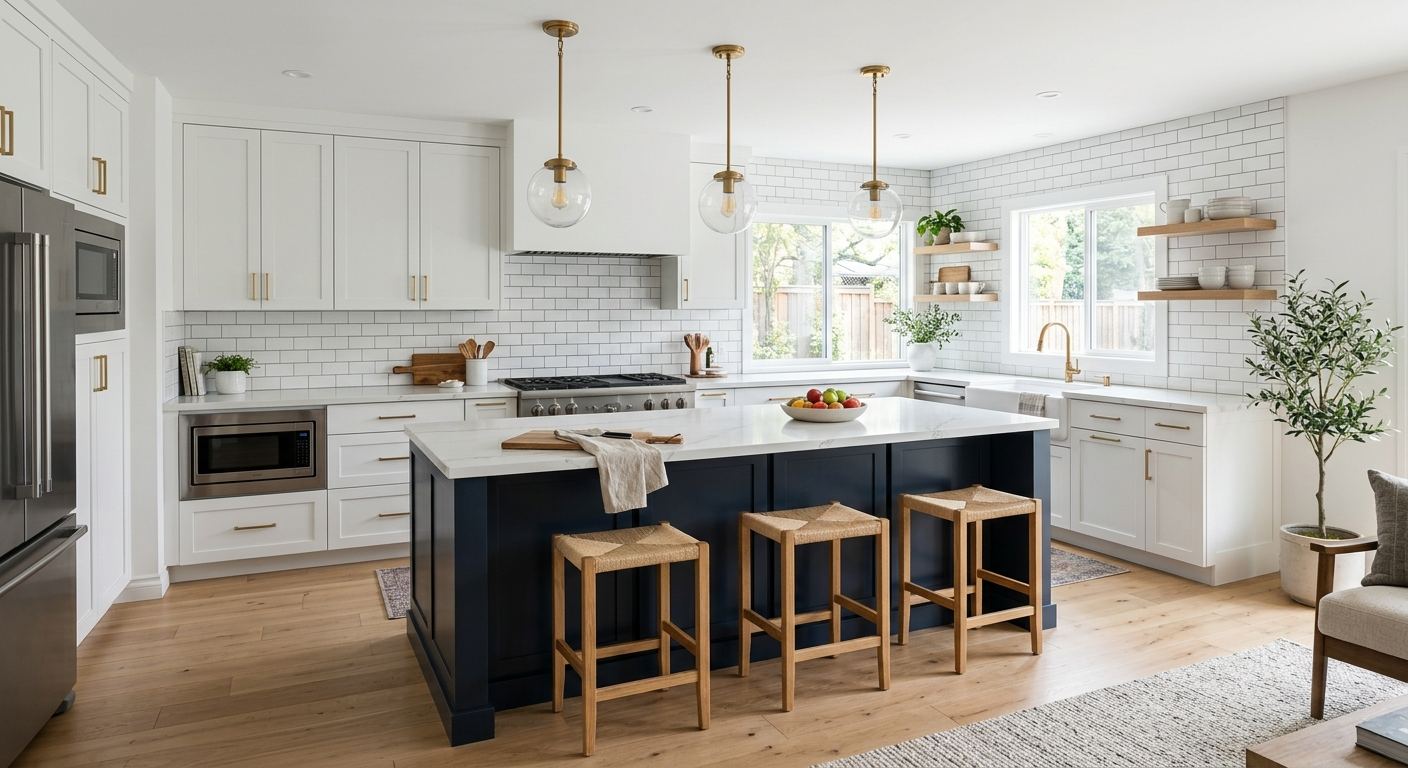
Kitchen renovation options and costs in Blue Quill
Blue Quill, Alberta homeowners typically start kitchen planning with finish expectations and lifestyle needs, then let the budget decide the “tier” of work. In the Calgary economic region, household demographics matter because homeowners in higher-value areas are more likely to upgrade finishes for resale—especially when the local market supports it (Statistics Canada, 2021 Census). With a population of 4,552 in the community profile (Statistics Canada, 2021 Census), Blue Quill kitchens often reflect a practical mix of owner-occupied upgrades and family-driven refreshes rather than constant turnover. That’s why you’ll see many renovations aiming for today’s buyer-ready look: durable counters, better lighting, and cabinetry that functions well for day-to-day use.
In the Calgary region, costs are shaped more by demand and materials selection than Alberta weather itself. Even so, long winters and temperature swings affect installation scheduling: contractors protect materials during storage, and tiled or stone surfaces often need careful acclimation. Labour availability can also tighten during peak construction periods, so lead times for semi-custom cabinetry and quartz/stone slabs become a real part of your overall timeline. Areas within or near Blue Quill where trade demand is especially strong include established family neighbourhood pockets with steady turnover in the surrounding Calgary market, where contractors are booked ahead for cabinetry, electrical upgrades, and flooring tie-ins.
To compare realistic budgets, use the tiers below as a starting point—then we’ll break down the biggest price drivers and how Alberta permits work for kitchen projects.
| Renovation Tier |
What's Included |
Typical Duration |
Price Range |
| Cosmetic refresh (paint, hardware, new appliances only) |
Cabinet repaint or touch-up, new hardware, appliance swap (no layout change), minor trim/caulking |
3–7 days |
$8,000–$18,000 |
| Mid-range full renovation (new cabinets, counters, sink, tile) |
New semi-custom or quality stock cabinets, countertop install, sink/faucet, backsplash tile, flooring patching, basic electrical hook-ups |
3–6 weeks |
$25,000–$60,000 |
| High-end full renovation (custom cabinets, stone counters, island) |
Custom cabinetry, premium stone/quartz counters, island build-out, upgraded lighting (often under-cabinet + pendants), coordinated electrical/plumbing upgrades, more complex tile |
6–12 weeks |
$70,000–$100,000 |
| Cabinet refacing only (new doors + drawer fronts, same boxes) |
Door/drawer-front swap, new hardware, colour change, limited countertop/backsplash work if specified |
2–4 weeks |
$8,000–$35,000 |
| Countertop swap only (laminate to quartz or stone) |
Remove existing top, template, install new quartz/stone, new sink drop-in if included, edge profile change |
1–3 weeks |
$3,000–$12,000 |
| Backsplash tile installation only |
Surface prep, tile install (standard heights), grout/seal, trim/sill coordination, caulking |
3–7 days |
$2,500–$8,000 |
Prices are estimates only and vary by project scope, site access and material selection.
What affects the price of kitchen renovation in Blue Quill
Even when homeowners in Blue Quill request the same “look,” bids can vary by 30–50% across Calgary and the wider Alberta region. The biggest reason is that contractors price different finish tiers and different levels of hidden work (old subfloor damage, electrical deficiencies, plumbing condition, and how much demolition is truly needed). Market expectations also shift the finish tier: in higher-value Calgary-area pockets, many buyers default to quartz or natural stone counters and semi-custom cabinetry because the upgrade tends to support resale value. In more modest markets, laminate and stock cabinets often deliver better ROI, since buyers may value functionality over premium stone. In both cases, layout changes drive the most unpredictable cost.
Concrete examples from local site conditions: first, moving plumbing for a new sink or adding a dishwasher line can turn a countertop job into a full demo-and-repair cycle, quickly pushing costs toward the higher end of the $25,000–$60,000 mid-range band. Second, when homeowners add an island and request under-cabinet lighting, you’re not just buying fixtures—you’re paying for new circuits and coordination time, which commonly clusters projects toward the $70,000–$100,000 high-end band in upgraded homes. Third, older housing stock may have out-of-square wall conditions; levelling, re-laminating where cabinets sit, and patching tile floors adds labour regardless of whether you choose laminate or quartz.
As for “climate,” Calgary weather mainly affects scheduling and protection, not the core material pricing. Still, with winter storage and thaw cycles, we build in acclimation time for stone slabs and give extra attention to moisture management at subfloors—small items that prevent expensive rework.
| Price Factor |
Why It Matters |
Cost Impact |
| Cabinet tier — stock vs. semi-custom vs. fully custom millwork |
Higher tiers add better fit, deeper options (pull-outs, organizers), and more labour for exact install |
Can shift the budget by roughly $10,000–$40,000 depending on layout complexity |
| Countertop material — laminate vs. quartz vs. granite vs. stone |
Material cost and fabrication/edge profiles change total pricing; stone also carries more template and labour time |
Often $2,000–$8,000+ difference for comparable sizes |
| Layout change — wall removal, island add, plumbing/gas move |
Structural and service work increases demolition, engineering/permits, and rework risk |
Usually the largest swing factor; frequently $5,000–$30,000+ |
| Appliance package tier — builder vs. mid-range vs. pro-grade |
Electrical and ventilation needs vary; pro-grade sets often require more precise trim and venting |
Commonly $1,500–$10,000+ across packages |
| Flooring — refinish existing vs. full replacement |
Whether cabinets sit on patched areas or full new floors changes demo and install time |
Typically $1,000–$7,000 depending on finish type |
| Backsplash — ceramic tile vs. marble vs. full-height slab |
Material thickness, pattern matching and sealing requirements drive labour and waste |
Often $1,000–$6,000+ difference |
| Electrical — new circuits for island, under-cabinet lighting |
Labour + licensed electrician time increases with additional fixtures and circuit work |
Commonly $800–$5,000 depending on scope |
| Permit fees and licensed trade requirements |
Permits and inspections add costs; licensed work also affects scheduling |
Often $500–$3,500+ depending on what changes |
Permits & regulations in Alberta
In Alberta, not every kitchen change triggers a permit. Generally, swapping cabinets, replacing countertops, and installing a backsplash on existing walls typically do not require permits. However, once you start altering systems or changing what buildings must inspect, permitting usually becomes part of the job. In practical terms for Blue Quill homeowners, permits are commonly required when you relocate or add plumbing supply/drain lines (for sink or dishwasher changes), relocate a gas appliance connection (stove/range and sometimes range-hood ducting when tied to a gas system), remove a load-bearing wall, or add new electrical circuits (for island outlets, under-cabinet lighting tied into electrical panels, or relocating the main feed for a kitchen upgrade). Gas work must be completed by a licensed gas fitter, and electrical work must be done by a licensed electrician, with inspections as required.
To verify a contractor before you sign, follow a simple checklist. First, ask for their Alberta licence information (and verify it via the appropriate online registry for the trade they will perform). Second, request a current certificate of insurance showing liability coverage for the term of the project. Third, ask for proof of WSIB/WCB coverage—if applicable—and keep documentation in your project binder. Finally, confirm who is responsible for permits in writing: the permit responsibility (contractor vs. homeowner) should be explicit in your contract, not assumed.
Cabinets, countertops and layout decisions in Blue Quill
The three most consequential decisions in a Blue Quill kitchen renovation are: (1) cabinet tier, (2) countertop material, and (3) layout changes. Cabinet tier controls everything from daily usability to how quickly the job finishes. Stock cabinets are the fastest and usually the cheapest option, but they’re less forgiving when your walls aren’t perfectly square. Semi-custom is the most popular mid-range choice because it balances lead time and fit—organizers, better drawer systems, and more door/finish selection. Custom cabinets provide the best fit for your specific space, but cost and scheduling rise fast.
Countertops affect both the look and the real maintenance effort. Laminate is the entry level and can be a budget win at the low end of $3,000–$12,000, but it’s less resilient to heat and can wear unevenly over time. Quartz is the practical upgrade most buyers expect in Calgary-area kitchens because it resists staining and is straightforward to live with. Granite or natural stone adds character but usually comes with more colour and installation variation, while butcher block adds warmth but demands more attention to moisture management and sealing.
Layout is where budgets can swing. Moving plumbing for a new sink or rerouting gas/venting for a cooktop often costs more than people expect. Still, the cost can be justified when it unlocks usable space—like adding an island for seating and traffic flow—or when you replace a cramped “work triangle” with a better plan that reduces movement during cooking. For a specific example: if you want to upgrade from laminate to quartz while keeping the existing sink position, the countertop-only swap might land in the $3,000–$12,000 range; but if you also move the sink and add an island with power, the project can quickly move into a full renovation tier such as $25,000–$60,000 because demolition and licensed trade work expands.
| Option |
Durability |
Maintenance |
Best For |
Price Range |
| Stock cabinets (big-box) |
Good with careful install; limited flexibility for uneven walls |
Low day-to-day upkeep; hinges and trim depend on exact product quality |
Budget refreshes and quicker turnarounds |
$8,000–$18,000 |
| Semi-custom cabinets (local dealer) |
Very good; better fit options and upgradeable hardware/features |
Low upkeep; organizers help reduce wear and tear on drawers |
Most Blue Quill mid-range full renovations |
$18,000–$45,000 |
| Custom cabinets (local millwork shop) |
Excellent; tailored to space and can incorporate special storage |
Low upkeep; craftsmanship details require proper care like any fine finish |
Homes where layout constraints demand perfect fit |
$45,000–$80,000+ |
| Laminate countertop |
Moderate; can be vulnerable to heat and moisture at seams |
Wipe clean; avoid hot pans and prolonged standing water |
Cost-sensitive upgrades and rental-friendly budgets |
$3,000–$7,000 |
| Quartz engineered countertop |
High; resistant to staining and everyday wear |
Simple cleaning; avoid harsh abrasives and treat chips promptly |
Most Calgary-area resale-minded renovations |
$6,000–$12,000 |
| Granite / natural stone countertop |
High; strong and durable, with unique pattern variation |
May require periodic sealing depending on the stone |
Premium look with one-of-a-kind character |
$8,000–$16,000+ |
| Butcher block countertop |
Moderate to high if maintained; sensitive to prolonged moisture |
Needs regular oiling and careful drying |
Warm aesthetic and kitchens used for food prep |
$4,500–$10,000 |
| Marble countertop |
Moderate; beautiful but more prone to etching and staining |
More attention needed; gentle cleaners and protective habits |
Statement kitchens where upkeep is acceptable |
$10,000–$20,000+ |
How to choose a kitchen renovation contractor in Blue Quill
Choosing the right contractor in Blue Quill is less about marketing and more about verification. Start by asking for Alberta licensing information for any trade work they’ll lead (especially electrical and gas—these must be done by licensed professionals). Request a certificate of liability insurance and confirm it covers the project duration. For worker coverage, ask for proof of WSIB/WCB coverage—documentation should be current and match the scope of work. A legitimate renovation partner will provide these without pressure and will answer questions clearly.
Next, get 2–3 itemised, written quotes. “Itemised” matters: you want a labour and materials breakdown, not just a lump sum. Ensure the scope is complete and consistent between quotes: what’s excluded (old backsplash removal, subfloor patching, cabinet adjustments, appliance hookups), is permit pulling included, and is disposal/hauling included. Warranty is another big differentiator: confirm the workmanship warranty length and whether manufacturer warranties for cabinets, countertops, and appliances are provided and transferable. On payment schedule, keep it practical—never pay more than 10–15% upfront, and hold back a portion until the job is complete and deficiencies (if any) are addressed. Finally, get a start date and completion estimate in writing so you have a realistic timeline tied to material lead times.
- Verify Alberta trade licences for every licensed scope (electrical/gas) with documentation.
- Confirm liability insurance certificate is active for your project term.
- Request proof of WSIB/WCB coverage and keep it with your contract.
- Use itemised quotes: separate labour, materials, demolition, disposal, and finish work.
- Ask who pulls permits and who pays permit fees (and ensure it’s in writing).
- Confirm whether appliance delivery, hookup, and fit adjustments are included.
- Get a finish schedule: cabinet colour/finish, countertop profile/edge, and backsplash layout.
- Clarify demolition scope: drywall patching, plumbing cap-offs, and floor repairs.
- Ask about lead times for cabinets and slabs; tie your schedule to it.
- Confirm warranty terms: workmanship duration and manufacturer warranty documentation.
- Agree on a payment milestone schedule with a holdback for completion.
- Require a written start date and a realistic completion range, not “ASAP.”
Red flags I see in Blue Quill include contractors who (1) won’t provide written scope details, (2) ask for large upfront payments beyond 10–15%, (3) provide a non-itemised lump sum with unclear exclusions, (4) can’t produce insurance/WSIB/WCB proof, or (5) dismiss permitting responsibilities for plumbing/electrical/gas and structural changes.
Frequently asked questions — kitchen renovation in Blue Quill
How long does a kitchen renovation take in Blue Quill?
In Blue Quill, the timeline depends more on materials lead times than on the calendar itself. A cosmetic refresh (paint, hardware, appliance-only swaps) can often be done in about 3–7 days if materials are already on hand. A mid-range full renovation with new cabinets and counters typically lands around 3–6 weeks, assuming cabinetry is ordered with enough lead time. High-end projects with custom millwork and stone work usually run 6–12 weeks because stone templating/fabrication and detailed cabinet installation slow the pace. Also, if you need permits for electrical, plumbing, or gas relocation, inspections can add days even when the trades are ready to work. (Statistics Canada, 2021 Census)
Quartz vs granite countertops — which is better?
For most Alberta homeowners, quartz is the “better all-around” choice because it’s consistently made and performs predictably in everyday use. It resists staining well and is generally easier to maintain than natural stone. Granite is also durable and brings one-of-a-kind patterning, but it can require sealing depending on the specific stone and finish. In terms of budgeting, quartz commonly fits the practical window of $6,000–$12,000 for many typical kitchen sizes (installed), while granite can land higher depending on slab selection, edge profile, and complexity. If you want low-maintenance with resale-friendly aesthetics, quartz is usually the safest bet in Blue Quill. If you love natural character and are comfortable with additional care, granite is a strong choice.
Should I reface or replace my cabinets?
Refacing is often the right move when your cabinet boxes are still solid, your layout works, and you mostly want a fresh look—new doors/drawer fronts and updated hardware. It usually costs less and can be quicker than full replacement. Replacement is smarter if boxes are damaged, the finish is failing, you want major internal changes (like upgrading to heavy-duty organizers), or your measurements don’t suit the current space. For budgeting, cabinet refacing is commonly in the $8,000–$35,000 band, while a full cabinet install is typically much higher. In older Alberta homes, I often see refacing make sense unless the original boxes are warped from past moisture issues. In Blue Quill, the decision is usually about box condition, desired storage, and whether you’re keeping the existing layout.
Do I need a permit for a kitchen renovation in Alberta?
Often, you do not need permits for straightforward cosmetic work like painting, hardware changes, replacing countertops, or installing a backsplash on existing walls. Permits are typically required when you move plumbing supply/drain lines, relocate gas connections for cooking appliances, remove load-bearing walls, or add/modify electrical circuits (for example, new island outlets or upgraded lighting that requires circuit changes). In Alberta, licensed trades must perform the work—gas by a licensed gas fitter and electrical by a licensed electrician—followed by the necessary inspections. For Blue Quill homeowners, the key is to confirm who will pull permits and who pays permit-related costs in your signed contract. Don’t assume; make it explicit before work starts.
What's the ROI on a kitchen renovation?
ROI in Blue Quill is influenced by buyer expectations and the neighbourhood’s finish norms, not by climate performance. In the Calgary economic region, homeowners often target a kitchen refresh in the range of roughly 10%–15% of home value for a refresh and up to about 20%–25% for a full redesign in more upscale properties. That’s why many buyers respond to quartz counters, clean backsplash work, and modern lighting—these are “see-it-in-the-walkthrough” upgrades. Even so, the best ROI usually comes from smart layout decisions rather than premium finishes alone: if you improve traffic flow and usability (without unnecessary plumbing/gas moves), you tend to get better satisfaction and resale appeal. Your exact ROI depends on what you change—layout moves can push budgets toward the $25,000–$60,000 mid-range or beyond—while cosmetic-only work stays closer to the lower tier.
How do I budget for a kitchen renovation?
Start by choosing the renovation tier, then plan a realistic allowance for the “unknowns” that come with demolition. In Blue Quill, a typical full-kitchen renovation often clusters in the mid five figures, with higher-end upgrades reaching six figures when layouts change or when you add premium stone and bespoke millwork. Use your target tier as a baseline: cosmetic refreshes might sit around $8,000–$18,000, while mid-range full renovations commonly fall in the $25,000–$60,000 band. Next, budget separately for permits and licensed trade work if you’re changing plumbing/electrical/gas. Finally, get itemised quotes so you can compare apples-to-apples: labour, materials, demolition, disposal, and any excluded work should be clear. A solid contractor will help you estimate contingencies early rather than add surprises later.