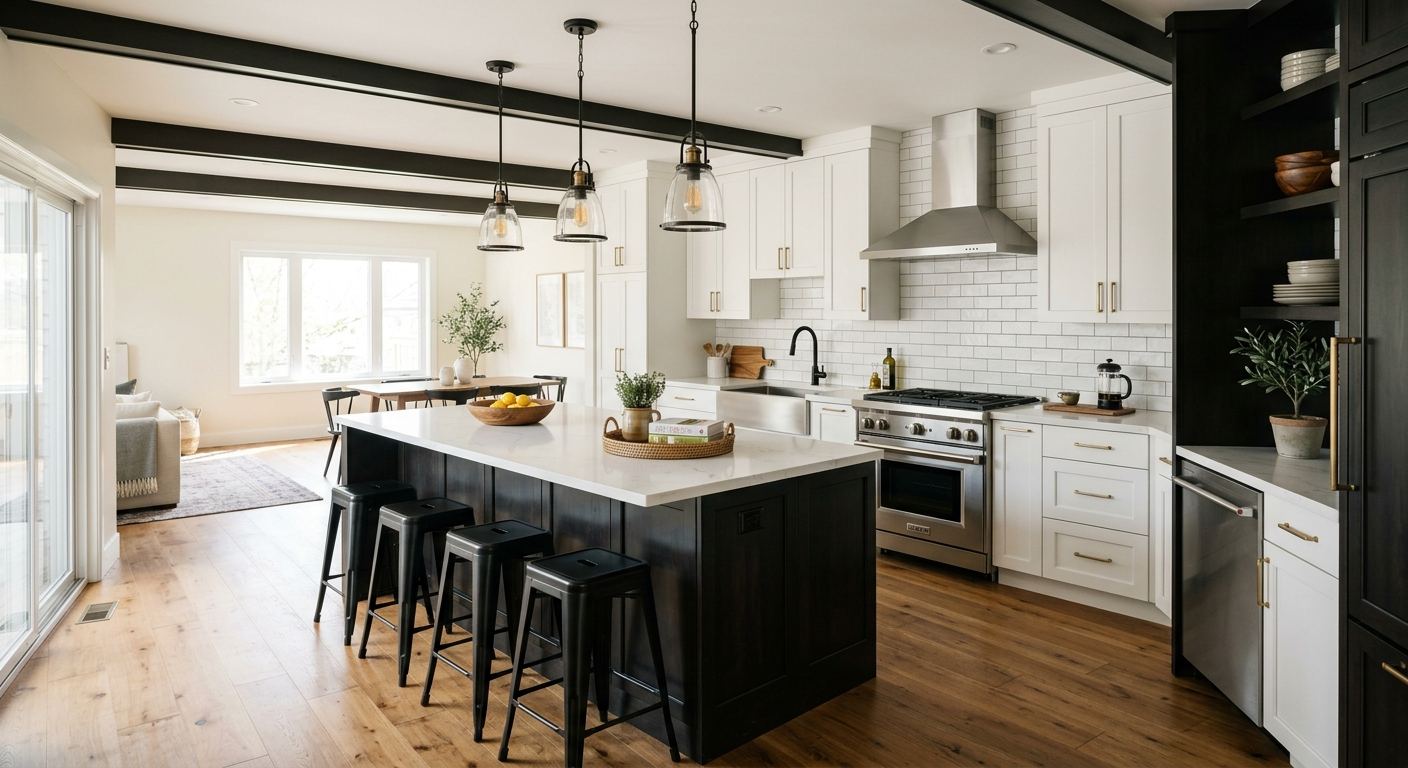
Kitchen renovation options and costs in Braeside
Braeside, Alberta homeowners usually start their kitchen plans by choosing how big a change they want: cosmetic, full refresh, or a true redesign that reworks the layout. With a community population of about 5,700 (Statistics Canada, 2021 Census), local renovations often cluster around practical upgrades—especially in homes that are mid-cycle after years of everyday wear. In the Calgary economic region, pricing also tracks closely to household economics; that’s why many homeowners here move up a finish tier sooner than they would in lower-value markets. As a reference point, Calgary-area buyers generally expect kitchens to look “current” and durable, and kitchens that feel updated tend to hold attention at resale.
Even though weather isn’t the main driver of cost in this region, Alberta’s strong construction market does affect contractor availability and scheduling. Trade capacity in and around Calgary can tighten in peak seasons, which can influence labour pricing and lead times for cabinetry, stone templating, and tile installs. In the more active renovation pockets—especially around the larger retail and service corridor near the Calgary edge—kitchen work tends to move faster because there’s steady demand for carpentry, countertop fabrication, and electrical add-ons.
Budget-wise, Calgary-area projects often land in the mid five-figures for full renovations, and go higher when stone, island builds, or wall moves are involved—choices that typically align with how Calgary buyers value turnkey updates. From there, comparing your options against realistic duration and cost ranges makes it easier to pick a scope that fits your timeline.
| Renovation Tier |
What's Included |
Typical Duration |
Price Range |
| Cosmetic refresh (paint, hardware, new appliances only) |
Cabinet paint or repaint, new hardware, fixture tweaks, appliance-only swap (no plumbing/gas relocation), minor caulking and touch-ups |
1–3 weeks |
$7,000–$18,000 |
| Mid-range full renovation (new cabinets, counters, sink, tile) |
Semi-custom or upgraded stock cabinets, new countertops, sink and faucet swap, backsplash tile, ventilation check, new flooring tie-ins |
4–8 weeks |
$25,000–$60,000 |
| High-end full renovation (custom cabinets, stone counters, island) |
Fully custom cabinetry, natural stone or premium quartz, island with electrical/plumbing as needed, full backsplash, upgraded lighting and appliance package |
8–14 weeks |
$60,000–$100,000 |
| Cabinet refacing only (new doors + drawer fronts, same boxes) |
Door/drawer replacement, new moulding, hardware, repaint or re-finish interior surfaces, optional lighting updates that keep boxes in place |
2–5 weeks |
$8,000–$35,000 |
| Countertop swap only (laminate to quartz or stone) |
Remove existing surface, template, install new countertop, seam adjustments, re-seal and re-fit sink cut-out |
1–3 weeks |
$3,000–$12,000 |
| Backsplash tile installation only |
Surface prep, tile layout and install, caulking and grout finish, optional electrical outlet trim-in where required |
4–10 days |
$2,500–$8,000 |
Prices are estimates only and vary by project scope, site access and material selection.
What affects the price of kitchen renovation in Braeside
In Braeside and across the Calgary economic region, two quotes for the “same” kitchen can vary by 30–50% because contractors price around finish tier, labour intensity, and risk—not just materials. The biggest levers are home value and household spending expectations: in higher-value Calgary-area pockets, homeowners are more likely to choose quartz or natural stone counters and semi-custom cabinetry because buyers often see those upgrades as easy-to-value, turnkey improvements. In more modest markets, laminate and stock boxes remain common because they deliver a strong visual upgrade per dollar.
Local renovations also hinge on the trade pace. When skilled labour is in short supply (Calgary labour is often around $90–$140 per hour for skilled work), scheduling complexity can push labour hours and coordination costs upward—especially when a job overlaps with other renovations or when cabinetry lead times compress the build window. Still, climate itself isn’t the main cost driver; it mainly shows up indirectly through maintenance expectations and the long-term performance homeowners want from finishes that handle temperature swings and cleaning routines.
Here are concrete Braeside examples that commonly change the price. First, cabinet boxes that need re-levelled after older floor settling can add labour and patching—often increasing the job even if you stay in a $25,000–$60,000 mid-range tier. Second, upgrading from laminate to quartz often looks “simple,” but if your sink cut-out, under-mount sink type, or backsplash details require extra re-work, the countertop swap can move toward the upper end of the $3,000–$12,000 band. Third, moving plumbing or adding an island that requires new gas or electrical lines is where budgets jump unpredictably, regardless of whether you choose stock or custom finishes.
For many homeowners, the decision that matters most isn’t the material alone—it’s whether you’re keeping plumbing and the core layout stable.
| Price Factor |
Why It Matters |
Cost Impact |
| Cabinet tier — stock vs. semi-custom vs. fully custom millwork |
Material quality, door/drawer construction, internal hardware, fit/finish tolerance, and lead time |
Typically shifts the project by $5,000–$25,000 depending on overall scope |
| Countertop material — laminate vs. quartz vs. granite vs. stone |
Material cost, templating complexity, seam layout, and edge profiling |
Commonly $1,500–$12,000 difference on similar kitchens |
| Layout change — wall removal, island add, plumbing/gas move |
Structural coordination, trades coordination, and unplanned rework when existing lines don’t match plans |
Frequently adds $10,000–$35,000 even with similar finishes |
| Appliance package tier — builder vs. mid-range vs. pro-grade |
Electrical/gas requirements, ventilation needs, and trim complexity for built-ins |
Often varies by $2,000–$15,000 |
| Flooring — refinish existing vs. full replacement |
Subfloor condition and matching levels after cabinet removal |
Can swing by $3,000–$12,000 |
| Backsplash — ceramic tile vs. marble vs. full-height slab |
Waterproofing, cutting around outlets, and material installation difficulty |
Typically $1,000–$6,000 |
| Electrical — new circuits for island, under-cabinet lighting |
Licensed labour, permit needs, and routing through walls/ceiling spaces |
Usually $1,000–$6,000 |
| Permit fees and licensed trade requirements |
Administrative costs plus inspection scheduling when plumbing/gas/electrical changes happen |
Often adds $500–$3,500 plus scheduling risk |
Permits & regulations in Alberta
In Alberta, you can typically do a cabinet paint, door swap, or countertop replacement without pulling a permit—because you’re not changing building systems. However, the moment you move plumbing supply or drain lines, relocate gas components (such as the stove/range or required gas connections), remove a load-bearing wall, or add new electrical circuits (commonly for an island, new outlets, or under-cabinet lighting), permits and licensed trades usually come into play. Gas work must be carried out by a licensed gas fitter, and electrical work must be done by a licensed electrician, with inspections as required.
Step-by-step, how a Braeside homeowner can verify a contractor before you sign: first, ask for the company’s licence details and confirm the trades involved are licensed—then check the contractor’s posted or provided certifications. Second, request a clearance letter or proof documents that match the specific trade scope (especially for gas and electrical). Third, get a current certificate of insurance (liability) naming the work and confirming it covers renovation activities. Fourth, confirm WSIB/WCB coverage where applicable—contractors should be able to provide documentation for coverage so you’re not taking on risk for injuries during the build. Finally, make sure the permit responsibility is written in the contract: who pulls it, who schedules inspections, and who pays the fees if scope changes. If a contractor won’t put that in writing, that’s a sign to pause.
Cabinets, countertops and layout decisions in Braeside
In Braeside, the most consequential decisions are usually (1) cabinet tier, (2) countertop material, and (3) layout change. Cabinet tier is a timeline and durability choice: stock cabinets are typically the fastest and cheapest, semi-custom is the sweet spot for most Alberta homeowners because you get better drawer organization and finishing options without full custom lead times, and custom cabinets are for when you need a perfect fit to an odd wall line or want built-in features that standard units can’t match. Countertops come next: laminate is the budget choice with straightforward maintenance, while quartz gives a good blend of stain resistance and consistent appearance. Granite/natural stone and marble can look exceptional, but they need a realistic care plan and careful installation detailing.
Layout decisions are where budgets change the most. An open-concept wall removal or island addition can be justified when you’re creating usable circulation and improving sightlines for day-to-day cooking and resale appeal in the Calgary market. But when you add an island, plan for new electrical (outlets, lighting) and possibly plumbing or gas relocation—those are system changes that add cost beyond finishes.
Here’s a dollar example to make it tangible. If you’re keeping plumbing and choosing quartz, a typical upgrade might sit in the $25,000–$60,000 mid-range full renovation band. If you keep the layout but switch to custom cabinets and premium stone, you may still stay close to that tier if the scope is contained. However, if you add an island with plumbing and move a gas line, the project often climbs toward the $60,000–$100,000 high-end range because of licensed trade involvement, construction detailing, and more complex coordination.
In Alberta’s housing stock, older renovations sometimes reveal out-of-level floors or dated rough-ins—so building in a buffer for shimming, patching, and verifying clearances is smart, regardless of whether you start with laminate or stone.
| Option |
Durability |
Maintenance |
Best For |
Price Range |
| Stock cabinets (big-box) |
Good for everyday use; durability depends on hinge quality and finish hardness |
Wipe-clean surfaces; touch-up painting may be needed over time |
Budget-focused refreshes with simple layouts |
$8,000–$20,000 |
| Semi-custom cabinets (local dealer) |
Better drawer construction and hardware; more consistent door alignment |
Standard care; choose finishes that resist scuffs and grease |
Most Calgary-area homeowners aiming for long-term value |
$18,000–$40,000 |
| Custom cabinets (local millwork shop) |
Highest fit and finish; built for irregular spaces and integrated features |
Wipe-clean; often premium hardware for smoother long-term use |
Unique layouts, ceiling-height designs, integrated pantries |
$35,000–$70,000 |
| Laminate countertop |
Decent impact resistance; seams and edges are the weak points |
Easy cleaning; avoid heavy chipping at seams and corners |
Shorter budget windows or rental-style upgrades |
$3,000–$6,500 |
| Quartz engineered countertop |
High resistance to staining and everyday wear; excellent for busy kitchens |
Low maintenance; wipe-clean and occasional resealing isn’t typically needed |
Busy families and resale-minded upgrades |
$6,000–$11,000 |
| Granite / natural stone countertop |
Very durable with proper sealing; heat and scratch performance varies by stone |
Needs periodic sealing and careful stain management |
Homeowners wanting natural character and premium look |
$8,000–$14,000 |
| Butcher block countertop |
Solid performance but can dent; edge and end-grain care matters |
Regular oiling and drying routines; treat as a “working” surface |
Chefs, casual cooking styles, and warm rustic designs |
$4,500–$9,500 |
| Marble countertop |
Beautiful but softer; can etch and stain if not maintained |
Higher upkeep (pH-safe cleaning, sealing schedule) |
Design-led kitchens where appearance is the priority |
$10,000–$18,000 |
How to choose a kitchen renovation contractor in Braeside
Choosing the right kitchen contractor in Braeside starts with verification. Ask whether the contractor is licensed for the scope you need, then confirm their liability insurance and WSIB/WCB coverage. For licensed trades, request certificates and licence numbers, and cross-check the documentation they provide so you’re not relying on verbal assurances. A good contractor will also give you product warranty details in writing, and will explain how manufacturer warranties interact with their workmanship warranty.
Next, get 2–3 itemised written quotes—not a single lump sum. You want a breakdown that separates labour from materials, shows allowance pricing for cabinets and countertops, lists demo/disposal, and specifies whether permits are included or billed separately. Read the exclusions: sometimes a “full renovation” quote doesn’t include drywall patching, subfloor repairs, or changes to ventilation. Ask directly whether jobsite disposal is included and whether cabinet removal and re-installation is part of the scope. Also confirm lead times for cabinetry and stone templating so your schedule is realistic.
For payments, keep it safe: never pay more than 10–15% upfront, and use holdback until substantial completion. Get a start date and a completion estimate in writing, including what triggers schedule changes (like delayed stone delivery or weather-related material storage). Finally, insist on a workmanship warranty length (and what it covers) and ask if the warranty is transferable to a future buyer—important in a Calgary resale market.
- Ask for licence details and confirm coverage for the trades on your project (especially gas and electrical).
- Request liability insurance certificate before work starts.
- Verify WSIB/WCB coverage documentation where applicable.
- Get 2–3 itemised quotes (labour + materials) with allowances clearly labelled.
- Ensure demo and disposal are explicitly included or excluded.
- Confirm who pulls permits, schedules inspections, and who pays permit fees.
- Check electrical scope: outlets, lighting, and island power included?
- Confirm plumbing/gas scope if you’re changing sinks, stoves, or venting.
- Ask for a written schedule: start date, key milestones, and completion estimate.
- Review cabinet and countertop lead times; confirm templating and fabrication responsibility.
- Clarify warranty: workmanship duration, manufacturer warranty details, and transferability.
- Use a payment schedule with no more than 10–15% upfront and a holdback until completion.
Red flags to watch for in Braeside: quotes that aren’t itemised, no clear permit responsibility in writing, vague timelines without lead-time assumptions, refusing to provide insurance/coverage paperwork, and pushing for large upfront deposits or only accepting cash/bare-minimum contracts.
Frequently asked questions — kitchen renovation in Braeside
What’s the most popular kitchen style in Braeside right now?
In Braeside and the wider Calgary economic region, the most requested look right now is a clean, modern transitional style: flat-panel or lightly detailed shaker doors, warm white to greige walls, and durable finishes that read “bright” in daylight. Homeowners often pair semi-custom cabinetry with quartz counters because it photographs well and holds up to everyday cleaning. If you’re targeting a mid-range full renovation budget (often $25,000–$60,000), the common formula is semi-custom cabinets, quartz, a simple but substantial backsplash, and updated lighting. The city’s local population is about 5,700 (Statistics Canada, 2021 Census), and that tends to concentrate demand among a smaller circle of designers/cabinet suppliers—so it’s smart to book consultation early if you want a specific door style and colour.
How do I know if I need to update my kitchen plumbing in Braeside?
You don’t always need to replace plumbing just because you’re renovating cabinets, but you should plan for plumbing updates if you’re seeing slow drains, water discolouration, active leaks, or repeated faucet/supply-line issues. In older Braeside homes, the rough-in may be serviceable, yet the shutoffs, braided supply lines, or drain fittings can be outdated—changing them during renovation can prevent future access costs. A reliable approach is to inspect under-sink connections, check shutoff valves, confirm drain pitch, and pressure-test where appropriate. If you’re moving a sink location, adding an island with plumbing, or switching from a standard to a new dishwasher setup, expect plumbing scope expansion and potential permit involvement for supply/drain moves. Keeping plumbing in place helps most kitchens stay closer to the $25,000–$60,000 mid-range band.
What is the difference between a galley and open-concept kitchen?
A galley kitchen is typically a narrow, corridor-style layout with counters on two parallel walls, which can feel efficient but can limit traffic flow. An open-concept kitchen blends the kitchen into the living/dining area, often by removing a wall or reconfiguring where cabinets sit, creating a shared sightline and easier movement—especially with an island. In the Calgary market, open-concept designs are popular because they support how families entertain and watch activities while cooking. However, open-concept upgrades are usually more expensive because they can include structural work, electrical re-routing, and potential plumbing/gas considerations depending on what changes. If you’re aiming to stay near $25,000–$60,000, consider a partial redesign (refaced cabinets, upgraded counters, refreshed backsplash) rather than wall removal.
How do I get accurate kitchen renovation quotes in Braeside?
To get accurate quotes in Braeside, provide consistent information and ask for itemised pricing. Start with measurements and a clear scope: which cabinets (stock, semi-custom, custom), which countertop material, whether you’re changing the backsplash, and whether plumbing or gas will move. Request that the quote separate labour and materials, list allowances for cabinets/stone, and specify what’s included for drywall patching, disposal, and electrical tie-ins. Ask whether permits are included and who is responsible for them—especially if you’re adding circuits, relocating a stove, or moving drains. Also confirm lead times for cabinetry and countertop templating; delays can affect labour hours and site scheduling. If you want a mid-range renovation, insist the quote lands within the expected $25,000–$60,000 scope unless you explicitly add higher-end stone, an island, or wall moves.
What’s the best countertop material for a busy Braeside kitchen?
For most busy Braeside households, quartz is the practical “best overall” choice: it’s resistant to staining, handles daily cooking messes better than softer natural stones, and typically requires less ongoing maintenance than granite or marble. If you have kids, frequent entertaining, or heavy cleaning routines, quartz’s consistent look also helps keep the kitchen feeling fresh. But if you’re chasing natural character and want to commit to sealing/maintenance, granite/natural stone can be excellent. For the lowest entry price, laminate is a budget option, though you’ll want to be careful with seams and edge impacts. In the regional band, quartz upgrades often sit within the $6,000–$11,000 countertop swap range, while laminate can be closer to the lower end. Your final call should reflect how much you cook, how careful your household is with surface care, and whether your renovation budget targets $25,000–$60,000 or higher.
How do I add an island to my Braeside kitchen?
Adding an island in Braeside starts with space planning: you need clear circulation around it so the kitchen doesn’t feel cramped, especially in galley or smaller footprint homes. Next, confirm the island’s “power needs.” If you want an over-island hood or want outlets for small appliances, you’ll likely add electrical circuits; if you want a sink or gas cooking, plumbing and/or gas work may be required. Those system changes usually trigger permits and licensed trade involvement in Alberta, so your contractor should include that in scope before you sign. A practical pathway is to add an island as a seating/storage island first (no plumbing/gas), then upgrade to plumbing later if you truly need it. That approach helps keep budgets closer to mid-range full renovation expectations ($25,000–$60,000), while islands that include plumbing/gas and major rework often push projects toward $60,000–$100,000.