Kitchen renovation options and costs in Wild Rose
Kitchen renovation in Wild Rose is shaped as much by buyers’ expectations as it is by the job itself. With a population of 8,031 (Statistics Canada, 2021 Census), the local market is smaller than Calgary, so trades availability can tighten on peak renovation months. Prices also tend to rise when homeowners are aiming for a “Calgary-ready” finish level that holds value on resale—particularly in neighbourhood pockets where homes already command higher price points and owners prefer quartz or natural stone instead of laminate. In practice, the Calgary economic region’s housing profile means many full redesigns land in the mid five-figures, while wall moves and island additions can push projects toward the high end of the $25,000–$100,000 full-renovation band.
Alberta’s climate doesn’t usually change cabinet and counter material performance, but it does affect contractor scheduling and drying times. Winter temperature swings and spring humidity can slow painting, adhesive curing, and tile setting if work sequencing isn’t planned carefully. That’s why experienced crews build in weather buffers and protect new surfaces during close-season installs. For trades demand, the renovation work is especially concentrated in the broader Calgary-influenced hiring pool that services rural edges like Wild Rose, where kitchen carpenters, countertop installers, and electricians are booked quickly once families commit to spring/summer timelines.
Below is a practical comparison of the most common kitchen renovation tiers, so you can map your goals to a realistic budget before you request quotes.
| Renovation Tier |
What's Included |
Typical Duration |
Price Range |
| Cosmetic refresh (paint, hardware, new appliances only) |
Wall/ceiling paint, new cabinet hardware, faucet replacement, appliance swap, basic caulking/touch-up |
1–3 weeks |
$5,000–$18,000 |
| Mid-range full renovation (new cabinets, counters, sink, tile) |
Semi-custom or quality stock cabinets, new countertops, sink and faucet, backsplash tile, under-cabinet sealing/finishing, disposal haul-away |
3–7 weeks |
$25,000–$65,000 |
| High-end full renovation (custom cabinets, stone counters, island) |
Custom cabinetry, quartz/natural stone counters, island build, expanded electrical/lighting, upgraded backsplash (tile or full-height feature), premium sink/faucet, appliance package allowance |
7–14 weeks |
$65,000–$100,000 |
| Cabinet refacing only (new doors + drawer fronts, same boxes) |
Door/drawer replacement, updated hardware, refinishing/edge work on existing boxes, new uppers where needed, simple backsplash allowance |
2–5 weeks |
$8,000–$35,000 |
| Countertop swap only (laminate to quartz or stone) |
Removal and install of counters, new seam layout as required, cut-outs for sink/cooktop, edge profile upgrade, basic backsplash top-up if applicable |
3–10 days |
$3,000–$12,000 |
| Backsplash tile installation only |
Tile supply/installation, surface prep, waterproofing membrane where needed, finishing trims and caulking around outlets |
5–10 days |
$2,500–$8,000 |
Prices are estimates only and vary by project scope, site access and material selection.
What affects the price of kitchen renovation in Wild Rose
For the same kitchen renovation, homeowners in and around Wild Rose can see quotes vary by 30–50% across the Calgary economic region, even when the “look” sounds similar. The biggest drivers are not climate—they’re finish tier, labour allocation, and the uncertainty created by layout changes. In higher-value parts of Calgary’s orbit, homeowners often expect quartz or natural stone counters and semi-custom cabinetry because the upgrade is easier to justify on resale. In more modest scenarios, laminate and stock cabinets dominate because they deliver better value per dollar, especially when buyers mainly care about cleanliness, lighting, and functional storage.
Local conditions also matter. Example one: if your home has older plumbing runs, removing and replacing supply/drain connections can add hidden labour. Example two: kitchens with older electrical (limited circuits or undersized wiring for new under-cabinet lighting and an upgraded hood) can require panel/circuit work, pushing costs even if cabinets and counters stay the same. Example three: in winter-to-spring transitions, tile and paint schedules often get tightened to protect drying time; delays can be costly because installers are scheduled back-to-back.
As a rule, you’ll feel the price bands quickly. A countertop swap typically sits in the $3,000–$12,000 band, while a mid-range full refresh with new cabinets and tile often lands in the $25,000–$65,000 range. If you add an island, move a sink, or relocate a gas line, that “layout uncertainty” can be more expensive than stepping up from laminate to quartz—because it changes the trades involved and the permit/scheduling requirements.
| Price Factor |
Why It Matters |
Cost Impact |
| Cabinet tier — stock vs. semi-custom vs. fully custom millwork |
Material quality, door construction, internal storage features, and lead times |
Can shift totals by $10,000–$40,000 depending on layout and sizing |
| Countertop material — laminate vs. quartz vs. granite vs. stone |
Installation complexity, edge profiles, seam planning, and durability expectations |
Often changes countertop line-items by $2,000–$8,000 |
| Layout change — wall removal, island add, plumbing/gas move |
Creates structural, plumbing, gas, and electrical work that depends on existing rough-ins |
Most unpredictable; can add $5,000–$35,000 to the same finish tier |
| Appliance package tier — builder vs. mid-range vs. pro-grade |
Different rough-in requirements and ventilation/clearance standards |
Can swing budgets by $2,500–$20,000 |
| Flooring — refinish existing vs. full replacement |
Staying with existing subfloor vs. removing and matching finishes |
Typically $1,500–$10,000 depending on finish matching |
| Backsplash — ceramic tile vs. marble vs. full-height slab |
Surface prep, waterproofing, handling of specialty materials and heights |
Usually $1,000–$6,000 difference for similar areas |
| Electrical — new circuits for island, under-cabinet lighting |
Licenced electrical work, circuit load planning, and rework if layout changes |
Commonly $800–$6,000 (more if panel upgrades are needed) |
| Permit fees and licensed trade requirements |
Permits, inspections, and scheduling for licensed trades |
Generally $300–$3,500, but impacts timeline and coordination |
Permits & regulations in Alberta
In Alberta, many “swap-in-place” kitchen jobs don’t require permits, but anything that changes core services usually does. Cabinet and countertop swaps typically don’t require permits as long as you’re not altering plumbing, moving gas equipment, cutting out structural elements, or adding new electrical circuits. Where homeowners get tripped up is assuming “renovation” automatically means no paperwork—so it’s important to separate cosmetic work from system changes.
Work that commonly DOES require permits and licensed trades includes: relocating plumbing supply or drain lines (for a moved sink or dishwasher), relocating or modifying gas lines and gas appliances (including a stove/range or certain range hood venting setups), removing a load-bearing wall or modifying structural supports, and adding new electrical circuits (for island outlets, new lighting zones, or upgrading the range circuit). Gas work must be done by a licensed gas fitter; electrical work by a licensed electrician—both require appropriate inspections.
Step-by-step for Wild Rose homeowners: (1) ask for the contractor’s Alberta licence numbers and verify them online through the relevant provincial registry listings; (2) request a current certificate of insurance for general liability—confirm the effective dates and that the project address is covered; (3) ask whether they carry WCB coverage (or provide the appropriate clearance documentation); (4) get everything in writing in the contract—specifically who pulls permits, who schedules inspections, and what’s included. If you can’t confirm these items before work starts, don’t assume it will be handled later.
Cabinets, countertops and layout decisions in Wild Rose
For most Wild Rose homeowners, three decisions drive both your budget and your resale appeal: (1) cabinet tier, (2) countertop material, and (3) whether you change the layout. In the Calgary market, buyers tend to expect functional storage, strong lighting, and a durable “everyday” surface—so your selections should balance lifespan with the price tier you’re targeting.
Cabinet tier is usually the fastest way to control cost and timeline. Stock cabinets are the quickest path, semi-custom is the mid-range sweet spot because you get better sizing and options without the full custom lead time, and custom cabinets cost the most but can be tailored to odd corners and ceilings. Countertops follow similar logic: laminate is budget-friendly and easy to source, but it’s less heat- and scratch-resistant in day-to-day use. Quartz is the common upgrade because it stays consistent, hides stains better than many natural stones, and tolerates Alberta’s temperature swings well. Natural granite/stone looks premium but can demand more careful sealing and higher install complexity. Butcher block can be stunning, yet it requires ongoing oiling and is best for homeowners who want maintenance.
Layout changes are where you justify spending—or risk overspending. An open-concept wall removal or island addition can add real usable space, but moving plumbing/gas and adding circuits often creates the largest cost jumps. For example, if you’re deciding between sticking with the existing sink location and paying for quartz, vs. moving the sink to free up island seating: the quartz upgrade may sit within the countertop band ($3,000–$12,000), while relocating plumbing can quickly push you into the $25,000–$65,000 mid-range full renovation tier even without changing cabinet quality.
| Option |
Durability |
Maintenance |
Best For |
Price Range |
| Stock cabinets (big-box) |
Good everyday durability with limited customization |
Low; protect from water at seams and edges |
Fast timelines and budget-focused refreshes |
$8,000–$22,000 |
| Semi-custom cabinets (local dealer) |
Very durable; better hardware integration and storage options |
Low; routine cleaning and quick wipe-downs |
Most remodels targeting strong resale value |
$15,000–$40,000 |
| Custom cabinets (local millwork shop) |
Highest fit and finish; robust construction choices |
Low; custom parts can be easier to repair/adjust |
Challenging layouts, ceilings, and high-end finishes |
$30,000–$70,000 |
| Laminate countertop |
Moderate durability; edges and heat exposure need care |
Easy cleaning; avoid prolonged heat and abrasive scrubbing |
Cost-conscious upgrades that still refresh the look |
$3,000–$6,500 |
| Quartz engineered countertop |
High durability; resistant to staining and daily wear |
Low; wipe clean and use cutting boards |
Most popular “looks premium” option for Alberta families |
$6,500–$12,000 |
| Granite / natural stone countertop |
Very durable; variation is part of the appeal |
Moderate; periodic sealing may be needed depending on stone |
Premium visual impact and distinct colour/veining |
$7,500–$15,000 |
| Butcher block countertop |
Durable when maintained; sensitive to water sitting |
Regular oiling and mindful drying around sinks |
Warm, casual styles with active home use |
$4,500–$10,000 |
| Marble countertop |
Beautiful but softer and more stain-prone than quartz |
Higher maintenance; seal and clean promptly |
Low-traffic showpiece kitchens or careful households |
$10,000–$20,000 |
How to choose a kitchen renovation contractor in Wild Rose
Choosing the right contractor in Wild Rose starts with verification and clarity. In Alberta, confirm licensing and coverage before anyone touches your cabinets or wiring. Ask for proof of general liability insurance and verify the certificate is current for the project period and address. For work involving electrical, confirm a licensed electrician will be used (and request their licence details). For gas-related changes, confirm a licensed gas fitter handles that scope. Also verify WCB coverage—ask for clearance documentation or a WCB account confirmation, since gaps can create risk for you and delay trades.
Next, don’t accept one-page estimates. Get 2–3 itemised written quotes with a clear breakdown for labour and materials (cabinet supply, install labour, countertop template/fabrication/installation, tile labour, electrical allowances). A lump sum can hide substitutions that change your final cost. Read the scope: what’s excluded (drywall patching, disposal, appliance install hookups, minor electrical upgrades), whether permits are included, and whether demolition is part of the price. Confirm warranty details separately for workmanship and products—workmanship warranties should be stated in writing, product warranties should include the manufacturer and whether they transfer to future owners.
On payment schedule, avoid paying more than 10–15% upfront. Use a holdback until substantial completion and verify what “complete” means (inspection sign-off, punch list, final caulking and cleanup). Finally, request a start date and completion estimate in writing, including how delays are handled during winter scheduling and material lead times.
- Request Alberta licence numbers for any work that needs a licensed trade.
- Verify general liability insurance and ask for an updated certificate of insurance.
- Confirm WCB coverage with clearance documentation before work begins.
- Get itemised quotes (labour + material) rather than a single total.
- Clarify what’s included: permits, inspections, and whether trades pull them.
- Confirm demolition, hauling/disposal, and site protection are covered.
- Ask about countertop templating timing and who pays for remakes.
- Request a written schedule with key milestones and material lead times.
- Confirm electrical allowances for island outlets and under-cabinet lighting.
- Ensure warranty is in writing for both workmanship and products.
- Use a payment schedule with a holdback until final punch list is done.
- Get change-order process details (what triggers it and how it’s priced).
Concrete red flags I often see in Wild Rose-area projects: (1) quotes that don’t list allowances for countertops, tile, or electrical—then you get “surprise” invoices; (2) contractors who won’t provide proof of insurance or WCB coverage; (3) no written scope of work (especially around permits and disposal); (4) payment requests that exceed 10–15% upfront with no holdback; and (5) vague timelines that ignore cabinet/counter lead times and inspection scheduling.
Frequently asked questions — kitchen renovation in Wild Rose
Custom vs stock cabinets — is custom worth it?
In Wild Rose and across the Calgary economic region, custom cabinets are usually worth it when your kitchen layout is hard to “standardize” (odd corner geometry, ceiling-to-floor constraints, or storage goals that stock can’t meet). If your plan is mostly straightforward and you want a quicker turnaround, semi-custom often gives the best balance for resale and daily use. Stock cabinets can be the most cost-effective path when you’re targeting a cosmetic upgrade or staying within the mid-range budget band. If you’re comparing options, a cabinet tier shift can be the difference between staying closer to the lower portion of a $25,000–$65,000 mid-range full renovation and creeping toward the $65,000–$100,000 high-end tier—especially once you add crown details, upgraded hardware, and specialized storage. In Alberta, the “worth it” test is whether you’re solving a functional problem or buying purely for aesthetics.
How do I choose a kitchen contractor in Wild Rose?
Start by verifying coverage and trade licensing: ask for the contractor’s proof of general liability insurance, confirm WCB coverage (clearance documentation), and ensure any electrical or gas-related changes are performed by properly licensed trades in Alberta. Then request 2–3 itemised quotes that break out labour and materials—especially cabinets, countertop fabrication/installation, tile labour, and electrical allowances. In Wild Rose-area builds, I recommend confirming who pulls permits and schedules inspections when plumbing lines move, a gas appliance/line is relocated, or new circuits are added. Pay attention to the scope: disposal, drywall patching, and countertop templating timing should be stated. Finish with a written schedule and warranty documents for workmanship and products. If a contractor refuses to put details in writing or pushes large deposits early, that’s a practical red flag for homeowners.
What order do kitchen renovation steps happen in?
A typical renovation sequence in Wild Rose is designed to protect finishes and avoid rework. First comes measurements and planning: you confirm cabinet sizes, countertop template timing, and appliance/lighting specs. Then demolition and rough-in follow—this is when plumbing/drain changes, electrical circuits, and any gas-related work (if required) happen under the correct permits and inspections. After that, floors (if replacing), drywall/patching, and prime/paint come before cabinets are installed. Cabinets go in next, followed by countertops (templating, fabrication, then install) and sink/cooktop cut-outs. Tile/backsplash often comes after cabinets are set to ensure a consistent line. Finally, you finish with electrical trim/lighting, caulking, hardware installs, appliance hookups, and a punch-list walkthrough. Sequencing matters more in Alberta’s seasonal transitions because adhesives and paint need the right curing conditions to reduce callbacks.
Can I live at home during a kitchen renovation in Wild Rose?
Often yes, but it depends on how disruptive the scope is. If you’re doing a cosmetic refresh (paint/hardware and new appliances only), many homeowners stay comfortably at home since demolition is minimal and you can protect work zones. For mid-range full renovations with cabinet and countertop installs, you may be without a functional kitchen for part of the schedule—especially once counters are removed and during backsplash/tile work. In high-end redesigns involving an island or moving plumbing/gas, expect a longer period without full kitchen access. In Alberta, also plan for dust control and ventilation during sanding and tile cutting; a “stay-at-home” plan works best if the contractor sets up containment and uses proper cleanup methods. A practical approach is setting up a temporary cooking station (microwave, kettle, toaster oven) in another room and arranging a short meal plan around the countertop install day, which is usually a key milestone.
Should I renovate my kitchen before selling in Wild Rose?
If you’re planning to sell soon, the best strategy is to renovate what buyers notice without overbuilding beyond local expectations. In the Calgary economic region, many buyers respond strongly to clean lines, upgraded lighting, durable countertops, and updated cabinetry fronts—so a countertop and backsplash upgrade can deliver a refreshed look while staying closer to the $3,000–$12,000 countertop band plus a typical backsplash scope. If your cabinets are structurally sound but dated, refacing can also be a way to refresh efficiently. However, if your layout is inefficient or you’re planning to move a sink or add an island, that’s a bigger investment and usually pays off only when the remodel improves usable space that can be clearly shown in photos and during showings. Because Wild Rose has a smaller local market (8,031 population; Statistics Canada, 2021 Census), you should talk to your realtor about buyer expectations and resale timing before committing to the full $25,000–$100,000 range.
What's the most popular kitchen style in Wild Rose right now?
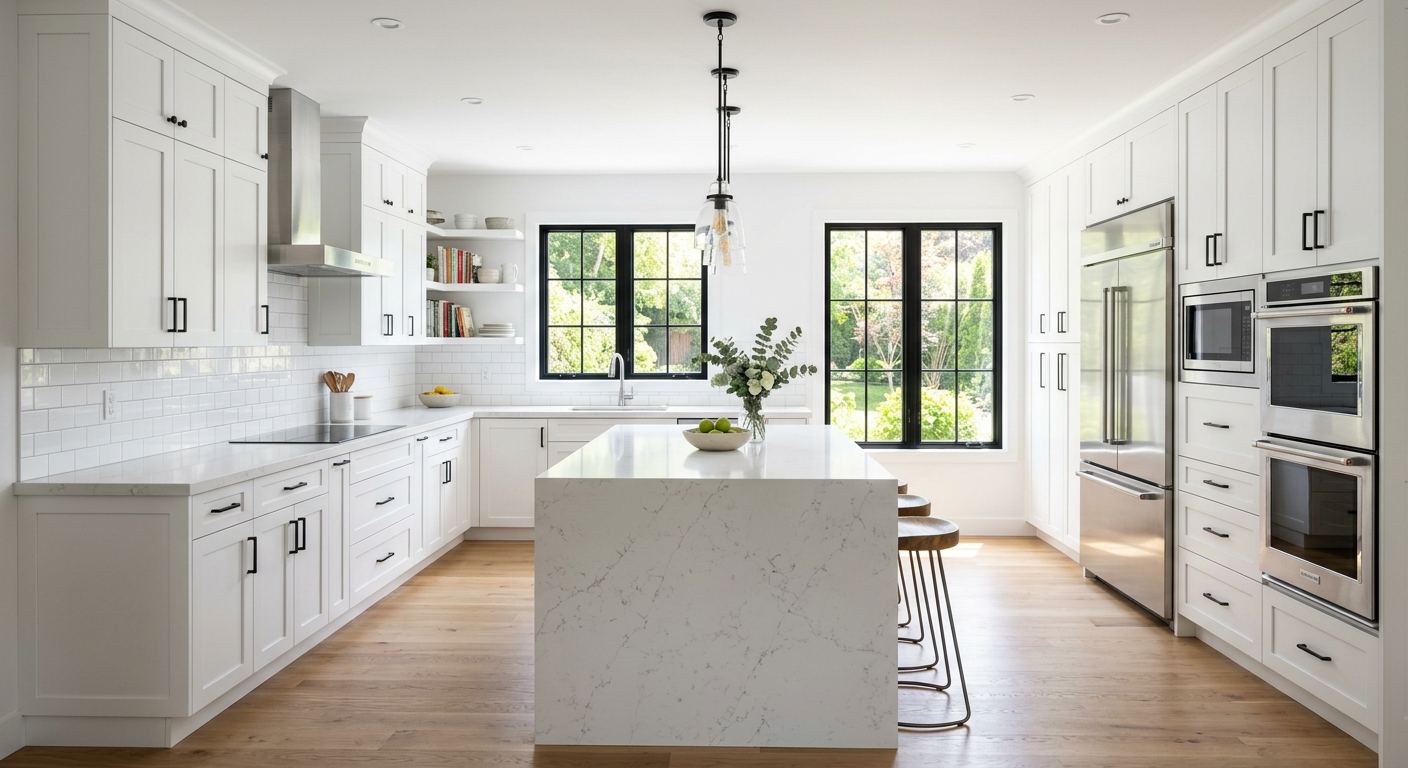
In Wild Rose (with buyer preferences pulled from the broader Calgary market), the most common “safe bet” styles are modern farmhouse and transitional looks—think warmer neutrals, shaker-style cabinet doors, and a mix of matte finishes with brighter task lighting. Quartz counters dominate because they photograph well and handle day-to-day Alberta life with low maintenance. Many homeowners also add a simple statement element—an oversized backsplash section, a contrasting island finish, or an upgraded range hood silhouette—rather than going fully bespoke. When budgets tighten, you’ll still see high consistency: durable surfaces, clean hardware, and updated fixtures. This is why full renovations often cluster in the mid five-figures: you get the cabinetry upgrade and countertop finish buyers expect, while the rest of the design stays practical. The “popular” style isn’t only about aesthetics—it’s about features that feel move-in ready and easy to maintain.