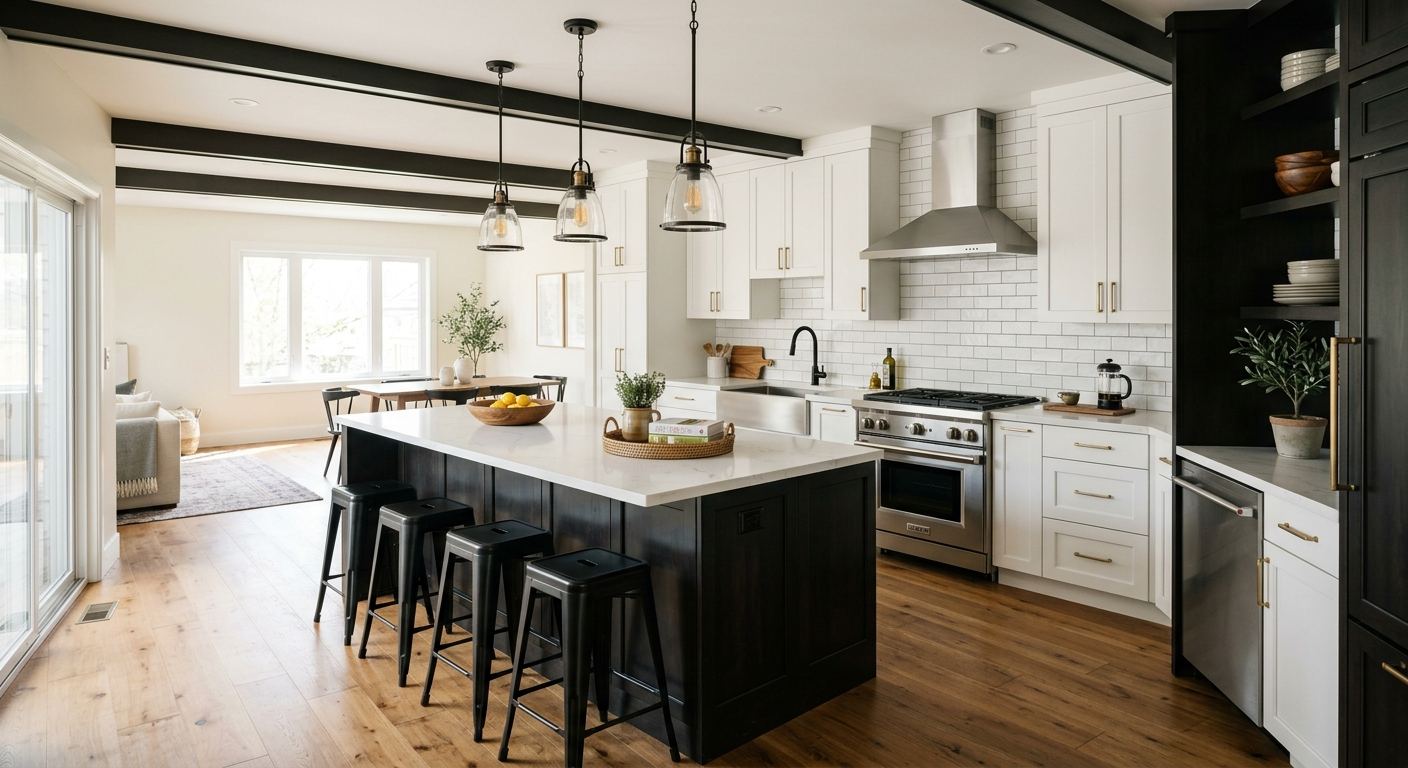
Kitchen renovation options and costs in Whitehorn
In Whitehorn, Alberta, homeowners typically choose between a refresh, a mid-range redesign, or a full high-end rebuild based on how long they plan to stay and what buyers will expect when they resale in Calgary. With Whitehorn’s population of 11,085 (Statistics Canada, 2021 Census), demand is steady enough that you’ll usually find multiple crews available in peak season. Calgary’s broader household profile (Statistics Canada, 2021 Census) also supports a “finish-led” market—meaning many projects move toward quartz or natural stone and upgraded cabinet systems rather than focusing on weatherproofing alone.
In this region, the big drivers are market economics and trade availability. Labour in Calgary is often around $90–$140 per hour, so design time, demolition, and project management can materially change the final total even when materials look similar. Calgary-area renovation costs also track local home values and household incomes: in higher-value pockets, homeowners commonly spend a larger share on durable surfaces and better storage because that’s what protects resale value. Climate plays a secondary role—Alberta’s freeze-thaw cycle matters most for flooring transitions, caulking at countertops, and keeping water management details tight around plumbing—but it doesn’t usually swing a quote by itself.
Within Whitehorn, trades often feel especially busy around the busier retail-and-transit corridors where contractors can access staging and deliveries more efficiently, so schedule windows can tighten when multiple kitchens are underway. Below is a practical comparison of the main renovation tiers so you can line up quotes against the scope before you start comparing contractors.
| Renovation Tier |
What's Included |
Typical Duration |
Price Range |
| Cosmetic refresh (paint, hardware, new appliances only) |
Cabinet paint or stain refresh, hardware change, new appliance drop-in, minor caulking, touch-up trim |
1–3 weeks |
$8,000–$18,000 |
| Mid-range full renovation (new cabinets, counters, sink, tile) |
New cabinets (semi-custom or quality stock), countertop install, sink + faucet, backsplash tile, flooring repairs, plumbing re-connects |
4–8 weeks |
$25,000–$55,000 |
| High-end full renovation (custom cabinets, stone counters, island) |
Custom cabinets, quartz/natural stone with higher profiles, island build, integrated lighting, upgraded plumbing/electrical rough-in, premium backsplash (tile to slab feature) |
8–16 weeks |
$70,000–$120,000 |
| Cabinet refacing only (new doors + drawer fronts, same boxes) |
Refacing on existing layout, new doors/drawer fronts, new hardware, paint/finish of refaced surfaces, often includes minor trim updates |
2–5 weeks |
$8,000–$35,000 |
| Countertop swap only (laminate to quartz or stone) |
Remove old top, template, quartz/stone install, re-seat sink/cooktop (if staying in place), new caulking and edge finishing |
1–2 weeks |
$3,000–$12,000 |
| Backsplash tile installation only |
Tile layout and install, edge trims, grout/seal where needed, basic prep and cut-ins around outlets |
3–7 days |
$2,500–$8,000 |
Prices are estimates only and vary by project scope, site access and material selection.
What affects the price of kitchen renovation in Whitehorn
Even when two homeowners in Whitehorn describe the “same kitchen,” Calgary-area quotes can differ by 30–50% because the hidden scope—labour hours, trades scheduling, and what’s actually being replaced—rarely matches perfectly. Local home values and income levels strongly shape which finish tier a homeowner chooses. In higher-value markets around Calgary, homeowners often default to quartz or stone counters and semi-custom cabinetry because buyers expect that level of durability and it’s easier to recoup in resale. In more modest finish tiers, laminate and stock boxes dominate to protect the budget and keep ROI realistic.
Layout changes are where cost becomes most unpredictable across Alberta. Removing a wall, adding an island, or moving plumbing or gas lines means new rough-ins, inspections, and additional skilled labour—pushing work into the higher middle of the $25,000–$55,000 band quickly. Conversely, if you keep your sink and stove in the same footprint and focus on surfaces, you can often stay closer to a counter-first scope like $3,000–$12,000 for a countertop swap plus manageable tile and trim changes.
Concrete Whitehorn examples: (1) older kitchens often have out-of-square walls, which increases shimming and increases labour time for cabinetry installs; (2) if your backsplash is tiled to the ceiling in one spot and painted in another, prep and surface leveling can add hours before tile goes in; (3) kitchens with exterior walls can have more temperature swings, so properly sealing joints around sinks and along countertop edges matters—redoing bad caulking later is expensive, even if it’s “small” work. That’s why contractors price the prep phase carefully and why electrical add-ons—like under-cabinet lighting and additional outlets—can quietly add up at Calgary’s typical trade rates.
| Price Factor |
Why It Matters |
Cost Impact |
| Cabinet tier — stock vs. semi-custom vs. fully custom millwork |
Higher tiers cost more per linear foot and often require more carpentry time for perfect fit |
Can shift a mid-range job into the $25,000–$55,000 or higher end depending on scope |
| Countertop material — laminate vs. quartz vs. granite vs. stone |
Material and install complexity (templates, edge profiles, sink cut-outs) changes labour and material cost |
Laminate tends to be lowest; quartz/stone commonly pushes into the $3,000–$12,000 countertop band |
| Layout change — wall removal, island add, plumbing/gas move |
Rough-in work adds inspections, scheduling, and demolition/restoration |
Often the biggest swing factor; can add weeks and move budgets toward the top of full-reno pricing |
| Appliance package tier — builder vs. mid-range vs. pro-grade |
Different sizes, venting needs, and connection requirements affect install time |
Can add thousands even if cabinetry and counters stay the same |
| Flooring — refinish existing vs. full replacement |
Refinishing is faster and cheaper if subfloors are sound; replacement is required when damage or unevenness exists |
Refinish usually holds cost down; replacement adds demo + install labour and materials |
| Backsplash — ceramic tile vs. marble vs. full-height slab |
Harder materials and more coverage increase cutting, labour time, and waste |
Tile-only typically fits $2,500–$8,000; premium choices push toward the upper end |
| Electrical — new circuits for island, under-cabinet lighting |
Additional breakers, outlets, and lighting add licensed electrician time and permit steps where required |
Common “hidden” cost driver that increases labour and trade coordination |
| Permit fees and licensed trade requirements |
When plumbing, gas, structural changes, or new electrical circuits are involved, permits/inspection and licensed work become non-negotiable |
Adds cost and schedule certainty; typically raises overall budget even when finishes are unchanged |
Permits & regulations in Alberta
In Alberta, a simple cabinet and countertop swap is typically permit-free because you’re not altering the plumbing, gas, electrical circuits, or structure. However, permits and licensed trades are usually required when your scope touches the home’s systems or structure—particularly when you change where water, waste, gas, or electrical power runs. If you’re in Whitehorn and your renovation includes removing a load-bearing wall or making changes to the framing/opening, that’s also in the “permit and engineered verification” territory.
Here’s a practical breakdown of what DOES and DOES NOT typically require permits:
- Typically no permit: replacing countertops in the same footprint, installing new cabinet boxes/doors, backsplash tile, painting, and swapping hardware and fixtures that connect using existing supply/drain points.
- Typically requires permits and licensed trades: moving sink supply/drain lines, relocating a gas stove or changing a range hood venting approach, adding or moving electrical circuits (for example: new under-cabinet lighting circuits or adding power for an island), and removing or altering a load-bearing wall.
Step-by-step, verify your contractor: (1) confirm their Alberta licence details through the relevant online registry and ask for the licence number; (2) request a current certificate of insurance (liability) and verify coverage limits; (3) ask for confirmation of WSIB/WCB coverage for workers—before you sign—so you’re not exposed if labour-related incidents occur. For job risk control, require that permit responsibility and who pulls permits are explicitly stated in the written contract, including inspections and any required documentation.
Cabinets, countertops and layout decisions in Whitehorn
When you renovate in Whitehorn (and across the Calgary resale market), three decisions control most of your satisfaction and resale value: (1) cabinet tier (stock, semi-custom, or custom), (2) countertop material (laminate, quartz, granite, butcher block, or marble), and (3) layout changes (open-concept wall removal, island addition, or plumbing/gas relocation). Alberta’s climate—cold winters and large temperature swings—doesn’t usually determine the counter choice directly, but it does influence how critical it is to get moisture management right at sinks and to keep joints properly caulked so water doesn’t migrate behind finishes.
Cabinet tier is about fit and longevity. Stock is fastest and usually best if you want a cosmetic upgrade. Semi-custom is the most common “best balance” for families in Calgary economic-region markets because it offers better storage planning and nicer finishes than stock without the full premium of bespoke millwork. Custom cabinets are most justified when you need unusual dimensions, a specific appliance plan, or you want an island layout that’s perfectly proportioned.
Countertop choice is about maintenance as much as durability. Quartz is popular because it resists staining and typically needs less day-to-day care than granite or marble. Laminate can look great at first, but it’s more susceptible to damage along edges and seams over time. Butcher block offers warmth but needs regular sealing, and marble is beautiful but demands careful cleaning and protection from etching.
Layout changes should be driven by space. If you keep plumbing and gas in the same location, you can often stay closer to a counter-focused budget (for example, $3,000–$12,000 for countertops plus controlled tile). If you add an island or relocate a gas line, the cost increase is only worth it when the improved workflow meaningfully changes the usable space for everyday living and future buyers.
| Option |
Durability |
Maintenance |
Best For |
Price Range |
| Stock cabinets (big-box) |
Good for standard layouts; less forgiving for non-standard walls |
Basic care; rely on hardware upgrades for “feel” |
Fast refreshes and tighter budgets |
$8,000–$20,000 |
| Semi-custom cabinets (local dealer) |
Better construction and finish options; stronger fit on site |
Low to moderate; choose quality hinges and slides |
Most mid-range Calgary resale expectations |
$20,000–$45,000 |
| Custom cabinets (local millwork shop) |
Highest fit and finish; tailored storage and mouldings |
Low care; premium finishes can be more consistent |
Unique layouts, islands, and high-end upgrades |
$45,000–$90,000 |
| Laminate countertop |
Moderate; sensitive at seams and edge damage |
Wipe clean; avoid cutting directly and keep edges protected |
Budget-first renovations |
$3,000–$6,000 |
| Quartz engineered countertop |
High; resists staining and everyday wear |
Low; normal cleaning with non-abrasives |
Durability-focused families and strong resale appeal |
$5,500–$10,500 |
| Granite / natural stone countertop |
Very durable; natural variation in hardness and appearance |
Periodic sealing depending on stone and finish |
Premium look with natural character |
$6,000–$12,000 |
| Butcher block countertop |
Good if cared for; can scratch and dent |
Regular oiling/sealing; protect from prolonged water exposure |
Warm, farmhouse-style kitchens |
$4,000–$8,000 |
| Marble countertop |
Beautiful but can be softer; more prone to etching |
Higher care; clean gently and protect from acidic spills |
Designer aesthetic for low-abuse settings |
$8,000–$14,000 |
How to choose a kitchen renovation contractor in Whitehorn
For a kitchen renovation in Whitehorn, start by verifying Alberta compliance and protection. Ask for the contractor’s licence details (where applicable for the trade activities they perform), proof of liability insurance, and confirmation of WSIB/WCB coverage for their workers. How to check: request certificate documents directly and verify the policy is current (dates and coverage limits), confirm the certificate lists your contractor’s legal name, and ask who provides coverage for subcontractors. If they can’t provide documentation quickly, that’s a major risk signal.
Then get 2–3 itemised written quotes. You want a breakdown that separates labour and materials (including cabinetry, countertops, backsplash, plumbing/electrical allowances, and disposal). A good quote also states whether permits are included, who pulls them, and what exclusions apply—like whether removal and disposal are included, whether wall repair/paint is part of scope, and whether floor transitions are included at the kitchen threshold.
Warranty matters. Look for a workmanship warranty length (often 1–2 years for labour, but confirm the exact term), plus the product/manufacturer warranty for cabinets, countertops, and tile. Ask whether the warranty is transferable if you sell the home.
Payment schedule: never pay more than 10–15% upfront. Hold back funds until key milestones are complete—especially after countertop templating/installation and after the final electrical/plumbing connections are inspected and tested. Finally, timeline: require a written start date and completion estimate, along with a process for schedule changes when materials arrive late.
- Provide licence/insurance/WSIB/WCB documentation before you sign.
- Quotes must be itemised with labour + materials, not a single lump sum.
- Scope includes demo, disposal, and any drywall repair and paint touch-ups.
- Clarify what happens if you discover hidden damage behind existing cabinetry.
- Confirm whether permits are included and who pulls them.
- Include allowances for plumbing/electrical changes even if “minimal.”
- Specify countertop templating timing and responsibility for measurement accuracy.
- Get the cabinet lead-time in writing (especially for custom or semi-custom).
- Warranty terms in writing: labour coverage period and product warranty details.
- Payment milestones tied to completion stages; no large upfront deposits.
- Project manager name and daily site contact method listed.
- Clean-up expectations documented (dust control, protection, final sweep).
Red flags specific to kitchen renovations in Whitehorn: (1) the contractor won’t provide current insurance and WSIB/WCB proof; (2) the quote excludes permits but doesn’t mention it in writing—then you’re asked to pay later; (3) they won’t itemise allowances for plumbing/electrical changes; (4) they push for a high deposit (over 10–15%); or (5) they start demolition before confirming countertop templating dates, which can strand your kitchen unfinished for weeks.
Frequently asked questions — kitchen renovation in Whitehorn
Should I reface or replace my cabinets?
In Alberta, cabinet refacing is often the smarter move when the existing boxes are solid, straight, and well-fixed to the framing. Refacing can deliver a major visual upgrade without the full demolition and re-install labour, which is why many homeowners target it when they want to stay closer to the cabinet band of $8,000–$35,000. Replacement is usually better if your boxes are damaged from past leaks, the layout no longer fits your storage needs, or your doors and drawers can’t be reworked to correct poor spacing. In Whitehorn, kitchens in older homes sometimes have out-of-square walls; if your current cabinetry sits poorly, a full replacement with correct shimming and trim alignment can look better and last longer. A contractor should confirm box condition in an on-site assessment before you decide.
Do I need a permit for a kitchen renovation in Alberta?
In most cases in Alberta, a straightforward countertop swap and cabinet work don’t require a permit because you aren’t changing the home’s systems. However, permits are typically required when you move plumbing (sink supply/drain), relocate gas appliances or associated venting, or add/move electrical circuits (for example, new island receptacles or a new lighting circuit). If you’re removing a load-bearing wall, that also triggers additional approvals and inspections. For Whitehorn homeowners, the key step is to confirm who pulls permits in your signed contract—don’t rely on verbal assurances. When in doubt, ask whether your electrician or gas fitter will handle permits and inspection requests, and ensure those are documented so your renovation doesn’t stall at inspection time.
What's the ROI on a kitchen renovation?
ROI in the Calgary economic region is influenced more by finish tier and layout desirability than by weather performance. Homes in higher-value Calgary-style markets tend to reward kitchens that look modern, feel durable, and have updated storage and surfaces—especially quartz or natural stone counters and upgraded cabinetry hardware. In practical budgeting terms, many homeowners who refresh without major changes can protect value while keeping costs controlled, while full redesign projects can align with the mid five-figure to six-figure range depending on scope (for example, full kitchen renovations often cluster around $25,000–$100,000). If you spend heavily but don’t improve workflow (like adding an island where it actually helps, or fixing a cramped traffic path), resale benefit may be limited. The best ROI typically comes from matching what buyers expect at your home’s price point, not from “upgrading everything” regardless of layout.
How do I budget for a kitchen renovation?
A solid approach for Whitehorn is to budget by scope tiers first, then add realistic allowances. Start with the total project band you’re aiming for: cosmetic upgrades can fall around the lower end of the full project universe, while mid-range full renovations typically sit around $25,000–$55,000, and higher-end redesigns can climb toward the upper end of $70,000–$120,000 when layouts change or premium stone and custom cabinetry are selected. Next, allocate contingency (commonly 10–15%) for surprises such as old plumbing rough-ins, out-of-square walls, or subfloor repairs. Finally, don’t forget the “system” costs: electrical circuits, plumbing adjustments, and any required permits can raise the budget even if the finishes stay the same. Ask for an itemised quote so you can see where your dollars are going before you commit.
Can I move my kitchen sink or stove?
Yes, but moving a sink or stove is where kitchens in Alberta shift from a straightforward renovation to a systems project. Moving a sink usually means changing supply and drain lines, which typically requires permits and licensed plumbing work. Moving a stove depends on whether you’re relocating gas lines and how venting is managed; gas work must be performed by a licensed gas fitter, and inspections are standard for that kind of change. If you keep the sink or stove in the same general location, you can often limit extra labour and stay closer to countertop and tile budgets. In Whitehorn, kitchens sometimes have constrained cabinet walls and older rough-in routes, so the “move” can cost more than expected if demo reveals hidden issues. A good contractor will assess your existing rough-in locations and share the trade-off clearly before you approve the change.
What's the most cost-effective kitchen upgrade?
For many Whitehorn homeowners, the most cost-effective upgrade is a blend of what looks high-end and what stays within your workflow. If your cabinet layout is functional and boxes are in good shape, a countertop swap to quartz or natural stone can create a dramatic “new kitchen” effect without the demolition of a full replacement—often in the $3,000–$12,000 countertop band. Adding a backsplash is another relatively efficient upgrade when the wall is prepared properly, commonly around $2,500–$8,000 for tile installation. If you want one-step improvement with strong day-to-day impact, upgraded hardware and under-cabinet lighting can also feel transformative, but the biggest visual payoff usually comes from counters and the backsplash “frame.” Choose finishes that match the local Calgary buyer expectation—durable, cleanable, and modern—so your upgrade reads well for resale.