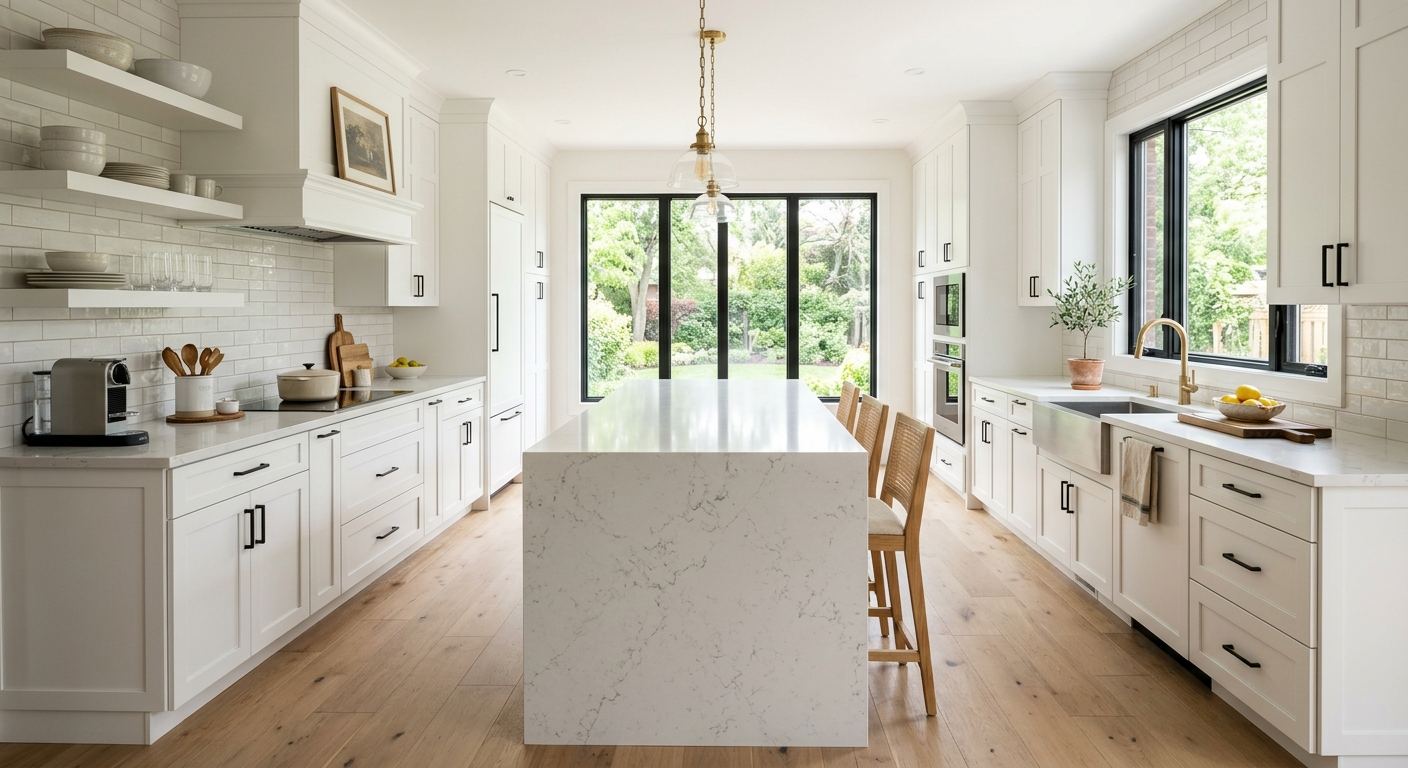
Kitchen renovation options and costs in Smoky Lake
Smoky Lake homeowners typically start their kitchen planning by matching what they want to keep with what they’re willing to replace. With a median household income of $61,600 (Statistics Canada, 2021 Census) and 73.9% of households owning their homes, many buyers in town are renovating for everyday comfort first, then for resale value. In Wood Buffalo–Cold Lake, that “value recovery” mindset is strong: higher-end finish choices are often selected when the overall home value can support it, while more modest budgets lean toward practical updates that still modernize the room.
Cost is also influenced by the realities of the regional market. Contractor availability can tighten outside core hubs, so schedule certainty, material lead times, and how quickly site prep can be done affect final pricing. Climate matters too—Alberta’s freeze-thaw cycles and indoor temperature swings place extra stress on caulking, sink sealing, and grout lines, so good waterproofing prep and durable backsplash/tile installs reduce callbacks. In neighbourhoods around the downtown Smoky Lake core and the older residential pockets built before 1981 (70.5% of homes in the area), you’ll commonly see service upgrades, flooring adjustments, and careful wall/trim detailing before new cabinets go in.
Below is a practical way to compare renovation tiers before you request quotes, starting with a simple refresh and moving up to high-end custom millwork.
| Renovation Tier |
What's Included |
Typical Duration |
Price Range |
| Cosmetic refresh (paint, hardware, new appliances only) |
Paint/trim touch-ups, new cabinet hardware/hinges, appliance swap (no cabinet moves), basic deep clean |
1–2 weeks |
$18,000–$28,000 |
| Mid-range full renovation (new cabinets, counters, sink, tile) |
Semi-custom/stock cabinetry, new countertops, sink & faucet, backsplash tile, new flooring or refinishing as needed |
3–7 weeks |
$28,000–$45,000 |
| High-end full renovation (custom cabinets, stone counters, island) |
Fully custom cabinetry, premium stone counters, island build, upgraded appliance package, full-height or premium backsplash, upgraded lighting |
6–12 weeks |
$45,000–$70,000+ |
| Cabinet refacing only (new doors + drawer fronts, same boxes) |
Reface system with new doors/drawer fronts, new hardware, optional interior organizers, repaint/prepare boxes |
2–4 weeks |
$6,000–$20,000 |
| Countertop swap only (laminate to quartz or stone) |
Remove old surface, new quartz/stone install, new sink cut-out as needed, caulking and edge finishing |
3–10 days |
$3,500–$12,000 |
| Backsplash tile installation only |
Tile supply/installation, surface prep, thinset/grout, sealing as required |
3–7 days |
$2,500–$9,000 |
Prices are estimates only and vary by project scope, site access and material selection.
What affects the price of kitchen renovation in Smoky Lake
Across Wood Buffalo–Cold Lake and the broader Alberta market, homeowners can see the same kitchen renovation end up 30–50% apart once you separate finish tier from the “hidden” construction work. The biggest drivers are local home value and household income shaping what finish level is expected: when buyers can comfortably support premium choices, contractors price accordingly for quartz or natural stone counters and semi-custom cabinetry. In more modest bands, laminate and stock cabinetry remain common because they deliver a strong refresh without over-committing—especially when the layout is staying put.
Climate influences how long finishes should last, but it rarely beats cabinetry grade and layout work as a cost driver. For example, in older Smoky Lake homes (70.5% built before 1981), you may encounter shifting subfloors, dated plumbing rough-ins, or walls that aren’t perfectly square. That can push labour up during cabinet installation and increase tile prep time. If the project targets a mid-range budget (for example, $28,000–$45,000), you can often keep costs predictable by selecting durable, well-sealed tile and modern cabinet systems. If you move into a high-end scope (around $45,000–$70,000+), island construction, premium stone edges, and upgraded electrical/lighting become standard, and the material lead times widen too.
Two practical examples that commonly raise costs in Smoky Lake: moving a sink location typically forces plumbing supply/drain changes, and adding an island often triggers new electrical runs and sometimes different venting considerations. Conversely, if you keep the sink under the existing drain line and choose quartz over stone, you can usually stay closer to the lower end of countertop installation ranges ($3,500–$12,000) without sacrificing appearance.
| Price Factor |
Why It Matters |
Cost Impact |
| Cabinet tier — stock vs. semi-custom vs. fully custom millwork |
Materials, construction, door style options, internal organizers, and how precisely units fit the room |
Largest swing; commonly drives major differences within a single renovation tier |
| Countertop material — laminate vs. quartz vs. granite vs. stone |
Material price, edge complexity, thickness, and how much labour is needed to support/join long runs |
Can shift countertop totals across the $3,500–$12,000 band and beyond for premium stone/edges |
| Layout change — wall removal, island add, plumbing/gas move |
May require structural considerations, new rough-ins, and additional finish carpentry and patching |
Often creates the biggest unpredictability; adds trades and inspection requirements |
| Appliance package tier — builder vs. mid-range vs. pro-grade |
Different electrical requirements, venting needs, finishes, and installation complexity |
Moderate to high; upgrades can widen the budget even if cabinetry stays the same |
| Flooring — refinish existing vs. full replacement |
Subfloor condition, moisture resistance, and how flooring ties into cabinet bases |
Can add or reduce labour depending on whether flooring is disturbed during demo |
| Backsplash — ceramic tile vs. marble vs. full-height slab |
Surface prep, cutting, pattern alignment, and sealing requirements |
Backsplash typically lands in the $2,500–$9,000 range depending on coverage and material |
| Electrical — new circuits for island, under-cabinet lighting |
New power points, lighting runs, and code-compliant placement of outlets |
Can add significant labour/material if circuits must be extended |
| Permit fees and licensed trade requirements |
Certain work triggers permits/inspections, and certified trades affect scheduling and documentation |
Cost rises when rough-in work expands beyond simple swap-in scopes |
Permits & regulations in Alberta
In Alberta, many “swap” projects are straightforward from a permitting standpoint. Cabinet and countertop replacements typically do not require permits when you are keeping plumbing and gas in the same location and not changing the building structure. Likewise, finishing work such as painting, hardware replacement, and most backsplash installs generally proceed without permits as long as you’re not altering rough-ins or electrical service.
Permits and licensed trades usually come into play when you move or create new infrastructure. That includes moving plumbing supply or drain lines, relocating a sink, changing a gas stove/range location, or adding/relocating a range hood that involves gas venting. Removing a load-bearing wall (or doing any structural modification) also requires the appropriate permits and professional sign-offs. Electrical work such as adding new circuits for an island, installing hardwired under-cabinet lighting, or adding dedicated outlets commonly requires permits and work by a licensed electrician, followed by inspections. Gas work must be performed by a licensed gas fitter with inspection where required.
For a homeowner in Smoky Lake, verification should be methodical: (1) ask the contractor for their current Alberta licence documentation and proof of liability insurance; (2) confirm coverage details on the certificate of insurance (make sure it’s current and matches the contractor name); (3) request evidence of WSIB/WCB coverage where applicable—your contractor should provide documentation on request; and (4) ensure permit responsibility is spelled out in writing before you sign. If the quote is vague, that’s a red flag.
Cabinets, countertops and layout decisions in Smoky Lake
In Smoky Lake, your three biggest cost-and-satisfaction levers are: (1) cabinet tier, (2) countertop material, and (3) layout changes. Cabinet tier determines fit, longevity, and how “custom” the kitchen feels. Stock cabinets are typically the fastest and cheapest path, semi-custom is the most common mid-range choice in our region, and custom cabinets give the tightest fit for older home walls, but at the highest cost. For countertops, laminate is budget-friendly but less heat- and scratch-resistant than higher grades. Quartz is popular because it resists staining and holds up well to everyday use in busy households. Granite/natural stone looks premium but may require more care and is priced higher for supply and installation. Butcher block adds warmth and can be very workable for families, but you’ll treat and maintain it to protect the surface.
Then there’s layout. An open-concept wall removal or moving plumbing/gas can be justified when you’re gaining usable space, improving workflow, or fixing an awkward existing layout. But if your goal is modernization on a predictable budget (for example, staying in the $28,000–$45,000 mid-range band), keeping sink and cooktop near current rough-ins usually saves the most. In the Wood Buffalo–Cold Lake resale market, buyers often expect durable surfaces, modern lighting, and cabinetry that looks aligned and square—an especially important point in older Smoky Lake homes built before 1981 (70.5%).
Concrete example: if you’re choosing between laminate and quartz on a typical countertop run, the material upgrade often nudges the project toward the upper side of the countertop-only range ($3,500–$12,000) but can still be cheaper than expanding into a full layout change. A quartz swap with no plumbing move can deliver a high-impact visual upgrade without triggering the highest unpredictability costs that come from relocating drain lines or adding island electrical.
| Option |
Durability |
Maintenance |
Best For |
Price Range |
| Stock cabinets (big-box) |
Solid for normal use; fit depends on room squareness |
Low; wipe-clean surfaces and periodic hardware tightening |
Fast timelines and tighter budgets |
$6,000–$18,000 |
| Semi-custom cabinets (local dealer) |
Very good longevity; better sizes and options |
Low; maintain hinges/adjustments and keep interiors dry |
Most renovations aiming for strong value |
$15,000–$30,000 |
| Custom cabinets (local millwork shop) |
Excellent; tailored to wall conditions and storage needs |
Low to moderate; depends on finish type |
Complex layouts, older homes, and premium finishes |
$25,000–$45,000+ |
| Laminate countertop |
Good for day-to-day, but more prone to chips and heat marks |
Wipe-clean; avoid hot pans directly on the surface |
Budget refreshes where you’re changing mostly visuals |
$3,500–$7,000 |
| Quartz engineered countertop |
Very durable; resistant to staining and normal scratching |
Low; typical countertop cleaning |
Families wanting a “set it and forget it” surface |
$6,000–$10,500 |
| Granite / natural stone countertop |
Durable and heat-resistant; variability by slab |
Seal periodically if required by the stone |
Premium look with natural variation |
$7,500–$12,000 |
| Butcher block countertop |
Very tough when maintained; can show wear faster without care |
Oil/condition regularly; manage moisture around sink edges |
Warm, farmhouse-style kitchens and frequent cooking |
$5,000–$9,500 |
| Marble countertop |
Beautiful but more susceptible to etching and staining |
Moderate; requires careful cleaning and sealing |
Low-abuse premium kitchens and a high visual priority |
$10,000–$18,000 |
How to choose a kitchen renovation contractor in Smoky Lake
Choosing the right contractor in Smoky Lake starts with proof, not promises. First, verify Alberta licensing and trade credentials where the scope touches permits: confirm the electrician’s licence for new circuits and the gas fitter’s licence for any gas-related changes. Ask for liability insurance documentation (current certificate) and evidence of WSIB/WCB coverage where applicable. Then, confirm that coverage names align with the contractor you’re paying.
Next, get 2–3 itemised written quotes—not lump sums—so you can compare labour and materials line-by-line. A solid quote should list cabinetry supply (including brand/tier), countertop material and thickness, backsplash tile quantity/coverage, disposal, protection for floors during demo, and what’s included for electrical/plumbing work. Pay attention to exclusions: “patch and paint” may be limited, and disposal might be an add-on. Permits, inspections, and whether the contractor pulls the permit should be explicitly stated.
Warranty matters in real kitchens. Ask for workmanship warranty length, product/manufacturer warranty terms, and whether warranties are transferable if you sell your home. For payment scheduling, avoid heavy upfront deposits—generally aim to keep it around 10–15% upfront and use holdback until key milestones are complete (finish carpentry, countertop install, final tile grouting, and final electrical/gas sign-offs). Finally, require a start date and a completion estimate in writing, accounting for typical material lead times for cabinetry and stone slabs.
- Request licence numbers and trade documentation for any permitted scope.
- Verify liability insurance is current and ask for a certificate of insurance.
- Confirm WSIB/WCB coverage evidence (ask for documentation, not just verbal assurances).
- Get 2–3 itemised quotes with labour and materials broken out.
- Ask what disposal includes (demo only vs. off-site hauling and dump fees).
- Clarify protection and cleanup (floor covering, dust control, and final clean).
- Check backsplash scope: tile type, grout type, sealing, and whether it’s full-height.
- Verify cabinet specs: tier (stock/semi-custom/custom), finish type, and hardware included.
- Confirm countertop details: slab thickness, edge profile, sink/cooktop cut-outs.
- Review electrical scope: under-cabinet lighting, switch locations, and outlet count.
- Confirm warranty: workmanship duration and whether it covers rework due to installation defects.
- Use a milestone-based payment schedule with holdback until final inspection-ready completion.
Red flags in Smoky Lake include: quotes that are vague on what materials/tiers you’re actually getting, major scope items missing (electrical/plumbing/disposal/backsplash grout), no written start/completion timeline, pressure to pay more than 15% upfront without milestones, and refusal to provide insurance/licence/coverage documentation.
Frequently asked questions — kitchen renovation in Smoky Lake
What's the most cost-effective kitchen upgrade?
In Smoky Lake, the most cost-effective upgrades are usually “high-impact, low-disruption” changes—things that refresh the look without triggering new plumbing or electrical work. For many homeowners, that means modernizing fronts and finish details (hardware, paint) and upgrading one key surface like countertops or backsplash. If you want a clear budget example, a countertop swap only typically lands around $3,500–$12,000, and that can dramatically change the kitchen’s appearance even when cabinets stay. If you’re aiming at a broader refresh tier, a mid-range renovation (new cabinets, counters, sink, tile) often falls in the $28,000–$45,000 band, but you can sometimes reduce cost by keeping the layout and sink/drain locations as-is. Also factor in older home realities: 70.5% of homes built before 1981 can mean extra prep time if walls aren’t perfectly square.
Custom vs stock cabinets — is custom worth it?
Custom cabinets are “worth it” when you have a layout challenge, uneven walls, unusual dimensions, or you want specific storage features that stock can’t match. In Smoky Lake, many kitchens sit in homes built before 1981 (70.5%), where tolerances can be off and floors/walls aren’t perfectly straight—custom or semi-custom tends to look better because it fits the space instead of forcing the space to fit the cabinets. If you’re budget-focused, stock cabinets can be the lowest-cost path and are usually faster to order, but you may see more gaps or the need for additional trim. A common approach in Wood Buffalo–Cold Lake is semi-custom as the compromise: it delivers a more “tailored” look while keeping labour and material costs more controlled. If you compare renovation tiers, moving into a high-end scope ($45,000–$70,000+) often aligns with custom millwork and premium stone—otherwise, you can spend that money on quartz/lighting instead for similar visual payoff.
How do I choose a kitchen contractor in Smoky Lake?
Start by verifying Alberta licensing and coverage. Ask the contractor for proof of liability insurance and documentation for WSIB/WCB coverage where applicable. For any permitted electrical or gas-related scope, confirm the work will be done by the correct licensed trades (licensed electrician for electrical work; licensed gas fitter for gas work). Next, request 2–3 itemised written quotes that separate labour and materials. A good kitchen quote should spell out what’s included (cabinet tier/finish, countertop material, backsplash coverage, disposal, protection during demo, and whether permits are handled). In Smoky Lake, ask how they deal with older-home prep—uneven walls and floor height changes are common. Finally, check warranty terms and payment schedule: avoid paying more than 10–15% upfront and use holdback until completion and any required inspections are done.
What order do kitchen renovation steps happen in?
Typically, kitchens in Smoky Lake follow a predictable sequence. First comes site protection, then demo and removal of old finishes. Once the room is open, the contractor verifies wall/floor condition and addresses any needed framing or subfloor corrections—especially important in older homes. Next, rough-ins are completed if you’re changing plumbing/gas/electrical (this is where permits and inspections can come in). After rough-ins pass, cabinets go in, followed by countertop templating and installation. Then flooring transitions, backsplash tile install, and final paint/trim touch-ups are completed. The last steps usually include appliance installation, caulking/sealing checks around sinks/counters (important for Alberta’s freeze-thaw conditions), and a final walkthrough. Your specific order can shift based on countertop lead times and whether the job includes an island or moving services.
Can I live at home during a kitchen renovation in Smoky Lake?
Often yes, but it depends on how invasive the work is and your household setup. If you’re doing a cosmetic refresh or a smaller scope like backsplash tile or countertops only, many homeowners stay put. For a mid-range full renovation ($28,000–$45,000), living at home is possible if there’s a workable temporary kitchen arrangement and dust control is strong—expect a partial shutdown of the main prep/cook space during demo and cabinet installation. If you’re going high-end with custom cabinets and an island, or you’re moving plumbing/gas and adding new electrical circuits, it’s usually harder to stay comfortable because the kitchen area can be non-functional for longer stretches. In Alberta, cold weather can also affect drying/curing times for certain adhesives, paints, and sealants, so ask your contractor for a realistic timeline and whether they plan dust barriers and a temporary food setup.
Should I renovate my kitchen before selling in Smoky Lake?
Renovating before selling can help, but it needs to match the buyer expectations for your neighbourhood and price point. Smoky Lake has a high share of owner households (73.9% own, Statistics Canada, 2021 Census), and many buyers prioritize a kitchen that feels modern, bright, and durable rather than “trendy only.” Durable upgrades that typically appeal include updated cabinets/finishes, quartz countertops, and a clean backsplash. If your budget is constrained, focus on “sale-friendly” improvements like a countertop swap (often $3,500–$12,000) and a well-installed backsplash ($2,500–$9,000) before considering full cabinet replacement. If you’re contemplating a full renovation, align your spend to the likely buyer band—high-end custom kitchens can push well into the $45,000–$70,000+ territory, which may not be fully recovered unless the rest of the home supports that finish level. A contractor can help you choose an approach that improves showability without overbuilding for local demand.