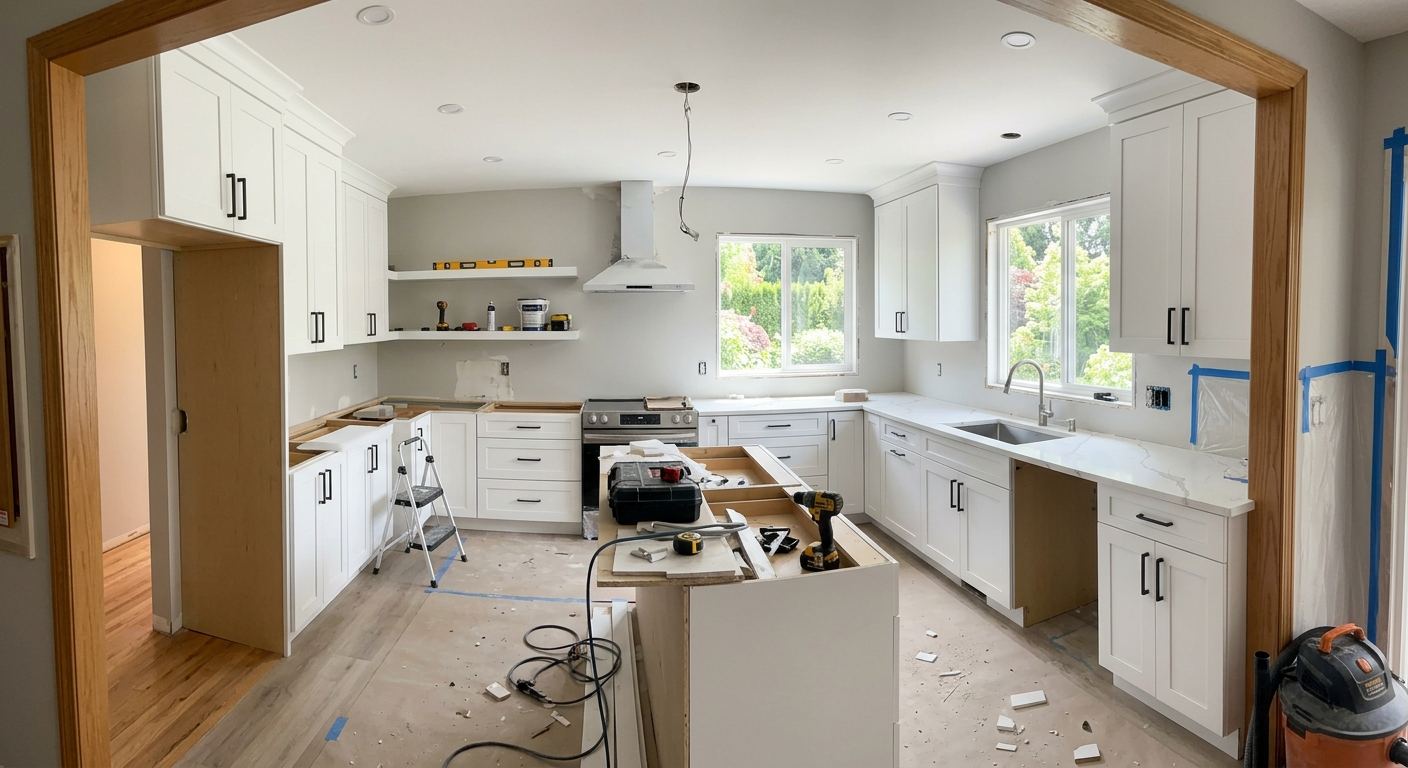
Kitchen renovation options and costs in Ogilvie Ridge
In Ogilvie Ridge, Alberta, kitchen renovations tend to follow the same pattern as the rest of the Calgary economic region: the “right” option is usually the one that matches your resale expectations and daily usability, not just the look. With a 2021 population of 1,001 in the local profile, you’ll often find a smaller pool of specialists on the jobsite—so booking schedules can tighten when multiple neighbourhoods are renovating at once (Statistics Canada, 2021 Census). Homeowner expectations also track with the broader Calgary market where household budgets commonly support mid-to-premium finishes; that’s why many projects cluster in the mid five-figures and can move toward six figures when layout changes or walls move. While Alberta’s weather can influence drying times, ventilation, and the handling of adhesives, climate typically affects scheduling more than it changes material pricing. The bigger cost drivers are still labour availability, finish tier (quartz/stone and custom millwork), and how much work touches plumbing/gas and electrical.
In Ogilvie Ridge, trades are especially in demand when homes in nearby established areas of Calgary are in active upgrade cycles—most often for cabinets, countertop templating, and tile work—because those trades get shared across multiple jobs. If you want a predictable plan, start with the renovation “tier” that matches your goals: cosmetic refresh, mid-range full remodel, or a higher-end redesign with an island and upgraded surfaces. Then use the table below to map your scope to realistic timing and budget ranges.
| Renovation Tier |
What's Included |
Typical Duration |
Price Range |
| Cosmetic refresh (paint, hardware, new appliances only) |
Cabinet paint or refinish (if existing finish is suitable), new pulls/hinges, backsplash touch-up, appliance swap (no cabinetry or plumbing changes) |
3–7 days (plus appliance delivery) |
$6,000–$18,000 |
| Mid-range full renovation (new cabinets, counters, sink, tile) |
New semi-custom or quality stock cabinets, countertop installation, new sink and faucet, backsplash tile, flooring refresh or partial replacement, basic electrical allowance |
3–6 weeks |
$25,000–$55,000 |
| High-end full renovation (custom cabinets, stone counters, island) |
Fully custom cabinetry, premium stone/quartz counters, island build (if applicable), upgraded lighting package, more extensive tile work, potential layout refinements |
6–12 weeks |
$60,000–$100,000 |
| Cabinet refacing only (new doors + drawer fronts, same boxes) |
Remove and replace doors/drawer fronts, new hardware, re-seal/finish, repaint where needed; existing boxes reused |
1–3 weeks |
$8,000–$25,000 |
| Countertop swap only (laminate to quartz or stone) |
Measure and template, remove existing tops, install new counters (backsplash may be separate), cut-outs for sink/cooktop adjustments |
1–2 weeks |
$3,000–$12,000 |
| Backsplash tile installation only |
Surface prep, tile install, grout/seal where required, edge finishing and caulking; does not replace countertops |
3–7 days |
$2,500–$8,000 |
Prices are estimates only and vary by project scope, site access and material selection.
What affects the price of kitchen renovation in Ogilvie Ridge
Even when two homeowners ask for the “same” kitchen renovation in the Calgary economic region, quotes can swing by 30–50% because contractors are pricing uncertainty—especially around labour scope, sequencing, and how much hidden work shows up after demolition. In Ogilvie Ridge and across Alberta, home value and household income shape the finish tier far more than climate. In higher-value Calgary-area markets, homeowners tend to default to quartz or natural stone counters and semi-custom cabinetry because buyers often expect that look and it supports easier resale. In more modest markets, laminate and stock cabinetry dominate because the investment is easier to recover on everyday ROI.
Here’s what commonly pushes cost up or down in Ogilvie Ridge specifically. First, older housing stock (common in established pockets) may have out-of-level walls and dated plumbing rough-ins; correcting that can add labour before cabinets ever go in—typically affecting the total mid-range budget of about $25,000–$55,000. Second, if you add or relocate a gas line or move a stove location, you’re paying for permitted licensed work and rework, which often makes a “simple” refresh behave like a full renovation. Third, countertop templating and fabrication timelines can affect scheduling; a delayed template can keep crew downtime on site, which matters when labour runs roughly $90–$140 per hour in Calgary. Layout changes—removing a wall, adding an island, or moving plumbing—are still the biggest unpredictable driver regardless of whether you choose laminate or quartz. That’s why many projects start in the “swap” category (countertops from $3,000–$12,000) but rise quickly once electrical and plumbing updates are needed.
To compare quotes fairly, focus on the factors below: they explain why two contractors can price the same brochure design differently.
| Price Factor |
Why It Matters |
Cost Impact |
| Cabinet tier — stock vs. semi-custom vs. fully custom millwork |
Higher tiers allow better door styles, storage layouts, and fit; they also increase design time and fabrication complexity |
Stock: lowest; semi-custom: moderate premium; fully custom: biggest uplift (often shifts project into higher bands) |
| Countertop material — laminate vs. quartz vs. granite vs. stone |
Material cost, edge profiles, and fabrication methods determine labour effort and installation time |
Laminate typically least; quartz mid-to-upper; natural stone usually higher and more schedule-sensitive |
| Layout change — wall removal, island add, plumbing/gas move |
These changes trigger new rough-ins, inspections, and structural considerations; they also add demo and patch work |
Often the largest variable; can push a job toward full kitchen pricing |
| Appliance package tier — builder vs. mid-range vs. pro-grade |
More advanced models may need better electrical requirements and integration (hoods, ventilation, built-in cut-outs) |
Pro-grade packages add cost and planning time, especially around venting and power specs |
| Flooring — refinish existing vs. full replacement |
Tile/laminate replacement affects demo scope and subfloor prep; removal can expose hidden issues |
Refinish is cheaper; full replacement increases labour and materials substantially |
| Backsplash — ceramic tile vs. marble vs. full-height slab |
Harder materials and larger coverage increase cutting complexity, sealing, and labour |
Full-height slab generally costs more than standard ceramic tile |
| Electrical — new circuits for island, under-cabinet lighting |
New circuits require permitted work and licensed installation; fixture types affect wiring and spacing |
Can add meaningful cost even if cabinets and counters stay the same |
| Permit fees and licensed trade requirements |
Permits and inspections are tied to plumbing/gas/electrical and sometimes structural changes |
Not every job needs them, but when they do, they raise the total and reduce scheduling flexibility |
Permits & regulations in Alberta
In Alberta, some kitchen changes are straightforward, but others require permits and licensed trades—particularly when you touch plumbing, gas, structural elements, or electrical. Generally, cabinet and countertop swaps (including replacing cabinets with the same footprint and installing new tops) typically do not require permits. However, moving plumbing supply or drain lines, relocating a gas stove or range setup (including work connected to a gas line and properly vented range hood situations), removing a load-bearing wall, or adding new electrical circuits for an island or new under-cabinet lighting are the work types that typically do require permits and inspections.
If you’re in Ogilvie Ridge, the easiest way to protect yourself is to build permit responsibility into the written contract before work starts. Step-by-step, verify the contractor’s Alberta licence(s) and coverage like this:
- Ask for company licence numbers and confirm they match the trade scope (gas fitter for gas work; electrician for electrical work).
- Request a certificate of liability insurance showing the policy is current and includes your project as required by the contract.
- Confirm WSIB/WCB coverage (where applicable) and have proof on file—contractors should provide clearance/coverage information upon request.
- Before signing, clarify: who pulls permits, who schedules inspections, and who pays permit fees.
- Get copies of insurance and licence information attached to the proposal or added as an addendum.
Most reputable crews will treat this as standard; if someone resists documenting it, that’s a scheduling and compliance red flag.
Cabinets, countertops and layout decisions in Ogilvie Ridge
For a kitchen renovation in Ogilvie Ridge, the three decisions that most strongly determine your long-term satisfaction (and your resale appeal in the Calgary market) are: (1) cabinet tier, (2) countertop material, and (3) layout changes. Stock cabinets are the fastest and usually the cheapest because they come from standardized sizes and shorter lead times. Semi-custom cabinetry is the popular mid-range choice because you get better storage layouts and style options without fully custom millwork pricing. Custom cabinets cost more, but they can solve awkward bays, unusual wall conditions, and built-in appliance alignment—especially helpful in older homes where walls are rarely perfectly square.
Countertops drive both day-to-day durability and appearance. Laminate is usually the most budget-friendly, but it is more vulnerable to burn marks and can show wear at seams over time. Quartz engineered counters are a strong choice for Alberta households because they’re non-porous and resist staining better than many natural alternatives, while still delivering the “stone look” buyers expect at higher finish tiers. Granite and other natural stones can look exceptional, but they may require sealing and more careful stain management. Butcher block is warm and repair-friendly, though it needs consistent maintenance around moisture and heat.
Layout changes are where costs can jump: removing a wall, adding an island, or relocating plumbing/gas can add the most unpredictable work, regardless of whether you choose laminate or quartz. Still, it can be justified. For example, if your layout change adds an island and upgraded lighting but you keep cabinetry tier at semi-custom, you can often control the spread enough that you stay closer to the mid-range band (roughly $25,000–$55,000). If you jump straight into fully custom millwork plus premium stone and multiple relocations, you’re more likely to land in the higher-end $60,000–$100,000 range.
| Option |
Durability |
Maintenance |
Best For |
Price Range |
| Stock cabinets (big-box) |
Good everyday durability; limited flexibility for unusual spaces |
Low; periodic tightening/cleaning |
Fast refreshes, tighter budgets, predictable timelines |
$8,000–$20,000 |
| Semi-custom cabinets (local dealer) |
Very good durability; better fit, storage options, and finishes |
Low to moderate; hardware and finish care |
Most homeowners targeting a resale-ready kitchen without custom pricing |
$15,000–$35,000 |
| Custom cabinets (local millwork shop) |
Excellent fit and build quality; best for complex layouts |
Moderate; quality depends on finishing system |
Unique spaces, built-ins, and premium whole-home finishes |
$30,000–$60,000 |
| Laminate countertop |
Decent for normal use; can chip or wear at edges if abused |
Low; avoid heat and heavy impact at seams |
Value-focused projects that still look clean and modern |
$3,000–$7,000 |
| Quartz engineered countertop |
High durability; resistant to staining and everyday wear |
Low; wipe clean, avoid cutting directly on finished surfaces |
Busy families and homeowners who want stone look with easier upkeep |
$6,000–$12,000 |
| Granite / natural stone countertop |
Very durable; unique patterning and strong resistance to impact |
Moderate; sealing and careful stain management |
Premium look seekers and buyers who value natural character |
$7,000–$14,000 |
| Butcher block countertop |
Repairable and resilient; sensitive to moisture and heat |
Moderate; regular oiling and protection from spills |
Warm, lived-in styles; kitchens with disciplined maintenance habits |
$4,000–$9,000 |
| Marble countertop |
Beautiful but softer and more prone to etching/surface marks |
High; needs diligent sealing and gentler cleaning |
Low-traffic kitchens or buyers prioritising luxury appearance |
$8,000–$18,000 |
How to choose a kitchen renovation contractor in Ogilvie Ridge
Choosing the right contractor in Ogilvie Ridge is about proving capability—not just collecting a glossy estimate. Start with licensing and coverage. Ask for proof of Alberta trade eligibility where required: gas fitter documentation for any gas-related work, and licensed electrician documentation for electrical scope. Then verify liability insurance (current certificate of insurance), and confirm WSIB/WCB coverage status with documentation/clearance information. If any of these items aren’t provided promptly, take that seriously.
Next, get 2–3 itemised written quotes rather than one lump sum. A good kitchen quote breaks down labour vs. materials, and it clearly lists line items such as cabinet supply and install, countertop fabrication and templating, tile prep, electrical allowances, appliance delivery allowances, and disposal. Check whether permits are included and who is pulling them. A reliable contractor will specify what’s excluded (for example: hidden drywall repairs, subfloor corrections, or asbestos/mould remediation if encountered).
Review warranty details: workmanship warranty length, product/manufacturer warranty coverage, and whether warranties are transferable if you sell your home. For payment schedule, never pay more than 10–15% upfront; hold back a portion until completion and walk-through. Finally, request a start date and a completion estimate in writing, along with how delays (counter fabrication lead times, appliance backorders) are handled.
- Confirm licence scope matches your kitchen plan (gas, plumbing, electrical, structural).
- Request certificate of liability insurance and verify it’s current.
- Provide WSIB/WCB proof/clearance and who covers trades on site.
- Get at least three itemised quotes with labour and materials separated.
- Ensure cabinet measurements, countertop templating, and install dates are scheduled clearly.
- Ask whether demolition and disposal are included (and how they’re priced).
- Verify permit fees and inspection scheduling are included when required.
- Check electrical scope is explicit (new circuits, under-cabinet lighting, island outlets).
- Confirm flooring and tile prep scope (subfloor patching, underlayment, crack repair).
- Read the inclusions/exclusions list line-by-line—especially “unknown conditions.”
- Require a written warranty statement for both workmanship and products.
- Use a payment schedule aligned to milestones; limit upfront payment to 10–15%.
In Ogilvie Ridge, red flags to watch for include: a quote that’s not itemised (so you can’t compare scope), refusal to provide insurance/licence documentation, vague timelines without countertop templating dates, missing clarity on who pulls permits, and pressure to sign with a large upfront deposit.
Frequently asked questions — kitchen renovation in Ogilvie Ridge
How do I budget for a kitchen renovation?
Budgeting starts with your renovation tier and your tolerance for layout risk. If you’re mainly updating looks—paint, hardware, and new appliances—expect a cosmetic refresh style plan (often in the low-to-mid thousands). If you’re doing a mid-range full kitchen with new cabinets, counters, a sink, and tile, plan for roughly $25,000–$55,000, with Calgary labour typically running about $90–$140 per hour. For higher-end designs with custom millwork, stone counters, and an island, many projects move into the $60,000–$100,000 band. In Alberta, climate impacts scheduling (drying, adhesives, ventilation) more than it changes material prices, so your biggest budget swings come from plumbing/gas/electrical changes and wall moves. Get itemised quotes so you can compare apples to apples and protect your contingency.
Can I move my kitchen sink or stove?
In Ogilvie Ridge, you can move a sink or stove, but the feasibility depends on what’s being moved and how far. Moving a sink usually means relocating drain and supply lines; that’s the type of work that often triggers permits and licensed plumbing work. Moving a gas stove or cooktop generally requires licensed gas fitter involvement and an inspected setup, especially where vents or hood arrangements are involved. If you keep the existing plumbing footprint and only change the fixture (same location, minor adjustments), costs can stay closer to a countertop/cabinet swap budget. Once you relocate plumbing or gas lines, your project behaves like a full renovation even if the finish tier is “mid-range.” To avoid surprises, confirm in writing what distances are involved and who is responsible for permits, inspections, and rough-in work.
What's the most cost-effective kitchen upgrade?
Often, the most cost-effective upgrade is one that delivers “maximum visual change per dollar.” Many Alberta homeowners choose either a countertop swap or a targeted backsplash/tile update. If you’re starting from functional-but-dated cabinetry, countertop replacement can dramatically improve the look; typical countertop installation budgets can run $3,000–$12,000 depending on material. Pairing new counters with an updated backsplash can keep you closer to the lower end while still feeling like a full refresh. If your cabinets are structurally fine, cabinet refacing (new doors and drawer fronts) can also be a smart mid-cost option, commonly around $8,000–$25,000. The key is matching the upgrade to your layout reality: if your layout already has a “working triangle,” you can often update finishes without triggering expensive electrical/plumbing relocations.
Custom vs stock cabinets — is custom worth it?
Custom cabinets can be worth it when your kitchen has challenges stock can’t solve—odd dimensions, awkward corners, special built-ins, or a layout that needs precise appliance alignment. If your goal is speed, predictable lead times, and value, stock cabinets are usually the most cost-efficient. For most homeowners aiming at a resale-ready, well-fitted kitchen without fully custom pricing, semi-custom tends to be the best balance. In Ogilvie Ridge, where many renovations are influenced by Calgary’s resale expectations, buyers often respond positively to clean lines, integrated storage, and a cohesive look more than “handmade” detail. If you’re comparing options, look at the full scope: upgrading to custom millwork can push you toward the $60,000–$100,000 range when paired with premium counters and layout changes. If your layout stays mostly intact, custom may not be necessary to get a premium feel.
How do I choose a kitchen contractor in Ogilvie Ridge?
Choose a contractor who can prove compliance, detail, and accountability. First, verify Alberta trade requirements by asking for licence information relevant to your scope (gas work must involve a licensed gas fitter; electrical must involve a licensed electrician). Then ask for current liability insurance and proof of WSIB/WCB coverage/clearance. For pricing, request 2–3 itemised written quotes with labour and materials broken out—so you can see what’s included for permits, demolition, disposal, and any electrical/plumbing allowances. Watch the warranty: workmanship warranty length, product warranties, and whether the coverage transfers if you sell. For payment, ensure the schedule never asks for more than 10–15% upfront, and use milestone-based holds. Lastly, get a written timeline that accounts for cabinet lead times and countertop templating.
What order do kitchen renovation steps happen in?
A typical sequence in Alberta starts with measuring and detailed planning, then permits/rough-ins if required. Cabinet and countertop timelines are critical: templating usually happens after the layout and base cabinets are installed. In practice, most projects follow: (1) demolition and site protection, (2) rough-in work (plumbing/gas/electrical) if your layout changes, (3) subfloor and framing adjustments as needed, (4) base cabinet installation, (5) countertop templating and fabrication confirmation, (6) countertop install and sink/cooktop cut-outs, (7) backsplash tile and finishing details, and (8) final trim, hardware, and appliance installs. Alberta’s winter conditions can slow drying and cure times for patching, paint, and some adhesives, so reputable contractors plan ventilation and scheduling to avoid rework. If you want a smoother timeline, avoid changing your layout late—layout changes are the step that most often disrupts sequencing.