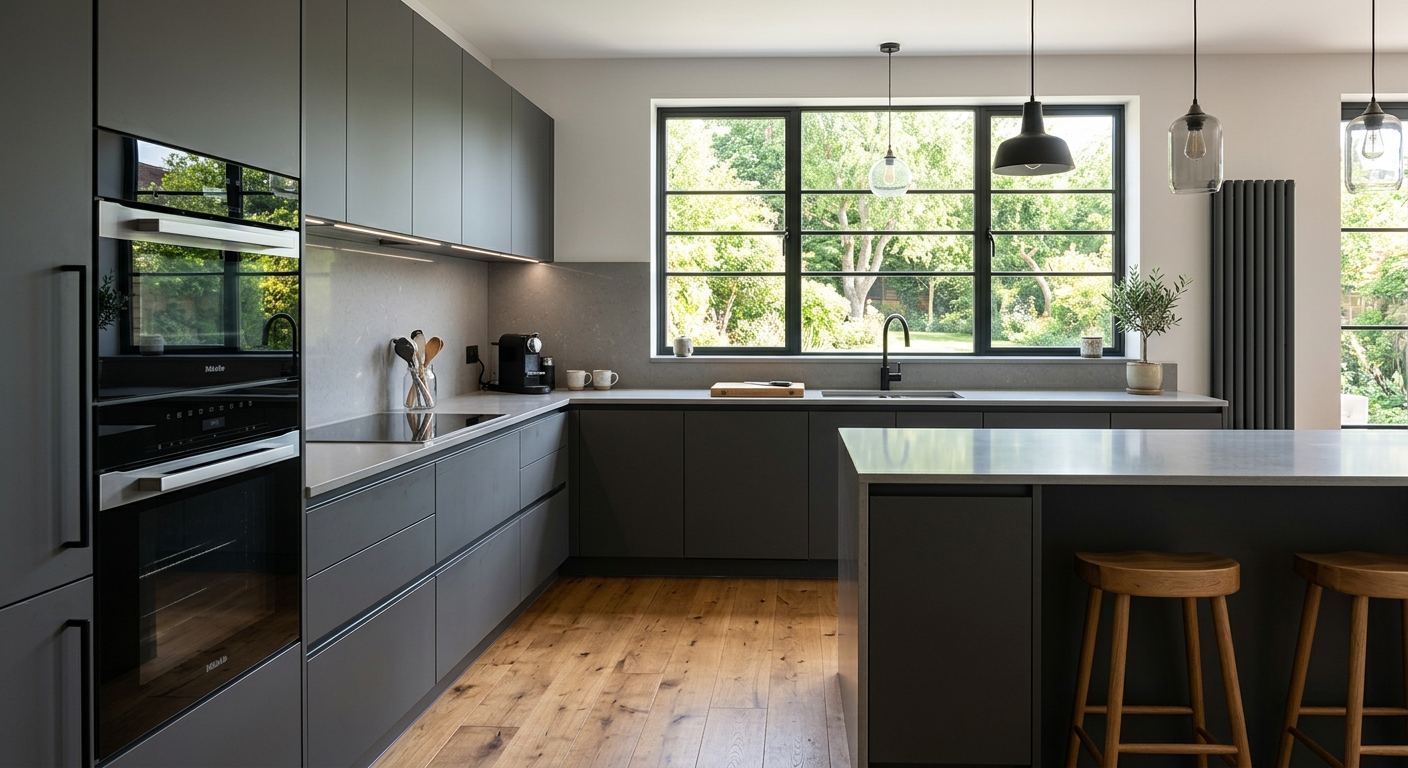
Kitchen renovation options and costs in Mactaggart
Mactaggart is a small community outside Calgary’s core, but the kitchen renovation pricing you’ll see here is tied closely to what homes are worth across the Calgary economic region. In the 2021 Census, Mactaggart had a population of 1,681 (Statistics Canada, 2021 Census), and that smaller local base means contractors often schedule work alongside broader Calgary demand. In higher-value pockets of the region, many homeowners choose finishes that feel “move-in ready” right away—typically quartz or natural stone and semi-custom cabinetry—because the cost is easier to justify on resale.
Even though we don’t budget for “rainy seasons” the way some regions do, Alberta’s freeze–thaw swings still matter. Delays caused by weather-related access issues, the drying time for tile and cabinet adhesives, and the way crews plan around heating for indoor work can affect timelines and labour availability. Calgary’s strong trades market also influences rates; skilled labour is frequently quoted around 90–140 per hour, so design time, project management, and on-site problem solving become a big part of the final budget.
In Mactaggart, kitchen renovations are especially in demand where families are updating older homes and preparing their main-floor spaces—many of these projects cluster around the northeast Calgary–Mactaggart commuter corridor because it’s a common route for trades scheduling and delivery runs. Below is a practical comparison of renovation tiers and what most homeowners in our area end up paying.
| Renovation Tier |
What's Included |
Typical Duration |
Price Range |
| Cosmetic refresh (paint, hardware, new appliances only) |
Cabinet paint or touch-ups (if applicable), new pulls/knobs, appliance swap, minor caulking/trim, lighting tweaks (no major electrical) |
1–3 weeks |
$6,000–$18,000 |
| Mid-range full renovation (new cabinets, counters, sink, tile) |
New semi-custom or quality stock cabinetry, countertop installation, new sink + faucet, backsplash tile, new flooring prep/partial replacement, basic plumbing refresh |
4–8 weeks |
$25,000–$65,000 |
| High-end full renovation (custom cabinets, stone counters, island) |
Custom millwork, quartz or natural stone counters, island (including power/lighting coordination), upgraded appliance package, full backsplash, improved lighting plan |
8–14 weeks |
$65,000–$110,000 |
| Cabinet refacing only (new doors + drawer fronts, same boxes) |
Door/drawer-front replacement, new hardware, repaint/finish on existing boxes (where viable), new toe-kick trim, optional minor countertop edge refresh |
2–5 weeks |
$8,000–$35,000 |
| Countertop swap only (laminate to quartz or stone) |
Measure + template, remove/replace counters, reinstall sink cut-outs, basic caulking + finish around edges, backsplash top-up as needed |
1–2 weeks (plus templating) |
$3,000–$12,000 |
| Backsplash tile installation only |
Tile supply/installs, layout, proper waterproofing prep, grout sealing, removal of old backsplash (if required) |
3–7 days |
$2,500–$8,000 |
Prices are estimates only and vary by project scope, site access and material selection.
What affects the price of kitchen renovation in Mactaggart
In the Calgary economic region, quotes for the same kitchen can vary by 30–50% because contractors price for different assumptions: how complex your layout is, how “new” the project needs to feel, and which trade rates and lead times they’re booking. The biggest drivers in Mactaggart aren’t climate-driven durability concerns so much as market-driven expectations—local home values and household income steer homeowners toward certain finish tiers. In higher-value Calgary-area settings, quartz or stone counters and semi-custom cabinetry are common defaults because buyers tend to reward that look at resale. In more modest cases, homeowners often stretch ROI by choosing laminate or stock options and allocating budget to appliances and lighting instead.
Layout changes are the cost wildcard regardless of finish level. Removing a wall, adding an island, or moving a gas line can add major labour time, inspections, and coordination—even if you keep cabinet lines similar. That’s why two kitchens that “look the same” on day one can land at very different totals once we open up walls and find what’s behind the plaster: old plumbing runs, non-standard framing, or hidden water damage.
Concrete examples we see in Mactaggart: (1) if your sink location needs to move, we often add plumbing and subfloor repairs that push you from a $25,000–$65,000 mid-range rebuild toward the upper end; (2) if you want an island with power and under-cabinet lighting, expect added electrical scope that can shift a budget closer to the $65,000–$110,000 range; (3) replacing flooring across multiple levels of the kitchen can raise costs quickly, especially when the existing floor is uneven or requires full underlayment replacement.
| Price Factor |
Why It Matters |
Cost Impact |
| Cabinet tier — stock vs. semi-custom vs. fully custom millwork |
Tier affects material quality, door/drawer options, fit tolerances, and installation labour |
Can move a full kitchen by roughly 15–35% on finish and install portions |
| Countertop material — laminate vs. quartz vs. granite vs. stone |
Material cost and fabrication/edge finishing drive both the counter price and downtime |
Often adds $2,000–$8,000+ compared with lower-cost options |
| Layout change — wall removal, island add, plumbing/gas move |
Triggers structural review, permits (as required), rework, and coordination between trades |
Commonly the biggest jump: +$5,000–$30,000+ |
| Appliance package tier — builder vs. mid-range vs. pro-grade |
Power requirements, fit/finish, and installation complexity rise with higher-end models |
Typically varies by $1,500–$10,000 depending on package |
| Flooring — refinish existing vs. full replacement |
Existing subfloor conditions and height changes affect base cabinets and transitions |
Can swing $2,000–$12,000 depending on extent |
| Backsplash — ceramic tile vs. marble vs. full-height slab |
Complex cuts, waterproofing, and heavier materials change labour and risk |
Often $1,000–$6,000+ difference |
| Electrical — new circuits for island, under-cabinet lighting |
New circuits require planning, permits (as required), and licensed electrical work |
Commonly adds $800–$4,500+ |
| Permit fees and licensed trade requirements |
Permitting and trade scheduling can add time and administrative cost |
Varies by scope; can add $500–$3,000+ and delays if not planned |
Permits & regulations in Alberta
In Alberta, a cabinet and countertop swap typically does not require a permit because you’re replacing finishes in place. However, Mactaggart homeowners must plan for permits and licensed trades whenever your renovation touches plumbing, gas, structural elements, or electrical beyond minor like-for-like replacement. The key difference is whether you’re altering the existing systems versus refreshing surfaces.
Work that typically does NOT require a permit (when done as a straightforward replacement): cabinet and countertop installation in the same locations, backsplash tile installation, repainting, and hardware swaps. Work that does require permits and licensed trades usually includes: moving plumbing supply or drain lines (sink relocation, adding a dishwasher line extension that changes routing, or changing under-sink plumbing), relocating a gas stove or gas cooktop, any gas work related to changing the gas line or venting, removing a load-bearing wall or making structural changes, and adding electrical circuits for an island or new dedicated lighting/range circuits.
To verify a contractor in Mactaggart, start by requesting their Alberta licence details (for the trades involved), then confirm liability insurance and WSIB/WCB coverage documentation before work begins. Look for a certificate of insurance that names you as an additional insured (or provides proof of coverage terms), and request written proof of clearance/coverage appropriate to the trade scope. Finally, make sure the permit responsibility is clearly written in your contract—who pulls permits, who schedules inspections, and whether any costs are included or billed separately.
Cabinets, countertops and layout decisions in Mactaggart
Your renovation will feel “right” for years if you choose the right cabinet tier, the right countertop material, and a layout that fits how you cook and how buyers will picture the home selling in the Calgary market. In Mactaggart, the three most consequential decisions usually are: (1) cabinet tier—stock for speed and budget, semi-custom as the best balance of price and fit, or custom for the highest cost and best tailoring; (2) countertop material—laminate, quartz, granite/natural stone, butcher block, or marble; and (3) layout changes—open-concept wall removal, island addition, or moving plumbing/gas lines when the space gain is genuinely worth it.
Durability and maintenance matter in an Alberta kitchen because daily life happens fast: hot pans, occasional spills, and frequent cleaning. Quartz and natural stone tend to hold up well and keep a consistent look, which aligns with what buyers often expect at the mid-to-upper price points. Laminate can be a smart budget choice, but seams and heat exposure are more sensitive over time. For example, if you’re choosing between a standard laminate counter package and quartz, the cost difference might be in the range of a few thousand dollars—often worth it if you’re already planning a full $25,000–$65,000 mid-range renovation and want the kitchen to photograph and market well.
Layout is where budgets shift fastest. A single plumbing move to better centre your sink or dishwasher line can be justified if it improves workflow, but it’s rarely justified purely for aesthetics. An island addition with power is the most “buyer-friendly” upgrade when you have enough space and clearances; in tighter kitchens, the same island can create circulation issues and reduce perceived usability.
| Option |
Durability |
Maintenance |
Best For |
Price Range |
| Stock cabinets (big-box) |
Good for standard sizes; durability depends on hinge/box build |
Low; straightforward finishes and easy replacements |
Fast timelines and tighter budgets in a cosmetic-first plan |
$8,000–$22,000 |
| Semi-custom cabinets (local dealer) |
Very solid; better door/drawer options and fit consistency |
Low to moderate; routine cleaning and hardware upkeep |
Most Mactaggart homeowners aiming for resale-ready quality |
$18,000–$45,000 |
| Custom cabinets (local millwork shop) |
Highest build quality; best for odd spaces and perfect alignment |
Low; same everyday care, often with premium hardware |
High-end full redesigns with islands and custom storage |
$35,000–$80,000 |
| Laminate countertop |
Moderate; can be more sensitive to heat and impact at edges |
Low; avoid prolonged heat and heavy cutting directly on surface |
Budget-conscious refresh where cabinets and layout are the priority |
$3,000–$6,500 |
| Quartz engineered countertop |
High; resists staining and daily wear well |
Low; simple soap-and-water cleaning |
Mid-to-high end projects needing a consistent look |
$6,000–$12,000 |
| Granite / natural stone countertop |
High; durable surface with natural variation |
Moderate; typically benefits from periodic sealing depending on stone |
Upscale kitchens where owners want real stone character |
$7,000–$14,000 |
| Butcher block countertop |
Moderate to high; can dent but repairs are possible |
Higher; regular oiling and careful heat management |
Casual, warm kitchens and frequent home cooking |
$5,000–$10,000 |
| Marble countertop |
Moderate; elegant but can etch or stain more easily |
Higher; sealing and gentle cleaners recommended |
Statement kitchens where upkeep is acceptable |
$8,000–$18,000 |
How to choose a kitchen renovation contractor in Mactaggart
When you hire a contractor in Mactaggart, the goal is to reduce surprises: surprises in cost, timeline, and workmanship. Start by verifying Alberta licensing for any trades involved (electrical for circuits, gas work if relocating a cooktop/range, and plumbing where required by scope). Ask for proof of liability insurance and request documentation for WSIB/WCB coverage, then verify it’s current and appropriate to the trades on your project. Don’t rely on “we’re insured” in conversation—get certificates and clearance letters in writing.
Next, insist on 2–3 itemised written quotes rather than a single lump sum. A good quote breaks out labour and materials by category—demo, framing/base cabinet install, counter templating and install, tile and waterproofing, electrical/plumbing allowances, disposal, and any permit or inspection fees. Read the scope carefully: what’s excluded (for example, moving appliances, floor levelling, or wall patching beyond a set area)? Is permit pulling included? Is jobsite disposal included or billed separately?
Warranty matters in kitchen renovations. Confirm workmanship warranty length and what it covers (for example, cabinet installation defects or tile coverage). Also ask about manufacturer warranties for cabinets and countertops, and whether they transfer if you sell the home. For payments, a schedule that never asks for more than 10–15% upfront protects you; use a holdback until the job is complete and deficiencies are addressed. Finally, get a start date and completion estimate in writing so the project schedule is enforceable rather than “best effort.”
- Verify Alberta licensing for the relevant trades before work begins
- Confirm liability insurance is current and ask to see the certificate
- Request WSIB/WCB coverage documentation and clearance letters where applicable
- Get 2–3 itemised quotes with labour and materials separated
- Check that countertop templating lead times are included in the schedule
- Ensure disposal and jobsite cleanup are clearly listed
- Confirm whether permits are pulled by the contractor or you, and who pays
- Ask who is responsible for patching/painting walls after cabinet installs
- Review warranty terms in writing (workmanship and product warranties)
- Use a payment schedule with a holdback until punch-list completion
- Confirm material specifications (cabinet finish, countertop thickness, tile grade)
- Ask for references from similar Calgary-area kitchen projects
Red flags we commonly see with kitchen contractors in the Mactaggart area: (1) they won’t provide written scope and exclusions, (2) they ask for large deposits (well over 15%) before measurable work starts, (3) they can’t show current insurance or trade coverage documentation, (4) the quote lumps labour and materials together with no line items, and (5) they refuse to put the timeline or warranty terms in writing.
Frequently asked questions — kitchen renovation in Mactaggart
What order do kitchen renovation steps happen in?
In Mactaggart (and across Alberta), we typically start with a detailed measure/template step, then demo and rough-in work, then cabinetry, countertops, and finish trades. The usual flow is: confirm layout and material selections, protect adjacent areas, remove old cabinets/counters/appliances, and complete any plumbing/gas/electrical work that’s required. Next comes cabinet install, then countertop templating and fabrication timing, followed by counter installation and sink/faucet hookup. After that, we complete backsplash, flooring touch-ups or replacement, trim/paint, and finally reinstall appliances and do a clean-up plus punch list. If your project includes an island with power, that electrical rough-in needs to happen before cabinets go in. (A tight sequencing plan helps avoid expensive rework when trades overlap.)
Can I live at home during a kitchen renovation in Mactaggart?
Many Mactaggart homeowners stay in the house, especially for cosmetic refreshes or smaller scopes, but it depends on how much of your kitchen becomes unusable. For example, a backsplash tile installation only usually keeps your kitchen functional with a few days of limited access. For mid-range full renovations, plan for temporary cooking arrangements (microwave, portable induction hot plate) and a temporary dish setup for several weeks. In high-end full redesigns—especially those with islands and plumbing/gas changes—living in place is still possible, but you’ll likely have downtime for sink use at certain stages and may need to restrict traffic while cabinets and tile cure. A good contractor will stage the work and protect the home, and they should also confirm dust control and jobsite access rules in writing.
Should I renovate my kitchen before selling in Mactaggart?
It can make sense, but it depends on what you already have and how far you want to move the kitchen up the price spectrum. In Calgary-area resale markets, buyers often reward kitchens that feel “finished” with updated cabinetry and counters, so a renovation can improve perceived value. If your kitchen is outdated but structurally sound, a targeted approach—new cabinet fronts/doors or a countertop upgrade—can help you stay within sensible budget bands. For instance, if you’re aiming for a mid-range full renovation, many projects land around $25,000 – $65,000 and focus on durable finishes buyers expect (like quartz). If you go all-in with custom millwork and stone plus layout changes, budgets can climb toward $65,000 – $110,000, so you’ll want to be confident the upgrades match the home’s overall market positioning.
What's the most popular kitchen style in Mactaggart right now?
In Mactaggart, the “most requested” look typically blends contemporary lines with warm materials: clean, modern cabinet faces (often shaker-style), neutral or warm-grey palettes, and upgraded stone-look surfaces. Quartz is especially popular because it gives a uniform finish that reads well in listing photos and daily life. Homeowners also ask for practical storage—pantries, drawers for small appliances, and better utensil layouts—because functionality sells as much as style. That said, the exact style choice still depends on the age and design of your existing home: newer builds often lean modern; older kitchens may need layout refreshes (like improving lighting and storage) before homeowners feel the style is truly “updated.” Your contractor should propose a finish direction that matches your home’s overall character and the current Calgary buyer expectations.
How do I know if I need to update my kitchen plumbing in Mactaggart?
You may need plumbing updates when you’re moving the sink/dishwasher, encountering leaks, or discovering old supply/drain lines behind cabinets. The most common triggers in Alberta homes are: aged shutoff valves that don’t hold pressure, drain piping that’s mis-sloped, or discoloured staining that suggests slow leaks. If you keep the sink in the same spot and only replace the faucet, you might not need major changes. But if you’re doing a full mid-range renovation (often $25,000 – $65,000), it’s smart to plan for at least a plumbing refresh allowance because you’ll have the wall and base areas open during cabinet install. A contractor should include how they’ll assess existing lines during demo, and whether any discovered issues change scope and cost.
What is the difference between a galley and open-concept kitchen?
A galley kitchen is a long, typically narrow layout with counters on two parallel walls—often efficient for cooking but sometimes limiting for seating and entertaining. An open-concept kitchen removes barriers or reconfigures space so the kitchen flows into living/dining areas, usually improving visibility and social flow. In Mactaggart renovations, moving from a galley to open-concept often involves structural review and, depending on what’s behind the wall, permits and licensed trades for electrical, plumbing, or load-bearing changes. That’s why costs can vary widely even when the “kitchen” looks similar afterward. If your plan is to open a wall, that layout work can be a major driver regardless of whether you choose laminate or quartz. Always confirm what wall is being removed and what utility reroutes are required before signing a contract.