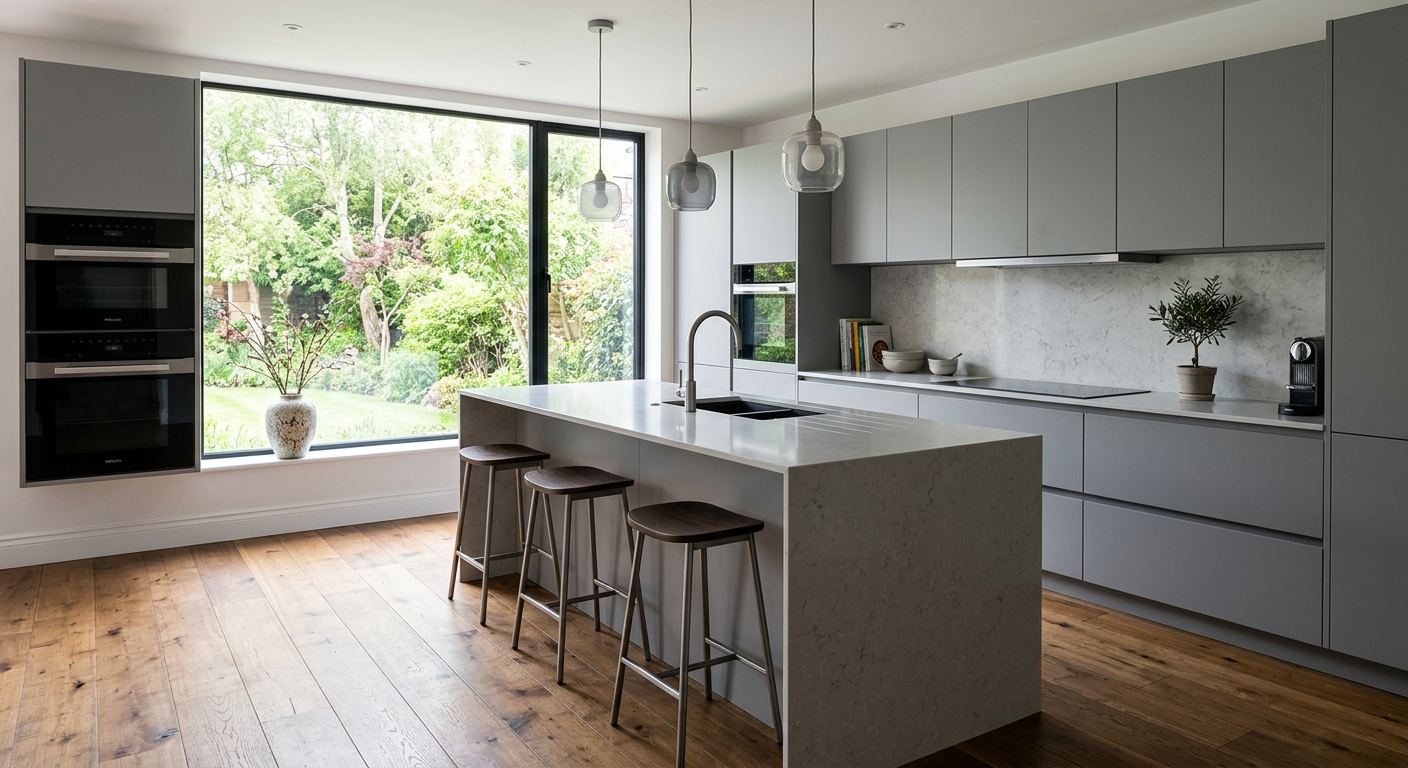
Kitchen renovation options and costs in Greenfield
Greenfield, Alberta homeowners typically approach kitchen upgrades in a few clear lanes—mainly cosmetic refresh, mid-range full renovation, or a high-end redesign with upgraded millwork and stone. With a small population base of 3,589 (Statistics Canada, 2021 Census), you’ll often find fewer competing showrooms than in larger Calgary hubs, which can concentrate scheduling around busy seasons. Just as importantly, homeowners in the Calgary economic region tend to tie kitchen choices to resale expectations; in higher-value areas, buyers expect finishes that look “current,” which drives higher cabinet and countertop spend. (Statistics Canada, 2021 Census)
Calgary-area labour demand also influences pricing. Skilled trades commonly run around 90–140 per hour, so design time, demolition, cabinet installation, and electrical/plumbing coordination become a major share of the total. Alberta’s winters don’t directly dictate kitchen material costs the way they do outdoor work, but they do affect project logistics: slower drying times for coatings, temperature-sensitive adhesives for tile work, and the need to protect floors and plumbing during haul-in and shop fabrication. In Greenfield, trades are especially in demand around established residential pockets near the Calgary commuter corridor, where homeowners often renovate between tenant turnovers and before putting homes on the market.
Because finish tiers and layout risk drive most of the variation, the quickest way to compare quotes is to match scope first, then compare materials. Use the table below as a budget backbone before you ask your contractor for an itemised quote.
| Renovation Tier |
What's Included |
Typical Duration |
Price Range |
| Cosmetic refresh (paint, hardware, new appliances only) |
Paint, new hardware/pulls, faucet refresh (if applicable), appliance swap, basic caulking and touch-ups |
3–7 days |
$6,000–$18,000 |
| Mid-range full renovation (new cabinets, counters, sink, tile) |
Cabinet install, new solid-surface or quartz counters, sink/faucet, backsplash tile, flooring protection and trim work |
3–5 weeks |
$25,000–$60,000 |
| High-end full renovation (custom cabinets, stone counters, island) |
Custom/semi-custom cabinetry, natural stone or premium quartz, island build, upgraded lighting, more extensive tile or slab backsplash |
6–10 weeks |
$60,000–$100,000 |
| Cabinet refacing only (new doors + drawer fronts, same boxes) |
Refacing materials and install, new pulls, minor prep/trim adjustments, touch-up paint where needed |
1–2 weeks |
$8,000–$35,000 |
| Countertop swap only (laminate to quartz or stone) |
Removal of existing tops (and sink access if needed), install new quartz/stone, seam work, basic caulking |
3–7 days |
$3,000–$12,000 |
| Backsplash tile installation only |
Tile supply coordination (optional), removal of old backsplash, tile setting, grout, caulking, cleanup |
2–5 days |
$2,500–$8,000 |
Prices are estimates only and vary by project scope, site access and material selection.
What affects the price of kitchen renovation in Greenfield
In Greenfield and across the Calgary economic region, the same “kitchen replacement” can land 30–50% apart because quotes respond to finish tier, scope risk, and how much redesign is involved—not because of Alberta weather alone. Your local home value and household income levels tend to steer homeowners toward a finish strategy that makes sense on resale. In higher-value pockets of Calgary, many owners default to quartz or natural stone counters and semi-custom cabinetry, because those choices photograph well and hold value at resale. In more modest-value homes, laminate and stock boxes are common because they deliver a noticeable refresh without pushing total spend up into the mid five-figures. (Statistics Canada, 2021 Census)
Layout changes are where costs become unpredictable regardless of whether you choose laminate at the lower end of $3,000–$12,000 for a countertop swap or quartz in the upper band. Removing a wall, adding an island, or moving a gas line/plumbing can trigger structural review, new subfloor work, rerouted services, and extra electrical/plumbing labour. Those trades are in high demand in the Calgary market, which is why scheduling and coordination can add real dollars.
Concrete Greenfield examples: (1) Older homes often have dated supply/drain routing under older floor systems, so “same location” sink swaps can still uncover rough-in upgrades; (2) If your backsplash run includes a window ledge, tile setting labour increases due to cuts and waterproof detailing; (3) If you renovate in winter, contractors build in additional cure and protection time for mortars, self-levelling prep, and cabinet-install surface readiness. Those factors push the project toward the higher end of typical bands like $25,000–$60,000 for mid-range full renos or even $60,000–$100,000 when stone and island work are added.
| Price Factor |
Why It Matters |
Cost Impact |
| Cabinet tier — stock vs. semi-custom vs. fully custom millwork |
Higher tiers improve fit, storage layout, and finish options; they also require more design and fabrication time |
Can swing total cabinetry cost by 2–3x |
| Countertop material — laminate vs. quartz vs. granite vs. stone |
Material price, edge profiles, and seam complexity change labour and template time |
Often shifts countertop scope from “swap” to “premium install” |
| Layout change — wall removal, island add, plumbing/gas move |
New services and potential structural work add trade coordination and inspection steps |
Usually the largest unpredictable add |
| Appliance package tier — builder vs. mid-range vs. pro-grade |
Pro-grade appliances can require custom clearances, ventilation planning, and stronger electrical circuits |
Can add significant material allowance and wiring complexity |
| Flooring — refinish existing vs. full replacement |
Protecting existing floors is cheaper; removing and replacing often expands the demo scope |
Typically changes the budget by several thousand dollars |
| Backsplash — ceramic tile vs. marble vs. full-height slab |
Premium surfaces require tighter tolerances and more labour for layout and installation |
Can move backsplash work toward the upper band |
| Electrical — new circuits for island, under-cabinet lighting |
Electrical upgrades require licensed electricians and can trigger permit/inspection |
Often adds cost even when finish stays “mid” |
| Permit fees and licensed trade requirements |
Where permits apply, paperwork, inspections, and scheduling add time and administrative cost |
Varies but can materially affect timelines and totals |
Permits & regulations in Alberta
In Alberta, many “swap-in” tasks are straightforward. Cabinet and countertop replacements typically do not require permits as long as you are not altering plumbing, gas lines, structural elements, or electrical circuits. That means a cabinet install on the existing footprint and a countertop change with the sink left in the same spot are usually permit-free.
Where permits and licensed trades are commonly required: moving plumbing supply/drain lines, relocating a gas stove or making changes to gas-rated components (including certain range hood ventilation setups), removing a load-bearing wall, adding or relocating electrical circuits (for example, new outlets on an island or rewiring under-cabinet lighting runs), and any work that changes the underlying life-safety systems. Gas work must be done by a licensed gas fitter; electrical work must be done by a licensed electrician. Expect inspections where the permit triggers them.
To protect yourself, confirm permit responsibility in writing before signing—your contractor should state exactly what they will pull permits for (if applicable) and which trade does what. To verify credentials as a Greenfield homeowner: (1) check the contractor’s provincial licence status via the appropriate online registry they provide access to, (2) request a certificate of insurance (general liability) and ensure it matches the contractor name/entity on the quote, (3) ask for WSIB/WCB clearance letter and confirm current coverage, and (4) verify that the specific gas fitter/electrician are licensed for their scope and are named on the job plan.
Cabinets, countertops and layout decisions in Greenfield
Your biggest cost decisions in a Greenfield kitchen renovation usually come down to three choices: (1) cabinet tier, (2) countertop material, and (3) whether you change the layout. Calgary-area buyers often expect a clean, updated look—good storage, modern hardware, and durable counters that don’t stain or chip easily—so the cabinet and countertop combination is where you feel the “value” most.
Cabinets: Stock cabinets are the fastest path (lower design time, easier lead times). Semi-custom is the most popular mid-range choice because it balances layout improvements with predictable budgets. Custom cabinets are best when you need special dimensions, built-ins, or an island design that doesn’t fit standard sizes—though they typically move your project toward the high end of full renovation budgets (often $60,000–$100,000 when an island and premium stone are included).
Countertops: Laminate is the budget-friendly option, while quartz offers a strong durability-to-maintenance ratio for busy households. Natural stone like granite looks premium but can vary in hardness and can require more careful sealing depending on the slab. In a cold-climate context, the key is installation quality and seam work—protecting edges and keeping surfaces properly supported to avoid stress points.
Layout changes: Open-concept wall removal or plumbing/gas relocation can be justified if you gain clear circulation, add seating at an island, or fix a traffic bottleneck. However, if the goal is mainly cosmetic, keep the footprint. A practical example: if you’re choosing between “swap counters only” and a full redesign, upgrading from laminate to quartz might fit within the countertop band (around $3,000–$12,000 depending on size and edge), but moving plumbing to accommodate a new island can add enough trade time and rough-in work that you may jump into the mid-range full renovation band (around $25,000–$60,000).
| Option |
Durability |
Maintenance |
Best For |
Price Range |
| Stock cabinets (big-box) |
Good everyday durability; fit is more standard than tailored |
Low; protect surfaces from standing water at sink |
Quick refresh, tighter budgets, straightforward layouts |
$8,000–$20,000 |
| Semi-custom cabinets (local dealer) |
Very durable with better storage and improved component options |
Low; wipe clean and maintain soft-close hardware |
Most common mid-range renovations aiming for resale-friendly fit |
$15,000–$35,000 |
| Custom cabinets (local millwork shop) |
Highest build quality; best for complex dimensions and premium finishes |
Low to moderate; depends on finish system |
Unique islands, cabinetry that must fit odd angles or full-height walls |
$30,000–$60,000 |
| Laminate countertop |
Moderate; can chip or scorch at edges if misused |
Easy; avoid prolonged moisture at seams |
Budget-friendly refresh when layout stays unchanged |
$3,000–$6,500 |
| Quartz engineered countertop |
High durability; resistant to staining and everyday wear |
Low; wipe clean, no sealing generally required |
High value-for-money look buyers expect across Calgary-area homes |
$6,000–$12,000 |
| Granite / natural stone countertop |
High durability; depends on the specific slab hardness and finish |
Moderate; sealing and careful maintenance may be required |
Premium look where you want a unique “vein” character |
$7,000–$16,000 |
| Butcher block countertop |
Moderate to high; can dent if heavy impacts occur |
Moderate; oiling and drying habits matter around sinks |
Warm, natural look; households that maintain finishes well |
$5,000–$12,000 |
| Marble countertop |
Beautiful but more vulnerable to etching/staining than quartz |
Higher; requires careful cleaning and sealing routines |
Showpiece kitchens where maintenance is part of the plan |
$10,000–$22,000 |
How to choose a kitchen renovation contractor in Greenfield
Choosing the right contractor in Greenfield is mainly about verification, clarity, and control of scope. Start by verifying Alberta compliance: request the contractor’s liability insurance certificate and confirm the insured entity matches the company named on the contract. Ask for the WSIB/WCB clearance letter (or equivalent proof of coverage) and check it’s current. For trade licensing, ensure that gas work is performed by a licensed gas fitter and electrical work by a licensed electrician—don’t assume “the contractor handles it” unless the paperwork is provided.
Next, get 2–3 itemised written quotes that separate labour and materials. You want line items for demo, framing/cabinet install labour, electrical/plumbing allowances (if any), countertop template and install, backsplash install, disposal, and finish work. Avoid lump-sum quotes that don’t describe what happens if something changes (like unexpected subfloor damage or the need to correct existing shutoffs).
Read exclusions carefully: is permit pulling included or not applicable? Is drywall patching and paint included where needed? Is disposal and site cleanup included? Confirm warranty details: workmanship warranty length, product/manufacturer warranty terms, and whether warranties are transferable if you sell your home. For payments, never allow more than 10–15% upfront; hold back a portion until key milestones are completed and punch-list items are corrected. Ask for a start date and completion estimate in writing, including lead-time assumptions for cabinets and stone, since winter scheduling and fabrication queues can shift timelines.
- Confirm Alberta licences for the general contractor and listed trades.
- Request a current liability insurance certificate and verify coverage amounts.
- Ask for WSIB/WCB clearance letter and confirm it’s in good standing.
- Get itemised quotes (labour vs. materials) rather than one total number.
- Ensure the scope lists demo, disposal, patching, and cleanup responsibilities.
- Clarify permit responsibility and inspection scheduling if services change.
- Verify countertop template and fabrication timelines in writing.
- Confirm backsplash substrate prep and waterproofing assumptions.
- Ask about electrical scope for island outlets and under-cabinet lighting.
- Check warranty terms for workmanship and product components.
- Keep payments within a 10–15% deposit; use a holdback until completion.
- Require a written schedule with milestones and change-order process.
Greenfield red flags: quotes that only show one lump-sum number; refusal to provide insurance/WSIB/WCB documentation; “we don’t need permits” when you’re moving plumbing, gas, or adding circuits; vague timelines with no allowance for cabinet/stone lead times; and change orders that aren’t documented in writing.
Frequently asked questions — kitchen renovation in Greenfield
How do I budget for a kitchen renovation?
Budgeting in Greenfield usually starts by choosing your renovation tier and then verifying scope line-by-line. If you’re doing a cosmetic refresh only, most projects land in the mid single-digits (for example, appliance-only and hardware/paint upgrades often sit around $6,000–$18,000 depending on what you replace). For a more complete update with new cabinets and counters, plan on the mid-range full renovation band of $25,000–$60,000, especially when you include sink and backsplash tile. If you’re adding an island, upgrading to quartz or natural stone, and moving services, many homeowners see totals in the high-end range of $60,000–$100,000. Even though Alberta weather doesn’t set material prices, winter timing can extend install/protection time, so build in a little scheduling buffer.
Can I move my kitchen sink or stove?
In Alberta, you can, but whether you need permits and licensed trades depends on what you’re moving and how much you’re changing. Moving a kitchen sink usually means altering plumbing supply and/or drain lines; that typically triggers permit requirements and requires licensed plumbing work. Moving a stove or making changes related to gas appliances means working with a licensed gas fitter, and the ventilation and gas connections need to be handled correctly. From a cost perspective, this is one of the biggest drivers of uncertainty in Greenfield: the labour, rough-in repairs, and inspection coordination can push the project well beyond a simple countertop swap. If your goal is to reduce risk, ask your contractor what’s possible “same location” first, then decide if the layout gain is worth the added scope.
What's the most cost-effective kitchen upgrade?
The most cost-effective upgrade is usually one that delivers “visible change” without triggering layout risk. In many Calgary economic region kitchens, homeowners get strong results from either a countertop swap (especially moving from laminate to quartz) or a backsplash tile upgrade—because they change the look quickly while keeping plumbing and electrical largely untouched. A countertop-only upgrade is commonly in the $3,000–$12,000 band depending on size and edge details. Backsplash tile installation is often $2,500–$8,000 for a typical run, and it can make the counters look more intentional even if cabinets stay the same. If cabinets are dated, refacing (new doors and drawer fronts with the same boxes) can also be a “cost-effective refresh,” often in the $8,000–$35,000 range—especially when the cabinet boxes are still structurally solid.
Custom vs stock cabinets — is custom worth it?
Custom cabinets can be worth it when your kitchen has unusual dimensions, you’re building an island, or you need a very specific storage layout that standard sizes won’t handle. In a Greenfield context, many homeowners compare fit and finish first because the countertop and hardware upgrade alone won’t hide cabinet gaps if the layout is awkward. Stock cabinets are typically the fastest and cheapest to install, but they are more standardized. Semi-custom is often the best middle ground for most mid-range full renovations. If you move toward custom, you’re usually paying for design time and fabrication—so it makes sense when you’re already in a full redesign approach. If you’re staying closer to a refresh, upgrading finishes while keeping the footprint often protects your budget; otherwise, custom cabinetry can help push the whole project toward the high-end full renovation range of $60,000–$100,000.
How do I choose a kitchen contractor in Greenfield?
Choose a contractor by verifying Alberta compliance, comparing itemised quotes, and confirming the warranty and payment structure. Ask for proof of liability insurance and a WSIB/WCB clearance letter, then confirm the licence details for the trades that will work on your scope. In kitchen renovations, this matters because permit-worthy work (like moving plumbing/gas or adding electrical circuits) depends on licensed professionals and inspections. Get 2–3 written quotes that break down labour and materials rather than a single total, and review what’s excluded—disposal, patching, permit pulling, countertop template scheduling, and electrical allowances. Also confirm warranty: workmanship warranty length, product/manufacturer warranty coverage, and whether warranties are transferable. For payments, limit upfront spend to about 10–15% and hold back until completion and punch-list items are addressed.
What order do kitchen renovation steps happen in?
Typical kitchen renovation sequencing keeps trades from working over each other and helps avoid rework. First comes design confirmation and measurements (especially for cabinets and countertops), then demo. If your scope includes permits, you’ll typically secure approvals before rough-in work. Next, install any framing/substrate repairs, then rough-in plumbing/electrical (when part of the scope). After that, cabinets go in (set and level), followed by countertop templating and installation. Backsplash tile typically comes after counters are set so the tile lines up cleanly and waterproofing details are correct. Finish steps—trim, paint touch-ups, sealants, and appliance hook-ups—happen near the end. If you’re in a winter renovation window in Alberta, contractors often add extra time for curing and protection so surfaces are ready for cabinet install and tile setting.