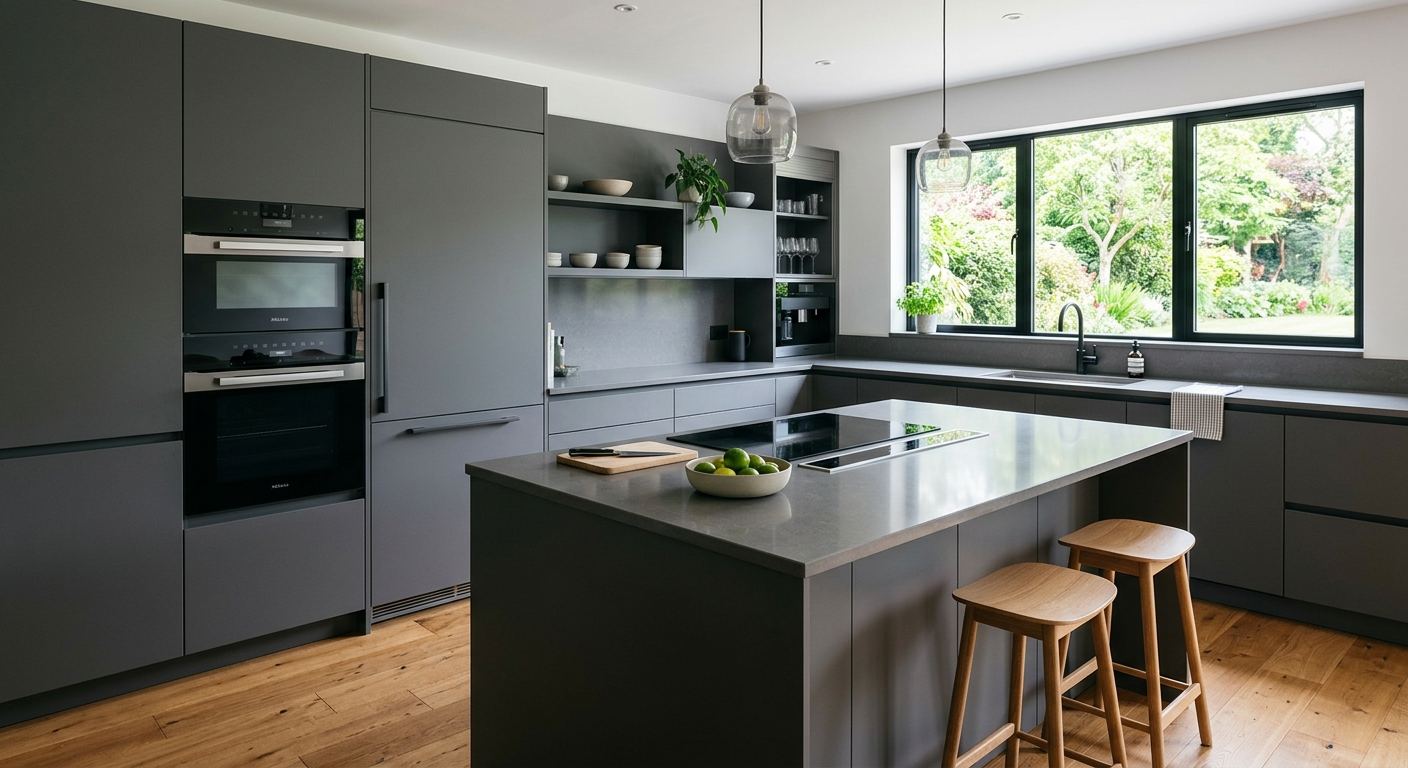
Kitchen renovation options and costs in Elmwood
Elmwood, Alberta kitchen renovations typically start with a “look first” decision: refresh what you already have, or plan a full redesign. With Elmwood’s population at 2,611 (Statistics Canada, 2021 Census), many owners renovate alongside the steady demand from nearby Calgary for move-in-ready finishes. In this part of the Calgary economic region, homeowners often choose finish tiers that match local buyer expectations—especially because renovation costs in higher-value pockets tend to be easier to recover at resale when you upgrade cabinetry and surfaces. That’s why, in practice, many Elmwood households gravitate toward semi-custom or higher-end options rather than only basic laminate.
In the Calgary region, the “market,” not climate, is the main cost driver. Trade availability and labour rates in Calgary commonly run about $90–$140 per hour, so labour, design, and project management are a major portion of the budget. Even though Alberta winters don’t directly affect tile or cabinetry performance, they do influence logistics: scheduling, site drying time after demolition, and the pace of trades working in active households. In busy build-and-reno pockets around South Calgary, crews are especially in demand, which can nudge timelines and pricing during peak season.
To help you compare realistic budgets, use the tiers below as a baseline—then match the scope to the options you want.
| Renovation Tier |
What's Included |
Typical Duration |
Price Range |
| Cosmetic refresh (paint, hardware, new appliances only) |
Cabinet paint or stain touch-up, new pulls/knobs, appliance swap (no plumbing/gas moves), minor countertop cleaning/sealing as applicable |
3–7 days |
$4,000–$18,000 |
| Mid-range full renovation (new cabinets, counters, sink, tile) |
New cabinets (stock or semi-custom), countertop install, sink swap with standard plumbing hook-up, backsplash tile, new flooring section or trim, finish carpentry |
2–5 weeks |
$25,000–$60,000 |
| High-end full renovation (custom cabinets, stone counters, island) |
Custom or higher-end semi-custom cabinetry, quartz or natural stone counters, island build with electrical/lighting, full-height or premium backsplash options, upgraded plumbing/electrical as needed |
4–10 weeks |
$65,000–$100,000 |
| Cabinet refacing only (new doors + drawer fronts, same boxes) |
Door/drawer replacement, hardware upgrades, new end panels where needed, re-veneering, countertop protection/trim adjustments as required |
1–3 weeks |
$8,000–$35,000 |
| Countertop swap only (laminate to quartz or stone) |
Old countertop removal, new countertop install (templating included), sink cut-out where applicable, basic finish sealing and adjustment |
2–7 days |
$3,000–$12,000 |
| Backsplash tile installation only |
Surface prep, tile installation, grout/seal, finishing at cabinets and outlets (scope depends on whether electrical plates are changed) |
2–6 days |
$2,500–$8,000 |
Prices are estimates only and vary by project scope, site access and material selection.
What affects the price of kitchen renovation in Elmwood
In Elmwood, two homeowners can receive quotes that differ by 30–50% for what looks like the “same kitchen” because renovation pricing in Alberta is driven more by finish tier, scope changes, and trade logistics than by climate. In the Calgary economic region, higher-value properties typically justify better recovery at resale, so many owners choose quartz or natural stone and semi-custom cabinetry. In more modest setups, laminate and stock boxes stay the default because they deliver the biggest visual change per dollar. Calgary’s tight construction market also pushes labour demand—skilled work around $90–$140 per hour means design time, demolition time, and skilled installation time matter.
Two scope elements consistently raise costs regardless of finish level: layout changes (especially moving plumbing supply/drain or shifting a gas line) and additional electrical (island circuits, under-cabinet lighting, or upgraded outlets). For example, a countertop swap only may land in the $3,000–$12,000 band, but if you also relocate the sink or adjust base framing to suit a new layout, you quickly shift into a mid-range full renovation range like $25,000–$60,000. Climate influences cost indirectly: winter scheduling can slow down drying and finish curing, which affects when installers can return—particularly for tile thinset and paint on cabinet surfaces.
Concrete Elmwood examples: (1) older homes with mismatched subfloor levels may require extra prep before new tile, (2) kitchens with knob-and-tube or outdated wiring often trigger electrical upgrades when adding island lighting, and (3) homes with older vents or cabinetry set slightly out of plumb may require more carpentry and shimming during cabinet installation.
| Price Factor |
Why It Matters |
Cost Impact |
| Cabinet tier — stock vs. semi-custom vs. fully custom millwork |
Material quality, build precision, and lead times affect both materials cost and labour hours |
$8,000–$65,000 |
| Countertop material — laminate vs. quartz vs. granite vs. stone |
Pricing and fabrication complexity vary; stone needs more templating and careful installation |
$3,000–$25,000 |
| Layout change — wall removal, island add, plumbing/gas move |
More trades, permits, and demolition increases uncertainty and schedule risk |
$5,000–$40,000 |
| Appliance package tier — builder vs. mid-range vs. pro-grade |
Higher tiers bring different venting/electrical needs and sometimes custom panels |
$1,500–$18,000 |
| Flooring — refinish existing vs. full replacement |
Kitchen demo creates dust and removal logistics; matching finishes can add cost |
$1,000–$12,000 |
| Backsplash — ceramic tile vs. marble vs. full-height slab |
Premium stone and full-height coverage increases layout work and material handling |
$2,500–$20,000 |
| Electrical — new circuits for island, under-cabinet lighting |
Licensed work, new runs, and fixture integration drive labour and inspection steps |
$1,000–$10,000 |
| Permit fees and licensed trade requirements |
Certain work triggers permits, inspections, and coordination between trades |
$300–$6,000 |
Permits & regulations in Alberta
In Alberta, not everything requires a permit, and understanding what does (and what doesn’t) helps keep your budget predictable. Typical kitchen cabinet and countertop swaps generally do not require permits when you are keeping the existing plumbing/electrical and gas locations intact. That means you can often replace cabinets, install new quartz or laminate, and update the backsplash without triggering the permit workflow.
Permits and licensed trades are commonly required when you make changes such as moving plumbing supply or drain lines, relocating gas for a stove (or changing how the range hood vents), removing a load-bearing wall, or adding/modifying electrical circuits—for example, wiring a new island circuit or installing under-cabinet lighting tied into new runs. Gas work must be performed by a licensed gas fitter, and electrical work must be completed by a licensed electrician; both typically require inspections.
For an Elmwood homeowner verifying a contractor before signing, follow a simple checklist: (1) ask for their contractor licence details and confirm they’re active via the applicable online licensing registry, (2) request a current certificate of insurance (general liability) and ensure it covers renovation work at your address, and (3) confirm WSIB/WCB coverage where applicable—request documentation directly and keep it with your contract package. Finally, confirm in writing who is pulling permits—responsibility should not be assumed.
Cabinets, countertops and layout decisions in Elmwood
When planning a kitchen renovation in Elmwood, three decisions tend to determine both your final cost and your resale appeal: (1) cabinet tier, (2) countertop material, and (3) whether you change the layout. In Calgary-area resale markets, buyers often expect a clean, modern look—so cabinet style and countertop selection carry more weight than minor material differences elsewhere. Stock cabinets are the quickest and cheapest path to a refresh, while semi-custom is the most popular mid-range option because it balances lead time and fit. Custom cabinets are the most expensive, but they’re strongest when you need uncommon dimensions, built-ins, or a specialty island layout.
Countertops are the second big lever. Laminate can be cost-effective but is more sensitive to heat and will show wear faster than engineered stone. Quartz offers a strong “set it and forget it” approach for daily use, and natural stone adds premium appeal but can be more maintenance-sensitive depending on the stone and finish. In terms of cost justification, if your budget is in the mid five-figures, a move from laminate toward quartz can be a smart investment because it upgrades the “headline” surface buyers notice first. For example, if you’re currently looking at a countertop-only scope in the $3,000–$12,000 range, upgrading to quartz may push you toward the upper portion, but it avoids the “second renovation” feeling if you’re keeping the rest of the kitchen for years.
Layout changes—like removing a wall for open concept, adding an island, or relocating plumbing/gas—can be justified when the space gain improves traffic flow or creates functional zones. The trade-off is unpredictability: moving a sink drain or a gas line adds coordination and licensed work, which is why many owners start by confirming the feasibility and total permit-triggering scope before choosing finishes. In practice, these decisions align most naturally with the Calgary market’s typical project clustering: cosmetic and partial upgrades tend to stay below mid five figures, while redesigns with islands and premium stone move toward $65,000–$100,000.
| Option |
Durability |
Maintenance |
Best For |
Price Range |
| Stock cabinets (big-box) |
Good for everyday use; fit can be less precise in older homes with out-of-square walls |
Low—wipe clean, replace minor hardware as needed |
Fast turnarounds and budget-conscious renovations |
$8,000–$20,000 |
| Semi-custom cabinets (local dealer) |
Solid construction with more door/drawer and size flexibility |
Low to moderate; maintain finishes and hinges with standard cleaning |
Most Elmwood owners aiming for resale-ready upgrades |
$20,000–$45,000 |
| Custom cabinets (local millwork shop) |
Highest fit and finish; best for specialty storage and unusual layouts |
Low with proper care; often built to tolerate active household use |
Island-centric designs and full redesigns |
$45,000–$80,000 |
| Laminate countertop |
Moderate durability; edges and heat exposure need care |
Easy cleaning; avoid prolonged heat and sharp impacts |
Cosmetic refreshes and cost-controlled mid-range jobs |
$3,000–$7,000 |
| Quartz engineered countertop |
High durability for daily cooking; resists staining better than many surfaces |
Low—typical wipe-down; still avoid extreme heat directly |
Homeowners wanting premium look with straightforward care |
$7,000–$12,000 |
| Granite / natural stone countertop |
Very durable; strength depends on the specific stone selection |
Moderate—may require periodic sealing depending on the stone |
High-end finishes and distinctive veining |
$8,000–$18,000 |
| Butcher block countertop |
Durable but can scratch; best when paired with good maintenance habits |
Moderate—oiling/conditioning to prevent drying |
Warm style and families who cook a lot |
$6,000–$14,000 |
| Marble countertop |
Premium look; more susceptible to etching and staining than quartz |
Moderate to high—requires mindful cleaning and protection |
Statement kitchens where maintenance is acceptable |
$10,000–$25,000 |
How to choose a kitchen renovation contractor in Elmwood
Choosing the right contractor in Elmwood is less about marketing and more about proof and process. Start by verifying Alberta licensing and coverage: request their licence details, a current certificate of insurance, and confirmation of WSIB/WCB coverage where applicable. Ask for document dates so you’re not relying on old paperwork.
Next, get 2–3 itemised written quotes that break labour and materials out separately—not a single lump sum. Good quotes list cabinet supply, fabrication/installation, countertop templating and install, tile prep, plumbing/electrical allowances, disposal, and any contingency for site conditions. Read the scope carefully: what is excluded? Is drywall repair included? Is permit pulling included (when required)? Is debris hauling included? Also confirm warranty terms: you want a workmanship warranty length, the product/manufacturer warranty coverage, and whether those warranties are transferable if you sell the home.
For payment, a safe practice is never paying more than 10–15% upfront. Use progress payments tied to milestones, and hold back a reasonable amount until completion and punch-list items are resolved. Finally, insist on a timeline: get a proposed start date and a realistic completion estimate in writing so you can plan around living arrangements during the work.
- Confirm Alberta licensing is active and relevant to the work being quoted.
- Request certificate of insurance (liability) and verify coverage limits.
- Ask for WSIB/WCB clearance or documentation (as applicable) before demolition.
- Get itemised quotes with line-by-line labour, materials, and allowances.
- Ensure cabinet install includes shimming/leveling and finish carpentry.
- Confirm countertop scope includes templating, sink cut-out, and edge finish.
- Check backsplash scope includes outlet refinishing and sealing details.
- Clarify who pulls permits when layout changes trigger them.
- Ask about disposal: demolition debris removal and recycling/haul-off.
- Verify electrical/gas/plumbing trades are licensed for their portions.
- Review warranty: workmanship duration and product warranty terms.
- Use milestone-based payments; avoid large upfront deposits.
In Elmwood, watch for red flags like: quotes that are missing allowances or list large “provisions” without details, no written demolition/disposal plan, vague warranty language (“best effort” instead of a defined period), schedule promises without a completion target tied to materials lead times, or contractors who won’t provide insurance documentation before site work begins.
Frequently asked questions — kitchen renovation in Elmwood
How do I budget for a kitchen renovation?
Budgeting in Elmwood starts by choosing your tier before you pick materials. Many full-kitchen projects in the Calgary region cluster in the mid five-figures, with the broader range landing around $25,000–$60,000 for a mid-range full renovation and up to $65,000–$100,000 when you add an island, premium stone, or custom cabinetry. A common mistake is treating “countertops” or “cabinets” as the entire budget—when layout changes are planned, add a buffer for plumbing/gas and electrical, plus permits when needed. Because labour rates are significant (often $90–$140 per hour), also budget for design and project management time. Get two or three itemised quotes so you can compare apples-to-apples, including demolition, disposal, and finish carpentry.
Can I move my kitchen sink or stove?
In Alberta, you generally can move a sink or stove, but whether it stays inexpensive depends on how far you move plumbing and gas lines. Moving a sink usually involves rerouting supply and drain, which often triggers permits and licensed plumbing work. Similarly, relocating a stove (or making changes tied to a gas setup or range hood venting) typically requires licensed gas work and inspection. If you’re only swapping cabinets and countertops without changing line locations, permits are often not required. For Elmwood homeowners planning a redesign, the best approach is to confirm feasibility first—where the current lines are, what the floor/ceiling cavities allow, and whether your proposed layout increases demolition. That’s where costs can jump from a countertop-focused budget into a full renovation band.
What's the most cost-effective kitchen upgrade?
The most cost-effective upgrade is usually the one that gives a big visual change without triggering major trades. For many Elmwood kitchens, a cabinet-and-hardware-focused approach is strong—either a cosmetic refresh (paint/hardware and appliance swap only) or cabinet refacing, which keeps the existing boxes and reduces demolition. If your cabinets are structurally sound, cabinet refacing only often fits within about $8,000–$35,000, while a countertop-only swap can land around $3,000–$12,000, especially when you keep sink cut-outs and edges straightforward. If you want “highest impact per dollar,” consider a quartz upgrade over laminate while maintaining the same layout; it upgrades what buyers see first. Avoid jumping straight into layout changes until you’ve confirmed plumbing/gas routing—those are the cost unpredictability drivers.
Custom vs stock cabinets — is custom worth it?
Custom cabinets are worth it when you need better fit, specialty storage, or an island configuration that doesn’t align with standard cabinet dimensions. In Elmwood, older homes can be slightly out of square or have irregular wall conditions, and semi-custom or custom can reduce ongoing “patchwork” and result in a cleaner, tighter finish. Stock cabinets can be very cost-effective and fast, especially for cosmetic refreshes and mid-range projects, but you may trade off flexibility and exact fit. If you’re trying to stay in a mid-range full renovation budget (often $25,000–$60,000), semi-custom is usually the best balance: better appearance and options without custom millwork timelines. If you’re nearing a higher-end redesign budget (up to $65,000–$100,000), custom cabinetry becomes more justifiable, especially combined with stone counters and integrated lighting.
How do I choose a kitchen contractor in Elmwood?
Choose a contractor based on documentation, process, and clarity—not just price. Verify Alberta licensing and ask for a certificate of insurance before work begins. Confirm WSIB/WCB coverage (as applicable) and request details in writing. Then compare 2–3 itemised quotes so labour and materials are transparent: cabinetry supply/installation, countertop templating/fabrication, tile prep, disposal, and any allowances. Read the scope for exclusions like drywall patching, outlet modifications, and permit responsibility—particularly if you’re moving plumbing/gas or adding circuits. Check warranty terms: workmanship duration and whether product warranties apply to your specific materials. Finally, keep payment safe: don’t exceed 10–15% upfront and use a holdback tied to completion and punch-list items.
What order do kitchen renovation steps happen in?
While every project has variations, a typical kitchen renovation sequence in Alberta follows a logical order to avoid rework—especially during winter scheduling when drying times matter. First, confirm measurements and finalize the design, including cabinet layout, appliance specs, and where countertop templates will be taken. Next comes demolition, then rough work: plumbing/gas reroutes and electrical changes (when required), followed by insulation/drywall repairs and surface prep. After walls are ready, cabinets are installed (leveling and shimming), then countertops are templated and fitted, and the backsplash is completed after counters are in place. Finally, flooring finishing details and hardware/appliances are installed, followed by caulking, cleanup, and the punch-list walkthrough. If you’re aiming for a quicker scope—like countertop swap only—the order compresses, but templating and cabinet protection remain essential.