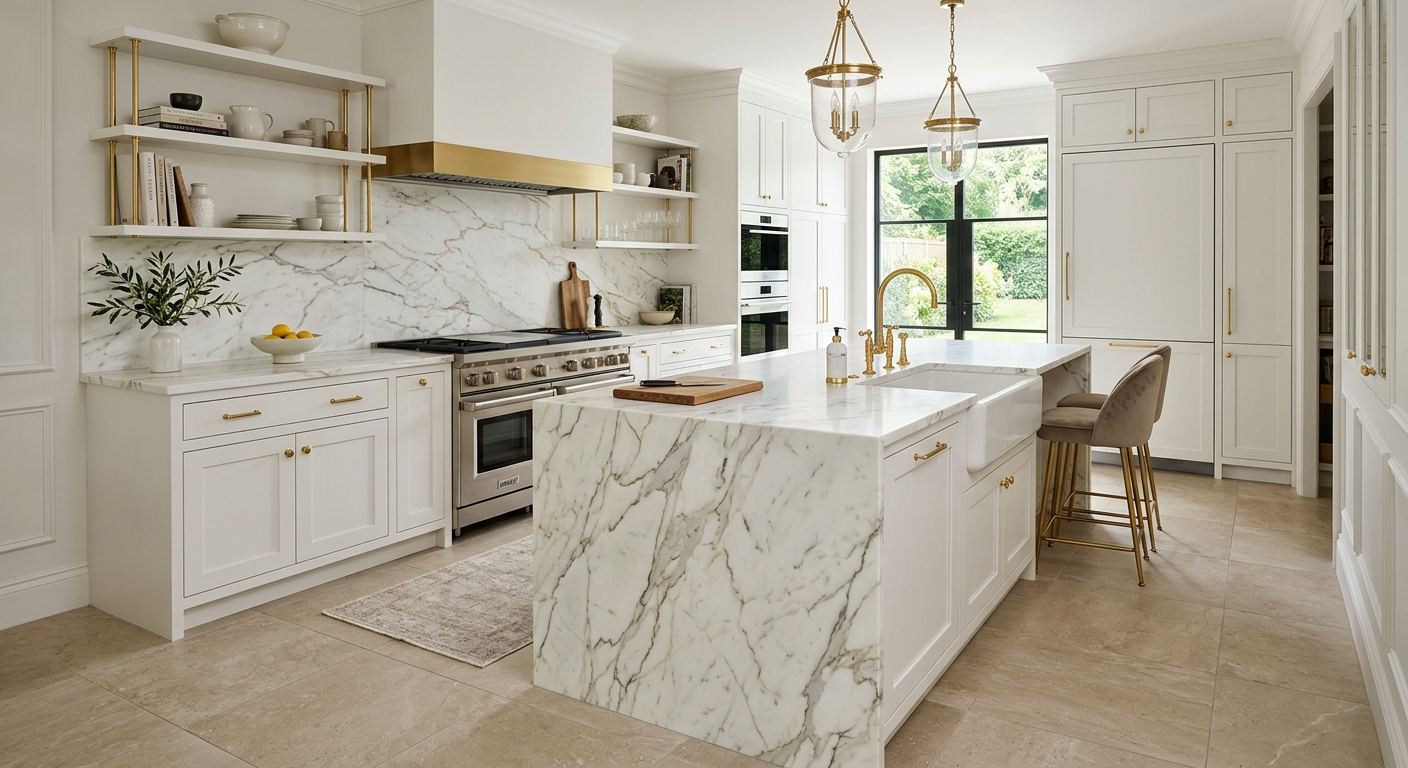
Kitchen renovation options and costs in Calmar
Calmar homeowners usually start their planning with one question: “How much will my kitchen cost?” In Calmar, the median household income is about $85,000 (Statistics Canada, 2021 Census), and with 80.9% of households owning their homes, renovations are commonly treated as long-term upgrades rather than short-term flips. Edmonton-area buyers also tend to pay attention to kitchens because older housing stock is common—39.3% of homes in the area were built before 1981 (Statistics Canada, 2021 Census)—so homeowners often replace outdated cabinet layouts, dated finishes, and tired electrical and lighting.
Costs in Alberta are shaped more by the local market and finish expectations than by winter weather. Edmonton’s trades availability and pricing are driven by neighbourhood demand and the household incomes that support higher-end materials. That said, cold-season scheduling still matters: flooring and sealants need proper site conditions, and installers often build in extra time for acclimation when temperatures swing. In high-demand pockets around Calmar’s main residential core, cabinet installers and countertop shops see strong turnaround requests, especially when homeowners are upgrading for resale appeal.
To compare your options, use the tiers below as a starting point. Then match the tier to your layout goals—because moving plumbing or gas lines is what tends to push budgets, even when the finish level stays the same.
| Renovation Tier |
What's Included |
Typical Duration |
Price Range |
| Cosmetic refresh (paint, hardware, new appliances only) |
Paint/trim touch-ups, new cabinet hardware, appliance swap, minor caulking and re-seal |
1–3 weeks |
$5,000 – $18,000 |
| Mid-range full renovation (new cabinets, counters, sink, tile) |
Semi-custom or upgraded stock cabinets, quartz counters, sink + faucet, backsplash tile, updated lighting, new flooring (LVP or tile) as budget allows |
4–8 weeks |
$25,000 – $60,000 |
| High-end full renovation (custom cabinets, stone counters, island) |
Fully custom cabinetry, high-end stone (quartz/granite/other natural stone), island build, upgraded electrical and lighting, full-height backsplash, higher-end appliance package |
8–14 weeks |
$60,000 – $90,000 |
| Cabinet refacing only (new doors + drawer fronts, same boxes) |
New door/drawer fronts and hardware, prep/finish work, optional new countertop edge detailing if applicable |
2–5 weeks |
$8,000 – $25,000 |
| Countertop swap only (laminate to quartz or stone) |
Remove/replace existing countertop, new quartz or stone, new sink cut-outs (if reused), caulking and basic backsplash tie-ins |
3–10 days |
$2,500 – $12,000 |
| Backsplash tile installation only |
Tile removal as needed, substrate prep, waterproofing where required, tile install and grout/seal |
1–3 weeks |
$2,000 – $8,000 |
Prices are estimates only and vary by project scope, site access and material selection.
What affects the price of kitchen renovation in Calmar
Even when two homeowners in the Edmonton economic region request “the same kitchen,” renovation quotes can swing by 30–50% because the budget isn’t just finishes—it’s labour risk, material lead times, and how much the scope touches plumbing, gas, and electrical. In higher-value pockets, homeowners more often choose quartz or granite and semi-custom cabinetry because the upgrade tends to hold value on resale. In more price-sensitive situations, laminate countertops and stock or entry-level cabinet lines can deliver a strong look while keeping the project closer to the lower end of the full renovation band (for example, $25,000–$60,000).
Local home values and median income shape typical finish tiers far more than climate. With median household income around $85,000 (Statistics Canada, 2021 Census), many Calmar households can support mid-range cabinetry and stone-look upgrades, while the older housing stock (39.3% built before 1981) often means hidden issues—outdated wiring, uneven subfloors, or non-standard venting—that add troubleshooting time. Edmonton-area labour costs also track neighbourhood demand; during busy periods, installers may charge premium rates for short timelines or must sequence work around backlog.
Concrete examples we commonly see in Calmar: (1) Converting a tired U-shaped kitchen into an open layout can require extra framing, patching and subfloor correction—sometimes adding $3,000–$10,000 even if finishes stay mid-range. (2) Upgrading to quartz counters can move you from countertop-only budgets into full renovation territory once new sinks, faucet plumbing adjustments and backsplash finishes are included. (3) If you want an island but need a gas or plumbing move, the design choice can justify the cost—yet it’s often the single biggest driver, regardless of whether you select laminate or quartz.
| Price Factor |
Why It Matters |
Cost Impact |
| Cabinet tier — stock vs. semi-custom vs. fully custom millwork |
Custom boxes, internal layouts and finish quality change both material and install time |
~$8,000–$35,000 difference across cabinet packages |
| Countertop material — laminate vs. quartz vs. granite vs. stone |
Material cost, fabrication complexity, and edge profiles affect labour and waste |
Laminate may be the lowest; quartz/stone typically add several thousand |
| Layout change — wall removal, island add, plumbing/gas move |
Structural work plus re-routing increases trades, inspections, and schedule risk |
Often the largest swing factor; can move total project into a higher tier |
| Appliance package tier — builder vs. mid-range vs. pro-grade |
Electrical/gas compatibility, ventilation needs and finish matching drive scope |
Can add ~$2,000–$10,000 depending on package level |
| Flooring — refinish existing vs. full replacement |
Subfloor condition and removal difficulty determine how much floor work is needed |
Full replacement usually costs more than targeted patching |
| Backsplash — ceramic tile vs. marble vs. full-height slab |
Higher-end materials require more precision, heavier substrates and longer install |
Full-height and stone backsplashes can multiply backsplash labour/material costs |
| Electrical — new circuits for island, under-cabinet lighting |
Bringing power to new locations increases wire runs, boxes and inspection steps |
May add several thousand if new circuits are required |
| Permit fees and licensed trade requirements |
Permits/inspections and licensed trades add administrative and labour cost |
Can add meaningful overhead when gas/plumbing/electrical scope expands |
Permits & regulations in Alberta
In Alberta, many “like-for-like” kitchen finish swaps do not need permits, but several common renovation steps do. Cabinet and countertop replacements typically do not require a permit when you are not changing the rough-in services. A simple example: swapping laminate for quartz or replacing cabinet boxes and doors, with the plumbing and gas shutoffs staying in place, is usually handled as a finish trade scope.
However, permits and licensed trades are typically required when you move plumbing supply or drain lines, relocate a gas stove/range, or add or modify electrical circuits. Removing a load-bearing wall is also a permit/engineering-driven step in most cases, because it changes structural support. Similarly, adding power to an island (for outlets or upgraded ventilation controls) usually triggers electrical work that must be performed by a licensed electrician and inspected.
For homeowners in Calmar, the verification process should happen before signing: (1) Ask the contractor for their current Alberta licence numbers (where applicable to the trade scopes they’re doing). (2) Request a certificate of liability insurance and confirm the policy is active for the project timeline. (3) Confirm Workers’ Compensation coverage (WSB/WCB clearance or evidence, depending on how your contractor is structured). (4) Verify who pulls permits in the written contract, because responsibility can’t be “assumed”—it must be stated clearly.
Cabinets, countertops and layout decisions in Calmar
The three decisions that most often make or break your kitchen renovation budget in Calmar are: (1) cabinet tier, (2) countertop material, and (3) layout changes. Start with cabinets because they set the overall look and determine how smoothly the rest of the work integrates with your counters, backsplash and hardware. Stock cabinets are the fastest and usually cheapest, but they can limit how well you solve awkward older-home dimensions. Semi-custom cabinets are the most popular mid-range choice in the Edmonton area because you can adjust sizing and internal storage while keeping project timelines manageable. Custom cabinets offer the best fit for irregular spaces and premium hardware layouts, but they add significant labour and shop fabrication time.
For countertops, laminate is the value leader—great if you want the new kitchen look without major stone cost. Quartz engineered countertops are a strong compromise for Alberta homes: they’re durable, consistent in appearance, and generally easier to maintain than porous natural stone. Granite/natural stone and marble are higher-end but come with different care expectations.
Layout is where ROI gets real or disappears. In a resale-focused Edmonton-region market, buyers often expect an efficient workflow and modern lighting; if your home’s 1980s-era floorplan feels cramped, an island can justify the cost—especially if it improves circulation and adds seating. One practical dollar example: choosing quartz (instead of laminate) may add a few thousand dollars, but if that upgrade pairs with keeping plumbing where it is, you may stay in the “mid-range full renovation” band (roughly $25,000–$60,000). If you add an island and move gas/plumbing, the project can quickly escalate toward the upper “high-end full renovation” range (roughly $60,000–$90,000), even with the same cabinetry tier.
| Option |
Durability |
Maintenance |
Best For |
Price Range |
| Stock cabinets (big-box) |
Good for daily use; limited customization can affect long-term fit |
Low—normal cleaning and hardware upkeep |
Lower budgets, quick timelines, straightforward kitchen dimensions |
$8,000 – $20,000 |
| Semi-custom cabinets (local dealer) |
Very durable construction; better door styles and internal organization |
Low to moderate—wipe-down and periodic tightening of hardware |
Most Calmar renovations targeting a modern look with realistic cost |
$15,000 – $35,000 |
| Custom cabinets (local millwork shop) |
Highest durability; built for your exact space and storage needs |
Low—like other quality cabinetry, mostly hardware care |
Homes with awkward layouts or when you want a premium, built-in feel |
$25,000 – $50,000 |
| Laminate countertop |
Moderate—can chip or wear at edges with heavy impact |
Low cost to maintain; avoid prolonged heat exposure |
Budget-first renovations and short-to-mid horizon upgrades |
$2,500 – $6,000 |
| Quartz engineered countertop |
High—excellent scratch and stain resistance for everyday use |
Low—typically no sealing; clean with standard mild products |
Families, frequent cooking, and resale-friendly “stone” appearance |
$6,000 – $12,000 |
| Granite / natural stone countertop |
High—strong surface with unique veining and character |
Moderate—natural stone may require periodic sealing |
Premium looks when you want natural variation and upscale presentation |
$8,000 – $15,000 |
| Butcher block countertop |
Moderate—durable but can show cuts and requires careful surface protection |
Moderate—regular oiling and careful moisture management |
Warm, traditional styles and homeowners willing to maintain the surface |
$4,000 – $10,000 |
| Marble countertop |
Moderate—beautiful but more vulnerable to etching and staining |
Higher—requires more careful cleaning and sealing routines |
Low-traffic display kitchens or premium styling budgets |
$10,000 – $18,000 |
How to choose a kitchen renovation contractor in Calmar
Choosing the right contractor in Calmar is about confirming capability and protecting yourself on scope, scheduling and coverage. First, verify Alberta licensing for the trades involved (especially electrical and gas work). Ask for their liability insurance certificate and make sure the coverage is valid for the project period. Then confirm Workers’ Compensation coverage: you should be able to receive evidence/clearance for WCB/WSB status as part of your onboarding package. If a contractor won’t provide documents or answers clearly, pause there—kitchen renos involve multiple trades and responsibilities.
Next, get 2–3 itemised written quotes. You want a line-by-line breakdown that separates labour and materials, not just a lump sum. Check whether permits are included and who is pulling them, and confirm whether disposal/dump fees are included. Read the scope carefully: flooring underlayment, substrate repair, caulking and finish details can be excluded in “starter” quotes.
Finally, protect cash flow and timelines. A solid payment schedule keeps upfront deposits around 10–15%, with holdback until completion and sign-off. Ask for a written start date and estimated completion window, and ensure the contractor states when they’ll order custom items (cabinet lead times are often the schedule bottleneck). Warranty matters too: confirm workmanship warranty length, product/manufacturer warranty coverage, and whether warranties transfer to a new homeowner if you sell.
- Request proof of Alberta trade licensing for the scopes they perform (or provide subcontractor documents).
- Verify liability insurance certificate and confirm limits are appropriate for the project size.
- Confirm WCB/WSB clearance evidence before work begins.
- Get 2–3 itemised quotes with labour and materials separated.
- Confirm permit pulling responsibility in writing (especially for electrical/gas/plumbing changes).
- Ask what’s included for demolition, debris hauling and disposal.
- Confirm electrical scope: new circuits, under-cabinet lighting, and where wiring will be routed.
- Confirm plumbing scope: shutoffs, valve replacements and whether drain lines are adjusted.
- Review countertop details: templating, fabrication, sink cut-outs and edge finishing.
- Ask who is responsible for measurements, and when site measure is scheduled.
- Get a written warranty schedule for both workmanship and product coverage.
- Use a payment schedule with minimal upfront deposit and a completion holdback.
Red flags we see in Calmar include contractors who won’t provide insurance/WCB proof, quotes that don’t list materials (so you can’t compare apples-to-apples), “permit assumed” language without specifying who submits and pays, change-order practices that charge for basics like minor plumbing valve adjustments, and timelines that start before cabinet measurements/ordering are confirmed.
Frequently asked questions — kitchen renovation in Calmar
Do I need a permit for a kitchen renovation in Alberta?
In Alberta, many kitchen upgrades like replacing cabinets or swapping countertops generally don’t require a permit when plumbing and gas lines are not moved. However, permits typically come into play when you change the rough-in systems. Moving plumbing supply or drain lines, relocating a gas stove or range, removing a load-bearing wall, or adding/modifying electrical circuits (like power to a new island) usually requires the right licensed trades and inspections. For a Calmar homeowner, the best approach is to confirm in the contract exactly what triggers permits and who pulls them—then verify the contractor’s documents (insurance and WCB/WSB evidence) before work starts. If your contractor plans a gas or electrical change, plan for inspection scheduling so the project timeline stays realistic.
What's the ROI on a kitchen renovation?
Kitchen renovation ROI varies by finish tier, layout changes, and how well the update matches what buyers expect in your area. In Edmonton-region markets, builders and remodelers often use a rule of thumb that kitchen renovations commonly run about 15%–25% of the home’s value when done with mid-range finishes. Your starting budget in Calmar typically frames what ROI looks like: for example, a mid-range full renovation budget band is roughly $25,000–$60,000, while higher-end work can land around $60,000–$90,000. ROI usually improves when you avoid unnecessary structural moves and focus on widely desired upgrades—modern lighting, durable quartz counters, and storage-friendly cabinetry. Because many Calmar-area homes include older builds (39.3% pre-1981), buyers often appreciate practical improvements like better electrical placement and smoother cabinet storage more than ultra-luxury extras.
How do I budget for a kitchen renovation?
Budgeting in Calmar works best when you plan in tiers and then add a contingency. Start by choosing your tier: cosmetic refresh, mid-range full renovation, or high-end full renovation. If you want a realistic target without major layout work, many projects land in the mid-range band ($25,000–$60,000). If you’re changing the kitchen footprint—adding an island, moving plumbing/gas, or going fully custom—budget closer to the upper band ($60,000–$90,000). Then add contingency for “unknowns,” especially in older homes (39.3% built before 1981), where wiring, subfloors, or venting may need correction once walls are opened. Finally, ask for itemised quotes so you can separate cabinet, countertop, flooring, and trades—this makes it easier to adjust scope without losing the overall kitchen plan.
Can I move my kitchen sink or stove?
Yes, you can move a kitchen sink or stove in Alberta, but it changes the project cost and permitting requirements more than most homeowners expect. Moving a sink typically means plumbing supply/drain line work, and relocating a gas stove means gas line work and licensed installation. Those changes usually add trades time, inspection scheduling, and wall/floor modifications—so even if you keep the same cabinets, the total budget can climb quickly. In Calmar, where a lot of housing stock is older, access behind existing walls can be tricky, which can also affect timeline. If you want to move the sink or stove, plan it early with a designer/contractor so the layout and venting strategy are set before cabinets are ordered. For budgeting, expect layout/plumbing/gas changes to be the biggest unpredictable cost driver relative to countertop choice alone.
What's the most cost-effective kitchen upgrade?
In most Calmar kitchens, the most cost-effective upgrade is one that delivers maximum visual impact while avoiding structural changes. For many homeowners, that means cabinet hardware plus a fresh paint finish—or, if cabinets are worn, a cabinet refacing approach. Refacing (new doors and drawer fronts on existing boxes) commonly falls around $8,000–$25,000 and can refresh the look without the full demolition and cabinet replacement labour of a complete rebuild. Another high-impact option is a countertop swap, often roughly $2,500–$12,000 depending on material choice; pairing quartz with updated lighting can make the space feel “new” without relocating services. If you do have a little budget flexibility, backsplash tile and improved under-cabinet lighting are often where you get strong results per dollar, especially when you’re keeping the plumbing and gas in place.
Custom vs stock cabinets — is custom worth it?
Custom cabinets can be worth it, but they’re not automatically the best choice for every Calmar renovation. Stock cabinets (big-box) are usually the quickest and cheapest route, but they can struggle with awkward measurements common in older homes—39.3% of area dwellings are pre-1981—so you may end up with compromises in storage or fit. Semi-custom cabinets are often the “sweet spot” because they provide upgrades in layout flexibility, door styles and internal organization while keeping costs closer to a mid-range full renovation budget band ($25,000–$60,000). Fully custom cabinets can justify the added cost when you need a precise fit, unique storage solutions (pantries, appliance garages, built-in organizers), or a high-end look that matches stone counters and an island design. If you’re prioritizing ROI and timeline, start by choosing semi-custom first—then consider custom only for the sections that truly need it.