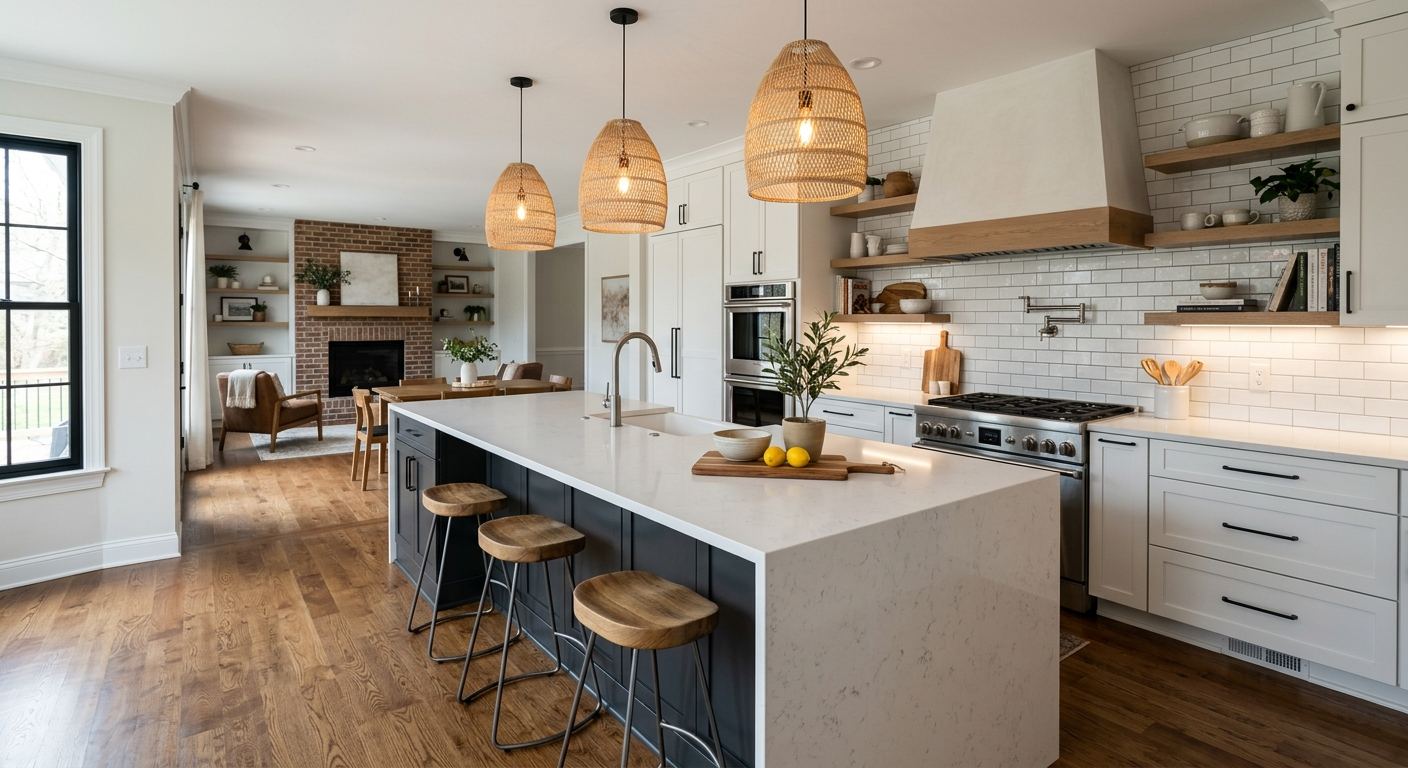
Kitchen renovation options and costs in Raymond
Kitchen renovation in Raymond usually starts with a budget conversation, because what you can realistically upgrade depends on where your home sits in the local market. With a median household income of $86,000 (Statistics Canada, 2021 Census) and a homeowner-leaning housing profile (1,150 homeowner households, 86.5% of households), many Raymond families plan renovations that modernize without over-customizing. In practice, the Lethbridge–Medicine Hat economic region pushes kitchens into a wide range: homeowners balance resale expectations with affordability, and builders often tailor finishes to what buyers typically want to see—clean lines, durable counters, and better lighting.
Costs are also shaped by market demand and labour availability across the region. Full kitchen projects tend to land in the mid to upper tiers—especially when cabinets are upgraded and layout changes are included—because transporting materials into smaller centres and scheduling trades can add time and cost. Raymond’s older housing stock matters too: with 53.8% of homes built before 1981 (Statistics Canada, 2021 Census), you’ll commonly see dated electrical, non-standard framing widths, and flooring transitions that increase “hidden” prep work. Climate plays a supporting role as well: Southern Alberta’s dry heating season can shrink/warp some lower-grade finishes if ventilation and installation details are overlooked, so contractors often steer clients toward better-sealed products and more robust counter systems.
In Raymond, trade demand is especially strong around the older residential corridors near the downtown area, where homeowners commonly renovate to keep kitchens functional and resale-ready. From there, it’s easiest to compare typical tiers before you request a quote, and that’s what the table below summarizes.
| Renovation Tier |
What's Included |
Typical Duration |
Price Range |
| Cosmetic refresh (paint, hardware, new appliances only) |
Cabinet paint or touch-ups, new pulls/handles, new refrigerator/range/dishwasher, and minor countertop/backsplash updates where existing surfaces are reused |
3–7 days |
$5,000–$20,000 |
| Mid-range full renovation (new cabinets, counters, sink, tile) |
Semi-custom or high-quality stock cabinets, new countertop, sink + faucet, backsplash tile, updated plumbing fixtures, and new flooring under typical conditions |
3–6 weeks |
$25,000–$55,000 |
| High-end full renovation (custom cabinets, stone counters, island) |
Fully custom millwork, premium quartz or natural stone, island cabinetry and millwork, upgraded lighting, tile to ceiling in key areas, and a more complex appliance package |
6–10+ weeks |
$55,000–$85,000 |
| Cabinet refacing only (new doors + drawer fronts, same boxes) |
Door and drawer front replacement, new hardware, veneer/paint refresh on existing boxes (when in good shape), and limited trim updates |
1–3 weeks |
$8,000–$22,000 |
| Countertop swap only (laminate to quartz or stone) |
Measure and remove existing top, new quartz/stone install, sink cut-out adjustments, and new edge profile |
1–2 weeks |
$6,000–$18,000 |
| Backsplash tile installation only |
Tile supply/installation, wall prep, caulking and grout sealing, and trim or corner pieces |
3–10 days |
$2,500–$9,000 |
Prices are estimates only and vary by project scope, site access and material selection.
What affects the price of kitchen renovation in Raymond
Two homeowners can receive very different quotes for the “same” kitchen in the Lethbridge–Medicine Hat region—often 30–50%—because pricing follows finish tier plus how much structural and systems work gets triggered once walls come open. The biggest drivers aren’t usually the weather; they’re the market expectations tied to local home values and household incomes. In higher-value pockets, homeowners often default to quartz or natural stone counters and semi-custom cabinetry because the upgrade is easy to sell on resale. In more cost-sensitive scenarios, laminate counters and stock cabinets dominate, since they still deliver a clean, modern look within a tighter budget.
Layout changes are the wildcard that pushes costs up or down regardless of finishes. Removing a wall for an open feel, adding an island, or moving a gas line/plumbing supply is where labour time, inspection requirements, and sub-trade scheduling multiply. In older Raymond homes—especially those built before 1981—floor and wall irregularities can also force extra scribing, patching, and rework around electrical boxes, vents, and soffits, which adds up quickly.
Here are a few Raymond examples that typically raise costs: (1) upgrading from mid-range to high-end stone usually increases the countertop and install scope at the same time—expect movement from the $25,000–$55,000 range toward the $55,000–$85,000 range when an island and upgraded lighting are included; (2) converting a basic backsplash to full-height tile often increases tile labour and material waste, commonly shifting a “small” project by thousands; (3) swapping laminate to quartz alone can move you from entry-level improvements into the countertop-only tier where install details like sink cut-outs and edge profiles matter, commonly landing around $6,000–$18,000.
| Price Factor |
Why It Matters |
Cost Impact |
| Cabinet tier — stock vs. semi-custom vs. fully custom millwork |
Quality of box construction, drawer mechanisms, fit/finish, and custom dimensions drive both material and labour |
Small changes in cabinet tier can shift a mid-range kitchen toward the high-end tier |
| Countertop material — laminate vs. quartz vs. granite vs. stone |
Material cost, thickness, edge complexity, and installation support requirements vary widely |
Countertops can swing thousands and affect total because of sink/backsplash integration |
| Layout change — wall removal, island add, plumbing/gas move |
Triggers engineering/permits, demolition, framing, and rerouting of services |
Often the biggest unpredictable cost driver; can add major labour and inspection steps |
| Appliance package tier — builder vs. mid-range vs. pro-grade |
Electrical/gas compatibility, trim kits, and ventilation requirements differ |
Can add significant spend even when cabinet and counter pricing stays fixed |
| Flooring — refinish existing vs. full replacement |
Older subfloors may require leveling or patching once cabinets are removed |
Partial flooring changes are usually cheaper; full replacement adds time and material |
| Backsplash — ceramic tile vs. marble vs. full-height slab |
Wall prep complexity, material fragility, and grout/seal requirements change labour intensity |
Full-height or stone backsplashes materially increase both labour and waste factors |
| Electrical — new circuits for island, under-cabinet lighting |
New circuits require licensed work, inspections, and careful placement planning |
Often adds mid-range electrical costs on top of base labour |
| Permit fees and licensed trade requirements |
Work that touches building systems or structural elements can require permits and inspections |
Adds administrative time, scheduling, and trade participation |
Permits & regulations in Alberta
In Alberta, many “swap-in” kitchen upgrades do not require permits—especially cabinet and countertop replacements when the work stays within the existing footprint. Typically, installing new cabinets where the footprint and connections remain the same, and replacing a countertop or backsplash without moving plumbing or electrical fixtures, is treated as non-permit work.
However, permits and licensed trades generally are required when you move building systems or touch structural elements. That includes moving supply or drain lines for a sink or dishwasher, relocating a gas stove or changing how a range hood vents when gas is involved, removing a load-bearing wall (or any wall where structural support changes), and adding new electrical circuits (for example, power for an island plus under-cabinet lighting). Gas work must be completed by a licensed gas fitter, and electrical work must be completed by a licensed electrician—both require inspections.
For a homeowner in Raymond, the best step-by-step verification is: (1) request the contractor’s licence details and proof of liability insurance before scheduling anything; (2) ask for a WCB/WCB clearance letter or the applicable coverage confirmation for the trades involved; (3) keep the scope-specific permit responsibility clear in your contract—who pulls permits, who schedules inspections, and what work is included; and (4) verify the licence with the applicable online registry using the contractor/trade name and licence number provided on documents. If a contractor can’t provide current documentation or bundles everything into a single lump sum without itemised scope, that’s usually the first red flag.
Cabinets, countertops and layout decisions in Raymond
For a Raymond kitchen renovation, there are three decisions that affect both your daily use and your resale value more than anything else: (1) cabinet tier, (2) countertop material, and (3) whether you change the layout. Cabinet tier sets the “feel” of the kitchen and how well it holds up over the long run. Stock cabinets are the fastest and cheapest, semi-custom cabinets are the most common mid-range choice, and custom cabinets cost more because you’re paying for exact sizing, better integration with your walls, and upgraded hardware options. In Raymond, where many homes are older (53.8% built before 1981), semi-custom is often the best balance because it tolerates off-square walls and uneven openings without the premium cost of fully custom millwork.
Countertop material is next. Laminate is cost-effective but needs careful seam placement and can show wear sooner under heavy use. Quartz is a strong “Raymond-ready” choice because it’s durable, doesn’t need sealing like natural stone, and performs well through Southern Alberta’s wide temperature swings. Granite and natural stone look premium, but installation, maintenance, and edge choices can raise the total cost. If your budget is tight, laminate can deliver a modern look in the $20,000–$50,000 band for full renovations, but the same kitchen with quartz often moves higher—particularly when you add an island and upgraded lighting.
Layout changes can be justified when they create real space gains: removing an awkward wall, adding an island for prep/storage, or relocating plumbing/gas for a better work triangle. But those changes are where budgets jump unpredictably. One example: if you’re already in a mid-range renovation scope, upgrading cabinets and counters might keep you near the $25,000–$55,000 range; pairing that with plumbing or gas relocation is what commonly pushes totals toward the $55,000–$85,000 range—worth it when it dramatically improves flow, but not if you’re only gaining a cosmetic feel.
| Option |
Durability |
Maintenance |
Best For |
Price Range |
| Stock cabinets (big-box) |
Good for standard-sized kitchens; durability depends on door/hinge hardware |
Minimal—regular tightening and gentle cleaning |
Fast timelines and cost control |
$8,000–$20,000 |
| Semi-custom cabinets (local dealer) |
Very durable with better fit options and upgraded internal components |
Low—routine cleaning and hardware checks |
Most Raymond renovations, especially older homes with minor irregularities |
$15,000–$35,000 |
| Custom cabinets (local millwork shop) |
Highest durability potential with tailored construction |
Low—built for longevity if properly installed |
Best fit, unique layouts, and premium resale finish expectations |
$30,000–$60,000 |
| Laminate countertop |
Moderate; can chip at edges if impacted |
Easy day-to-day, but seams require careful care |
Budget-conscious upgrades that still look clean |
$2,500–$5,500 |
| Quartz engineered countertop |
High durability and strong stain resistance |
Low—no sealing; wipe-clean surface |
Most popular “value upgrade” tier |
$6,000–$12,000 |
| Granite / natural stone countertop |
Very durable, but performance varies by stone type |
Usually requires periodic sealing and careful cleaning |
Premium look for resale-focused upgrades |
$8,000–$16,000 |
| Butcher block countertop |
Durable with proper care; can dent if abused |
Requires oiling and moisture management |
Warm, traditional kitchens and low-gloss aesthetics |
$5,000–$10,000 |
| Marble countertop |
Elegant but softer than quartz; sensitive to staining/etching |
Higher maintenance—seal and avoid acidic spills |
Design-forward kitchens where care is realistic |
$10,000–$18,000 |
How to choose a kitchen renovation contractor in Raymond
Choosing the right contractor in Raymond is mostly about verification and clarity. In Alberta, start by confirming licensing and coverage: ask for the contractor’s proof of liability insurance and documentation showing WCB/WCB coverage (or a clearance letter where applicable). For the trades, make sure gas work is handled by a licensed gas fitter and electrical is done by a licensed electrician; don’t rely on “we have electricians” without names and documentation. You can cross-check licences using the online registries by licence number, and you should be able to match paperwork details to the person/company assigned to your project.
Next, request 2–3 itemised written quotes—not a single lump sum. The quote should separate labour and materials by major line items (demolition, cabinetry install, countertop install, tile and backerboard prep, plumbing/electrical allowances, disposal). Carefully read exclusions: is permit pulling included, who pays for inspections, and is demolition disposal included or billed separately? Warranty is another area homeowners miss. Ask for the workmanship warranty length, what it covers (for example, cabinet installation and tile cracking under normal use), and whether product warranties from manufacturers transfer if you sell your house.
On payment schedule, keep it conservative. A common safe approach is never paying more than 10–15% upfront, then holding back a portion until completion and walkthrough punch list items are corrected. Finally, insist on a written start date and an estimated completion window so you can plan around lead times for cabinets and countertops.
- Ask for licence numbers and proof of liability insurance before signing.
- Request WCB/WCB clearance confirmation for the contractor and verify trades on the jobsite.
- Get 2–3 itemised quotes with labour + materials breakdown.
- Confirm who pulls permits and schedules inspections (in writing).
- Clarify disposal: demolition debris and packaging removal included or not?
- Require a site measure step for cabinets and countertops.
- Check that plumbing/gas and electrical lines are scoped explicitly (allowances where needed).
- Ask for a project schedule with realistic lead times for cabinets and countertops.
- Confirm warranty terms: workmanship length and exclusions.
- Ensure product warranties are named and tied to installed items.
- Use a staged payment plan with a holdback until final walkthrough.
- Verify how changes are priced (change-order rate and documentation process).
Red flags I see in Raymond include: contractors who won’t provide licence/insurance or who refuse to list specific trades; quotes that omit disposal or permit responsibility; “all-in” pricing with no itemisation (so you can’t compare apples to apples); no timeline/lead-time explanation for cabinets or countertop fabrication; and aggressive upfront payment requests that exceed 10–15% without a signed staging plan.
Frequently asked questions — kitchen renovation in Raymond
What's the ROI on a kitchen renovation?
In Raymond and across Southern Alberta, kitchen renovations often recoup value best when the upgrade matches what buyers expect in your neighbourhood and price tier. A fully remodeled kitchen can support resale, but ROI depends on whether you spend on “visible” finishes (cabinets, counters, lighting) versus expensive structural changes (major layout moves, relocating plumbing/gas). As a practical benchmark, many homeowners loosely align major renovation spend with about 10–20% of property value; in higher-value resale pockets, quartz or stone counters and semi-custom cabinetry tend to look more “current” and are easier to justify. Even with the same scope, renovation totals commonly land in the $20,000–$70,000 range for Raymond-area projects, and that’s where buyers generally evaluate whether the kitchen feels worth paying for. (Statistics Canada, 2021 Census)
How do I budget for a kitchen renovation?
Budgeting starts with choosing a renovation tier and then planning for allowances. If you’re doing a full kitchen, many Southern Alberta projects fall into the $20,000–$50,000+ band, and more premium millwork/stone and island layouts can push totals higher. For a reasonable mid-range approach in Raymond, plan for new cabinets and counters plus a backsplash—often aligning with the $25,000–$55,000 type totals seen in local estimates. If you’re trying to modernize with less disruption, a countertop swap (for example from laminate to quartz) frequently lands around $6,000–$18,000, while backsplash tile-only projects can be far lower. Also set aside a contingency for older homes: Raymond has a large share of pre-1981 housing, so hidden electrical, flooring transitions, and fit adjustments can show up once cabinets are removed.
Can I move my kitchen sink or stove?
Yes, you can move a kitchen sink or stove in Alberta, but it’s usually where renovation budgets and timelines change the most. Moving a sink means rerouting water supply lines and drain lines, which typically triggers permit requirements and licensed plumbing work; it can also require subfloor work and changes to cabinet plumbing clearances. Moving a gas stove or modifying the range hood setup involves gas considerations and generally needs a licensed gas fitter plus inspections. If you’re not changing plumbing/gas locations, you can save a lot by keeping the “rough-in” footprint and focusing on cabinetry, counters, and cosmetic upgrades. In Raymond, many older homes built before 1981 also have less predictable under-slab or wall access, so it’s smart to ask contractors to inspect access points before pricing a move.
What's the most cost-effective kitchen upgrade?
The most cost-effective upgrade is usually the one that changes the visual impact without triggering major trades. For many Raymond homeowners, updating hardware and painting cabinets (plus new appliances only) is a quick improvement, but it won’t replace worn surfaces. If you want a bigger “wow” at a manageable cost, a countertop swap is often a strong balance: laminate to quartz or stone commonly sits around $6,000–$18,000 depending on size and sink/edge complexity. Another high-ROI option is backsplash tile—especially when you re-use existing cabinet and counter dimensions—often within the $2,500–$9,000 range. If your layout is functional, it’s usually smarter to invest in cabinets and countertops first, because they set how the room reads day-to-day.
Custom vs stock cabinets — is custom worth it?
Custom cabinets can be worth it when your kitchen layout is unique, your walls/floors aren’t standard, or you want specific storage solutions that stock options can’t match. In Raymond, many homes are older (53.8% built before 1981), so exact sizing and better integration with off-square walls can be a real advantage for semi-custom and, in select cases, fully custom. That said, for many homeowners, semi-custom hits the sweet spot: it’s typically easier to fit and more durable than basic stock while keeping the project in the mid-range spend. A stock approach can be the fastest path, with cabinet-only tier pricing often around $8,000–$20,000 for typical scopes, while custom can push much higher. If your goal is resale-ready modernization on a controlled budget, semi-custom plus quartz counters is usually the value-friendly pairing.
How do I choose a kitchen contractor in Raymond?
Start by verifying Alberta coverage and licensing before you compare prices. Ask for proof of liability insurance and WCB/WCB clearance for the contractor, and confirm that gas work is done by a licensed gas fitter and electrical by a licensed electrician. You can also cross-check licence details online using the licence numbers they provide. Then request 2–3 itemised written quotes that break out labour and materials—not one lump sum—so you can compare demolition, cabinetry install, countertop fabrication/install, tile prep, and whether disposal and permit pulling are included. For payment, keep upfront deposits modest (generally no more than 10–15%) and use a holdback until completion and walkthrough. Finally, insist on a written timeline. In Raymond, delays often come from lead times for cabinets and countertop fabrication, so a contractor should explain expected durations clearly.