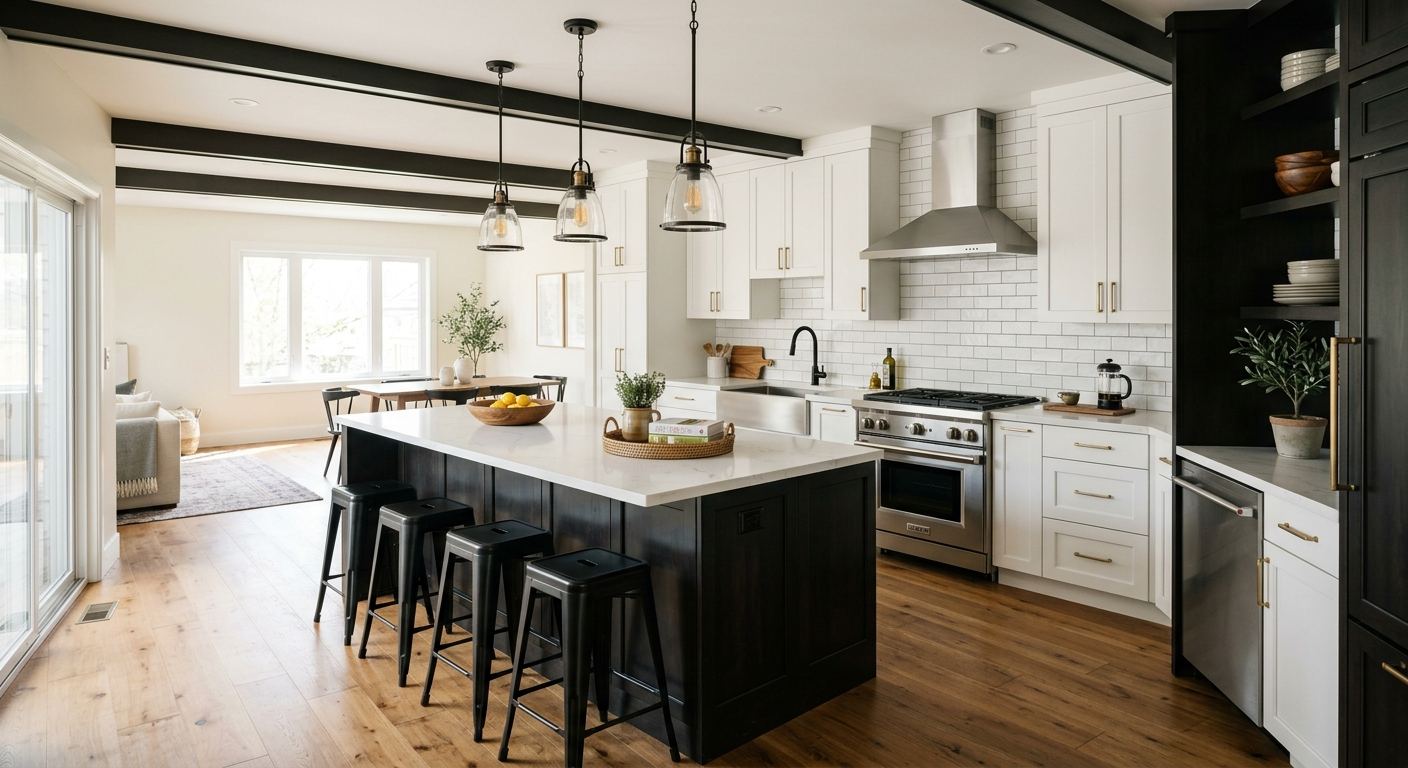
Kitchen renovation options and costs in Swan Hills
Swan Hills homeowners typically have a clear range of kitchen renovation options, and costs usually line up with the finish tier that best matches local buyers’ expectations. With a median household income of $83,000 (Statistics Canada, 2021 Census), many projects land in the mid-range where families want durable, good-looking results without going full custom. Add to that the housing profile—single-detached homes make up 82.5% of dwellings and 64.3% of homes were built before 1981 (Statistics Canada, 2021 Census)—and you often see older floor plans, dated electrical, and cabinetry that’s ready for replacement rather than minor patching.
In the Athabasca–Grande Prairie–Peace River region, renovation pricing is strongly influenced by contractor availability and the local supply chain for cabinets and stone products. We also see more attention to long-wearing materials because long winters and rapid freeze–thaw cycles can amplify issues like subfloor movement, grout cracking, and moisture-related wear around sinks and dishwasher zones. Trade partners often have a steady workflow through centres in the region, so scheduling flexibility in Swan Hills can affect the final labour quote—especially for demolition, cabinet set, and countertop templating.
In Swan Hills, the trade is especially busy around the older residential core where pre-1981 builds are common, and where homeowners tend to renovate kitchens to keep up with resale-ready standards. Below is a practical comparison of common renovation tiers, followed by realistic pricing ranges you can use to benchmark contractor quotes.
| Renovation Tier |
What's Included |
Typical Duration |
Price Range |
| Cosmetic refresh (paint, hardware, new appliances only) |
Paint, new cabinet hardware, appliance swap (no plumbing/gas moves), optional minor caulking/trim |
3–7 days |
$2,500–$8,000 |
| Mid-range full renovation (new cabinets, counters, sink, tile) |
Semi-custom or quality stock cabinets, new countertops, sink and faucet, backsplash tile, flooring touch-ups, standard electrical refresh |
2–5 weeks |
$20,000–$55,000 |
| High-end full renovation (custom cabinets, stone counters, island) |
Custom cabinetry, premium quartz or natural stone, island (often with upgraded electrical/plumbing), higher-end tile/stone backsplash, updated lighting package |
4–8 weeks |
$55,000–$90,000 |
| Cabinet refacing only (new doors + drawer fronts, same boxes) |
Reface doors/drawers, new hardware, re-tiling where needed, countertop kept or only minor trim work |
1–3 weeks |
$6,000–$25,000 |
| Countertop swap only (laminate to quartz or stone) |
Remove old top, templating, install new countertop, basic reseal/caulk, backsplash trim adjustments |
1–2 weeks |
$3,500–$15,000 |
| Backsplash tile installation only |
Surface prep, tile install, grout/seal, optional new outlet trim and caulking |
3–7 days |
$2,000–$9,000 |
Prices are estimates only and vary by project scope, site access and material selection.
What affects the price of kitchen renovation in Swan Hills
Even for what looks like the same kitchen on paper, Swan Hills quotes can swing by 30–50% across the Athabasca–Grande Prairie–Peace River region and across Alberta because labour rates, scheduling capacity, and material sourcing don’t behave like a “one-size” model. Cabinets and countertops also respond to demand: when stone fabrication slots or cabinet lead times tighten, contractors often need to build in scheduling buffers and tighter supervision, which shows up in the total.
Local home values and median income shape the typical finish tier far more than climate. In higher-value pockets in Alberta, homeowners commonly move straight to quartz or stone counters and semi-custom cabinetry because the renovation cost is easier to recover on resale. In more modest markets, laminate and stock cabinets dominate—less upfront expense with solid day-to-day durability. For Swan Hills, where median household income is $83,000 (Statistics Canada, 2021 Census), many families aim for the mid-range full renovation band (roughly $20,000–$55,000) and reserve premium stone for visible impact areas like the perimeter run and island faces.
Layout changes add the most unpredictable cost regardless of finish level: removing a wall, adding an island, or moving a gas line can turn a straightforward replacement into a trades-heavy rebuild. In Swan Hills, older homes built before 1981 often have wiring and subfloor conditions that only show up after demolition; when we open the walls, we sometimes find undersized breakers or outdated junctions that require electrical updates before cabinets can be installed safely.
Two common local cost examples: (1) a sink relocation inside an older footprint can trigger drain rework and drywall patching, pushing countertop and cabinet labour higher even if materials stay in the same tier; (2) upgrading tile to address water-splash zones behind sinks and around dishwashers can raise the backsplash & tile line, but it usually prevents recurring caulk failures in freeze–thaw cycles. If you’re comparing options, remember that switching from laminate to quartz can easily move a countertop-only project from the lower portion of the $3,500–$15,000 band toward the upper end, while moving plumbing generally pushes the overall renovation beyond the cosmetic tier quickly.
| Price Factor |
Why It Matters |
Cost Impact |
| Cabinet tier — stock vs. semi-custom vs. fully custom millwork |
Material quality, door/drawer fit, internal hardware, and lead times change labour and install complexity |
Largest swing item; stock keeps you closer to lower mid-range, semi-custom/custom can add major budget |
| Countertop material — laminate vs. quartz vs. granite vs. stone |
Material cost, fabrication time, and weight/handling requirements affect both pricing and scheduling |
Laminate sits lowest; quartz/natural stone move you toward the higher portion of the countertop band |
| Layout change — wall removal, island add, plumbing/gas move |
Creates demolition, structural, and trade coordination; exposes hidden framing, wiring, and subfloor issues |
Often the biggest unpredictable cost; can shift a job into a higher overall renovation tier |
| Appliance package tier — builder vs. mid-range vs. pro-grade |
Power requirements, fit tolerances, and installation complexity vary by model tier |
Can add moderate to significant cost depending on ventilation and electrical compatibility |
| Flooring — refinish existing vs. full replacement |
Older subfloors may need prep; replacing flooring adds demo, underlayment, and install time |
Refinish is cheaper; full replacement can add noticeable dollars to the overall project |
| Backsplash — ceramic tile vs. marble vs. full-height slab |
More complex materials require finer prep and labour-heavy layout/setting |
Tile can stay near the middle of the $2,000–$9,000 range; premium approaches push higher |
| Electrical — new circuits for island, under-cabinet lighting |
New wiring and code-compliant connections require licensed electrical work and inspections |
Can add cost quickly, especially with multiple lighting and outlet points |
| Permit fees and licensed trade requirements |
When plumbing, gas, electrical, or structural changes are involved, permitting and inspections add cost and time |
Usually modest fees, but the bigger impact is trade coordination and scheduling |
Permits & regulations in Alberta
In Alberta, cabinet and countertop swaps typically do not require permits. If you’re simply replacing cabinets in the same footprint and swapping the top without changing plumbing, gas, venting, or electrical locations, the work is usually treated as renovation without triggering a permitting path. However, permits and licensed trades are commonly required when you change systems—especially in kitchens where older homes built before 1981 may need updates uncovered during demolition.
Work that DOES typically require permits (and must be completed by licensed trades) includes moving plumbing supply or drain lines, relocating or modifying gas lines, and any gas appliance changes (including work tied to a stove or range hood with gas). Removing a load-bearing wall is another common trigger, as is adding new electrical circuits—for example, dedicated power for an island, new under-cabinet lighting tied into new wiring, or relocating major outlets. In these cases, inspections are typically part of the process, and a permit must be pulled before the work proceeds.
Step-by-step for Swan Hills homeowners: (1) Ask for the contractor’s Alberta licence numbers for the relevant trade(s) and check the online registry for status; (2) request a certificate of insurance showing general liability and, when applicable, coverage relevant to their scope; (3) confirm WSIB/WCB coverage where required for the contractor and any listed subcontractors; (4) ensure the contractor clearly states who will pull the permit(s) in writing; and (5) ask for copies of any clearance/inspection documentation after the work is complete. Always confirm permit responsibility in your written contract—don’t rely on verbal assurance.
Cabinets, countertops and layout decisions in Swan Hills
In a Swan Hills kitchen renovation, three decisions drive both budget and resale appeal: (1) cabinet tier, (2) countertop material, and (3) layout changes. Because many kitchens here sit in homes built before 1981 (64.3% of dwellings), you often inherit uneven walls, older subfloors, and dated wiring; choosing a cabinet system that can be reliably shimmed and aligned can reduce change-orders later. For resale buyers in the Athabasca–Grande Prairie–Peace River region, finishes that feel “clean and bright” tend to perform well—white or light cabinetry, durable counters, and backsplashes that tolerate splash zones.
Cabinet tier: stock cabinets are the fastest and usually cheapest, but fit and finish limits can show in older spaces. Semi-custom cabinets are the most popular mid-range choice because you can adjust widths, storage options, and door styles while keeping costs controlled. Custom cabinets suit unusual room dimensions or where you want integrated storage; they cost more because they take longer to design and manufacture.
Countertops: laminate is budget-friendly, but in daily use it can be less forgiving at seams and around the sink over time. Quartz offers strong stain resistance and consistent appearance, typically at a manageable jump from laminate in the $3,500–$15,000 countertop band depending on size and cut-outs. Granite/natural stone and marble add premium look and require more careful sealing/maintenance planning; they also usually push you toward the upper end when installed with edging, bullnose/waterfall details, and complex cut-outs.
Layout changes should be justified. If you add an island or open an area by removing a wall, you’re paying for plumbing/gas/electrical complexity and structural coordination. A practical example: upgrading countertops from laminate to quartz might move your countertop-only budget within the normal range, but moving a sink to an island footprint in an older kitchen can create drainage changes and drywall rebuilding—often costing more than the countertop upgrade itself. That’s when the space gain is worth it: better traffic flow, more seating, and improved work zones.
| Option |
Durability |
Maintenance |
Best For |
Price Range |
| Stock cabinets (big-box) |
Good for everyday use; fit gaps can be more noticeable in older walls |
Low—keep hardware tight; wipe down surfaces regularly |
Cosmetic refresh or straightforward layouts |
$6,500–$18,000 |
| Semi-custom cabinets (local dealer) |
Very durable construction with better door/drawer consistency |
Low; designed for frequent use and easier refinishing if needed |
Most mid-range full renovations in Swan Hills |
$12,000–$30,000 |
| Custom cabinets (local millwork shop) |
Highest durability and best alignment in non-standard spaces |
Low to moderate; quality finishes last, but hardware and joinery should be maintained |
Unusual layouts, max storage, high-end aesthetics |
$25,000–$55,000 |
| Laminate countertop |
Solid for scratches with careful use; seams can be a weak spot around moisture |
Wipe clean; avoid standing water at seams |
Budget-first renovations and quick upgrades |
$3,500–$7,500 |
| Quartz engineered countertop |
High durability; resistant to staining and everyday impacts |
Low—typically no sealing; gentle cleaners recommended |
Most popular “mid-to-upgrade” choice for busy households |
$7,500–$12,500 |
| Granite / natural stone countertop |
Very durable with natural resistance; performance depends on stone type |
Moderate—sealing may be required and spills should be wiped promptly |
Premium look and high-traffic kitchens |
$10,000–$18,000 |
| Butcher block countertop |
Strong for heat tolerance; can show wear if not oiled |
Moderate—oil/condition regularly to prevent drying and water marking |
Family-focused kitchens that want warmth and repairability |
$6,500–$13,000 |
| Marble countertop |
Premium and elegant but softer than many stones; more prone to etching |
Higher maintenance—more careful cleaning, sealing, and protection from acidic spills |
Statement kitchens and lower-abuse countertops |
$14,000–$25,000 |
How to choose a kitchen renovation contractor in Swan Hills
Choosing the right contractor in Swan Hills is mostly about verifying credentials and forcing clarity into your scope before work starts. First, verify Alberta licensing for the trades involved in your job—especially electrical and gas-related tasks. Electrical work should be performed by a licensed electrician, and any gas-related changes must be done by a licensed gas fitter. Ask for licence numbers and check their status through the relevant online registry. Next, request proof of liability insurance (certificate of insurance) and confirm WSIB/WCB coverage where applicable for the contractor and their subcontractors. If a contractor can’t produce documentation quickly, it’s usually a sign they aren’t managing compliance cleanly.
Get 2–3 itemised written quotes, not lump sums. You want labour and materials separated by line item so cabinet supply, countertop templating/installation, tile, electrical, plumbing, demolition, and disposal are visible. Read the scope carefully: what’s excluded (subfloor repairs, wall patching, fixture changes, appliance cost)? Is permit pulling included if it’s required? Is dust control and jobsite protection included?
Warranty should be specific. Ask for workmanship warranty length, the manufacturer’s product warranty details (cabinets/countertops), and whether warranties transfer if you sell your home. Payment schedule matters: never pay more than 10–15% upfront, and use a holdback until substantial completion and punch-list items are done. Timeline clarity is equally important—get a start date, a realistic completion estimate, and scheduled dependencies (cabinet lead time and countertop templating) in writing.
- Provide licence numbers for each applicable Alberta trade and match them to the exact work in your scope
- Confirm liability insurance with a current certificate of insurance
- Verify WSIB/WCB coverage for the contractor and named subcontractors
- Use 2–3 itemised quotes (labour + materials), with allowances clearly stated
- Check what’s included in demolition, disposal, and dust protection
- Confirm cabinet install includes shimming/leveling on uneven older subfloors
- Ask who pulls permits if plumbing/gas/electrical/structural work is triggered
- Ensure countertop quoting includes templating, removal, install, and cut-outs (sink, cooktop) terms
- Review tile scope: waterproofing prep, thinset/adhesive type, and grout/seal expectations
- Get electrical scope details in writing (circuits, lighting, outlets, switching locations)
- Ask for warranty terms for both workmanship and the supplied products, including transferability
- Use a payment schedule with a holdback until punch-list completion and final cleanup
Red flags in Swan Hills include: quotes that are only a single lump sum with no material breakdown; refusing to list which permits (if any) are required; “too low to be true” pricing on cabinets or countertops with missing lead-time assumptions; vague timelines that ignore cabinet ordering and countertop templating; and contractors who want large upfront payments beyond 10–15% without a signed schedule or clear scope.
Frequently asked questions — kitchen renovation in Swan Hills
How much does a kitchen renovation cost in Swan Hills?
In Swan Hills, a kitchen renovation commonly lands in the $20,000–$80,000 range depending on how much changes beyond surface-level updates. A mid-range full renovation (new cabinets, counters, sink, and tile) is often in the $20,000–$55,000 band, especially when you choose semi-custom cabinetry and quartz in the typical sizes. If you add an island, upgrade storage heavily, and move electrical or plumbing, totals can approach the higher end—particularly if you go custom cabinets and premium stone. With 64.3% of local homes built before 1981 (Statistics Canada, 2021 Census), some budgets rise after demolition reveals older electrical or subfloor corrections. As a reference point, countertop swaps alone usually start around $3,500, while full cabinet refacing sits roughly at $6,000–$25,000.
How long does a kitchen renovation take in Swan Hills?
Timelines in Swan Hills depend on lead times for cabinets and the scheduling window for countertop templating and fabrication. Cosmetic refresh projects can be as short as 3–7 days. A mid-range full renovation typically takes 2–5 weeks, while high-end kitchens with custom millwork and premium stone often run 4–8 weeks. If your plan includes moving plumbing supply/drain lines or adding new electrical circuits, expect extra time for permitting, inspections, and trade coordination. Older homes built before 1981 (Statistics Canada, 2021 Census) can also add time if we uncover wiring, moisture-related subfloor issues, or framing corrections once cabinets are removed. The best way to avoid delays is to lock your cabinet and countertop choices early, then confirm the installation schedule in writing.
Quartz vs granite countertops — which is better?
Quartz is usually the best “set it and forget it” choice for Swan Hills households. It resists staining well, typically needs less day-to-day maintenance than natural stone, and offers consistent colour and patterning—helpful when you want a clean modern look. Granite can be extremely durable and has unique natural variation, but it often requires sealing and a bit more mindful care with spills. In terms of budgeting, quartz commonly falls within the upper part of the countertop band (for many kitchens, think roughly $7,500–$12,500 depending on size), while granite/natural stone projects often trend higher (frequently around $10,000–$18,000). For resale-ready durability in a region with winter-to-thaw stress around sink and backsplash areas, quartz is usually the safer practical pick unless you strongly prefer granite’s look and are comfortable with maintenance.
Should I reface or replace my cabinets?
Refacing can be a great move when the existing cabinet boxes are solid, level, and not suffering from water damage near the sink/dishwasher areas. It’s typically less invasive and usually comes in around the $6,000–$25,000 range, depending on how many doors/drawers are involved and the finish level. Replacement is the better choice when boxes are sagging, heavily water-warped, or when you want to change storage layouts (pull-outs, reorganized drawers, corner solutions) and improve overall fit in older Swan Hills kitchens. A practical rule: if you’re already budgeting for new counters and a full tile refresh, replacing can sometimes be close in cost to refacing once you factor in labour to correct aging bases. Either way, ask the contractor to assess box condition before choosing—refacing over failing boxes usually creates long-term frustration.
Do I need a permit for a kitchen renovation in Alberta?
Often, simple cabinet and countertop swaps do not require permits in Alberta. However, if your Swan Hills project involves moving plumbing supply/drain lines, relocating gas (for a stove or gas range hood), removing a load-bearing wall, or adding electrical circuits (like new island power or new lighting circuits), permits and licensed trades are typically required. Gas work must be done by a licensed gas fitter, and electrical work by a licensed electrician, with inspections as applicable. Before you sign, confirm in writing who pulls permits—contractors are usually responsible for managing the permit process when it’s required. When quotes are unclear, it can lead to delays and rework. If you’re unsure whether your scope triggers permitting, ask the contractor to list each change and the trade involved.
What's the ROI on a kitchen renovation?
ROI varies because it depends on whether you fix the “buyer pain points” in older homes and whether the finish tier matches the local market. In Swan Hills and the broader Athabasca–Grande Prairie–Peace River region, renovations that balance durable materials with a modern, clean look usually perform best at resale. With 71.4% of households owning (Statistics Canada, 2021 Census), many buyers focus on practical upgrades like reliable storage, easy-to-maintain counters, and updated lighting/outlets rather than ultra-premium finishes. A kitchen move from laminate counters to quartz can be a relatively value-positive upgrade for day-to-day use, while full custom cabinetry and premium stone increase upfront cost and are best when the layout and storage improvements truly elevate the home. If you’re aiming for a solid mid-range project, staying roughly within the $20,000–$55,000 band often aligns better with achievable resale value than pushing straight to the highest-end “show kitchen” tier.