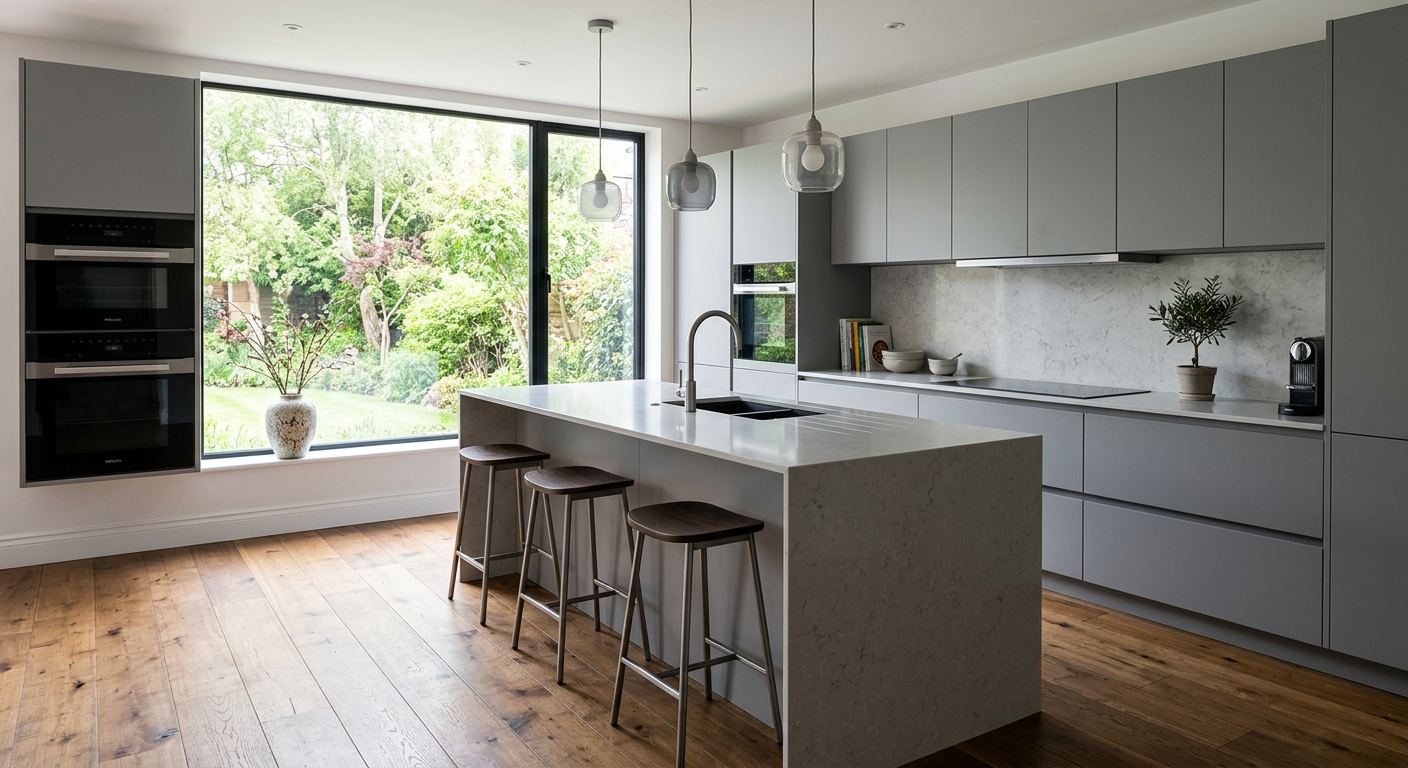
Kitchen renovation options and costs in Richmond
Richmond, Alberta is a small community (population 5,250 per the Statistics Canada, 2021 Census), but homeowners still renovate on the same economic rhythm as the broader Calgary region. In practice, Richmond kitchens trend toward the finish expectations you’d see in higher-value Calgary-adjacent buying: more people opt for durable cabinetry and solid-surface counters instead of “see-it-tomorrow” cosmetic tweaks. That shift matters because Calgary-area budgets are often tied to resale confidence—when renovations increase perceived value, homeowners are more willing to move from a refresh into a full redesign.
Although Richmond itself is modest in population, the cost drivers are regional. Calgary’s construction market keeps trade availability tight, and skilled labour commonly runs about $90–$140 per hour, so design, project management, and installation are a large share of your total budget. Alberta’s cold winters don’t directly change kitchen material performance the way they do exterior work, but they do affect scheduling (delivery lead times and site readiness), and they can influence what homeowners choose (e.g., long-wearing finishes that hold up to heavy winter cooking and frequent cleaning).
In Richmond, renovations are especially in demand in and around the Downtown Richmond / main residential core, where many homes are older and benefit from layout improvements and updated electrical. With that context, here’s a clear way to compare your options before you get quotes—then we can dial in the exact scope for your kitchen.
| Renovation Tier |
What's Included |
Typical Duration |
Price Range |
| Cosmetic refresh (paint, hardware, new appliances only) |
Cabinet paint or touch-ups, new pulls/knobs, new appliance set (no cabinet rework), basic caulking, minor drywall patching |
5–10 business days |
$8,000–$25,000 |
| Mid-range full renovation (new cabinets, counters, sink, tile) |
New semi-custom or quality-stock cabinets, countertop installation (quartz or laminate), sink + faucet, backsplash tile, flooring tidy-up, plumbing/electrical tie-ins as needed |
3–5 weeks |
$25,000–$60,000 |
| High-end full renovation (custom cabinets, stone counters, island) |
Custom millwork, stone counters (granite/stone look premium), island (often with upgraded electrical), upgraded backsplash details, appliance package upgrades, more extensive demo/rebuild |
5–10 weeks |
$70,000–$100,000 |
| Cabinet refacing only (new doors + drawer fronts, same boxes) |
New door/drawer fronts, laminate or veneer faces, new hardware, optional interior upgrades (shelves/organizers), countertop left in place |
1–3 weeks |
$8,000–$35,000 |
| Countertop swap only (laminate to quartz or stone) |
Removal and install of countertops, edge profile updates, sink cut-outs as needed, backsplash minimal change (if any) |
3–7 business days |
$3,000–$12,000 |
| Backsplash tile installation only |
Surface prep, tile install (ceramic/porcelain), grout/seal where required, finishing at counters and outlets |
3–7 business days |
$2,500–$8,000 |
Prices are estimates only and vary by project scope, site access and material selection.
What affects the price of kitchen renovation in Richmond
Even when two homeowners in the Calgary economic region ask for the “same” kitchen, quotes can swing by 30–50%. The reason is simple: local home value expectations and household purchasing power tend to pull you toward different finish tiers, and those tiers quickly change labour and material costs. In higher-value parts of the Calgary region, many owners default to quartz or natural stone counters and semi-custom cabinetry because the renovation cost is easier to recover on resale. In more modest markets, laminate and stock cabinets dominate because the ROI can be stronger for the same spend.
Layout is the most unpredictable cost driver regardless of finish. If you’re removing a wall, adding an island, or moving plumbing (or a gas appliance connection), labour hours rise and the job becomes more coordination-heavy—carpenters, plumbers, and electricians all need to align. That’s why, in practice, a “mid-range full renovation” can reach the higher end of the $25,000–$60,000 band, while “cosmetic only” can look like $8,000–$25,000 until you discover you need electrical updates for under-cabinet lighting or a new hood.
Richmond-specific examples we often see: (1) older homes may have non-standard cabinet spacing and uneven walls, requiring extra patching and shimming before new countertops—often adding a few days of drywall and fine carpentry; (2) winter delivery and scheduling can delay stone slab fabrication and template installs, which affects start dates and can increase standby labour; and (3) if your kitchen floor is older tile or uneven subfloor, you may end up replacing more than you planned—pushing you from a countertop swap near $3,000–$12,000 into a “full renovation” workflow.
| Price Factor |
Why It Matters |
Cost Impact |
| Cabinet tier — stock vs. semi-custom vs. fully custom millwork |
Higher tiers use better materials, wider options for sizes/finishes, and more precise fit to your room |
Typically shifts your cabinet line item by thousands; custom millwork often pushes the job toward the upper mid/high bands |
| Countertop material — laminate vs. quartz vs. granite vs. stone |
Material cost and templating/installation complexity vary a lot, and premium stone often needs more careful handling |
Countertops can swing from near the low end of $3,000–$12,000 to major add-ons within high-end full renovations |
| Layout change — wall removal, island add, plumbing/gas move |
More demo, framing, and coordination among trades; potential structural and systems adjustments |
Frequently the difference between “mid-range” and “high-end” outcomes |
| Appliance package tier — builder vs. mid-range vs. pro-grade |
Pro-grade units cost more and may require deeper integration (venting, clearances, electrical demands) |
Can add thousands and shift your project duration due to lead times |
| Flooring — refinish existing vs. full replacement |
Matching older floors can be harder; removing cabinets often reveals subfloor issues |
Can move you from “refresh-like” budgets into full renovation spend |
| Backsplash — ceramic tile vs. marble vs. full-height slab |
Coverage, substrate prep, and material fragility change labour time and waste rates |
Backsplash-only installs commonly sit around $2,500–$8,000; premium looks rise quickly |
| Electrical — new circuits for island, under-cabinet lighting |
Adding circuits requires licensed work and inspection; lighting also adds hours for planning and installation |
Can add noticeable cost even if cabinets/counters stay in place |
| Permit fees and licensed trade requirements |
Where permits apply, you add admin time, scheduling for inspections, and coordination overhead |
Not usually the biggest line item, but it can affect total project cost and timing |
Permits & regulations in Alberta
In Alberta, cabinet and countertop swaps typically do not require a permit. That means replacing cabinets in the same footprint and installing new counters over the existing base is usually a straightforward renovation. However, permits and licensed trades are generally required when you alter key building systems. The common Richmond (and Calgary area) examples that DO require permits include: moving or changing plumbing supply or drain lines, relocating a gas stove or altering a gas connection, removing a load-bearing wall, adding new electrical circuits (especially for an island, new hood requirements, or dedicated appliance circuits), and any work that needs inspection and sign-off.
Gas work must be done by a licensed gas fitter, and electrical work must be done by a licensed electrician; both require inspections when applicable. Before you sign, confirm in writing who pulls the permit and who is responsible for passing inspection—contract language matters because it affects cost, schedule, and liability.
How homeowners in Richmond can verify a contractor quickly:
- Ask for proof of liability insurance (certificate of insurance) naming your project as applicable.
- Confirm WSIB/WCB coverage (clearance letter or current account details). In Alberta, you want to see that coverage is active for the workers who will be on site.
- Verify trade licences for gas and electrical scopes (and that your contractor coordinates those trades, not substitutes unlicensed labour).
- Use the online registry or licensing search tools for the individual/firm where required, and match names to certificates you’re given.
- Request each contractor’s contact details and licence numbers early—don’t wait until demolition.
Cabinets, countertops and layout decisions in Richmond
Your Richmond kitchen renovation usually comes down to three consequential decisions: (1) the cabinet tier, (2) the countertop material, and (3) whether you change the layout. These aren’t just aesthetics—each choice affects durability, daily maintenance, and how smoothly the job lands inside your target budget.
Cabinet tier sets the ceiling for quality and fit. Stock cabinets are fastest and cheapest, while semi-custom (a common mid-range choice in the Calgary region) gives better sizing options and more forgiving installation. Fully custom cabinets usually pay off when you’re dealing with unusual room dimensions, want integrated storage, or plan to add features like tall pantry towers.
Countertop material is where buyers often judge the kitchen instantly. Laminate is the entry option and can look great on day one, but it’s less forgiving to heat and longer-term wear. Quartz is popular because it combines stain resistance with easy maintenance. Granite/natural stone looks premium and can be very durable, but requires correct sealing and careful handling of edge profiles. In Richmond’s winter routine—lots of cooking, frequent cleaning, and occasional spills—quartz often holds up best for most households.
Layout changes (open-concept wall removal, island addition, plumbing/gas relocation) can be justified when the space gain solves a real pain point, like traffic flow or lack of counter space. But relocating gas or plumbing can push your scope into the higher half of your bands—so we recommend “move only what benefits the new plan.” For example, if you’re comparing an island upgrade versus keeping your existing footprint, an island that requires electrical and plumbing tie-ins can add enough to move a project from the $25,000–$60,000 mid-range band toward upper mid-range/high-end execution.
Because Calgary-area resale expectations are closely aligned with finish level, choose what you can actually recoup: neutral, clean lines in semi-custom cabinetry and quartz counters typically test best for mid-to-upper budgets, while fully custom stone-and-island packages better match higher-end buyers.
| Option |
Durability |
Maintenance |
Best For |
Price Range |
| Stock cabinets (big-box) |
Solid for everyday use; fit can be less exact in older homes |
Low—typical cleaning; hinges/hardware may need occasional tightening |
Fast renovations where you want to control schedule and cost |
$8,000–$20,000 |
| Semi-custom cabinets (local dealer) |
Good strength and better sizing/finishing; handles uneven walls more reliably |
Low—similar to stock, with more organization options |
Most Richmond kitchens targeting strong resale and improved storage |
$15,000–$35,000 |
| Custom cabinets (local millwork shop) |
Top-tier build quality; best fit for awkward corners and tall storage needs |
Low—premium hardware and materials typically wear well |
High-end redesigns with islands, specialty storage, and bespoke layouts |
$35,000–$65,000 |
| Laminate countertop |
Decent for general cooking; sensitive to heat and long-term edge wear |
Easy daily cleaning; avoid direct heat on seams/edges |
Budget-conscious refreshes that still want a clean look |
$3,000–$6,500 |
| Quartz engineered countertop |
Very durable for stains and everyday impacts; consistent finish |
Low—wipe and clean; fewer worries than laminate over spills |
Busy Richmond households wanting a reliable, resale-friendly surface |
$6,000–$10,000 |
| Granite / natural stone countertop |
Strong and heat-tolerant; variation in material thickness and finishing |
Periodic sealing may be needed; care for edges and joints |
Premium look with natural variation and a “high-end” feel |
$8,000–$12,000 |
| Butcher block countertop |
Good durability when maintained; can scratch and needs protection from water |
Requires oiling/sealing; wipe dry after messes |
Homes with a more casual culinary style and a willingness to maintain |
$4,000–$8,000 |
| Marble countertop |
Beautiful but softer; can etch or stain if not cared for |
Higher upkeep—stone-safe cleaning and prompt stain removal |
Accent-forward kitchens where appearance is the priority |
$9,000–$15,000 |
How to choose a kitchen renovation contractor in Richmond
Choosing the right contractor in Richmond is mostly about verification and clarity. Start by confirming Alberta coverage and licensing: request liability insurance and proof of WSIB/WCB coverage, and make sure the contractor can clearly explain which parts are handled by licensed trades. Ask for the certificate of insurance (COI) and a current clearance letter or documentation showing active WSIB/WCB coverage. For gas-related work, ensure the licensed gas fitter is identified for the scope; for electrical alterations, insist on a licensed electrician for anything that changes circuits or adds island lighting.
Next, get 2–3 itemised written quotes—not lump sums. You want a breakdown showing labour and material allowances separately (cabinets, countertops, tile/backsplash, plumbing/electrical tie-ins, demolition, disposal). Read the scope for exclusions: disposal, drywall patching, subfloor repairs, backer board for tile, permit pulling, and any adjustments for site conditions. A good contractor will flag “unknowns” early—like uneven walls behind older cabinets—rather than trying to win the quote and renegotiate later.
Warranties should be specific: workmanship warranty length, what it covers, and whether it transfers to new owners. Product warranties also matter, but workmanship is what you’ll rely on during the first year after installation. For payment, keep it sensible: never pay more than 10–15% upfront; use milestone payments tied to completed stages and hold back until the job is finished and reviewed. Finally, confirm a start date and completion estimate in writing.
- Verify liability insurance and ensure coverage is active for the project period.
- Request proof of WSIB/WCB clearance for the workers who will be on site.
- Confirm gas and electrical work will be performed by licensed trades (provide licence details).
- Get itemised quotes with line-by-line labour and material allowances.
- Ask whether disposal/dump fees are included in the price.
- Confirm permit pulling responsibility and which work requires permits.
- Review the finish selections list (cabinet finish, counter edge profile, tile grout type).
- Ask who handles measurement/template steps for countertops and when they occur.
- Confirm start date, schedule phases, and a realistic completion target.
- Require a written warranty for workmanship (length and coverage terms).
- Check whether warranties are transferable to future owners.
- Use a payment schedule with staged milestones and a final holdback.
Red flags in Richmond that we see too often: quotes with no itemisation, unclear answers about permits and licensed-trade responsibility, “we’ll figure it out later” wording in the scope, warranty terms that are vague or only cover parts (not workmanship), and payment requests that exceed 10–15% upfront without a signed agreement and milestone plan.
Frequently asked questions — kitchen renovation in Richmond
What's the best countertop material for a busy Richmond kitchen?
For most busy Richmond households, quartz is the best balance of durability and day-to-day convenience. It handles spills well and won’t need sealing like many natural stones, which is a big advantage in a kitchen that’s constantly used through Alberta’s winter cooking season. If you’re aiming for a kitchen within the common renovation bands, quartz often fits comfortably inside a countertop-only plan (roughly $3,000–$12,000 depending on size and edge profile) or becomes part of a mid-range full renovation. Granite can be great too—heat-tolerant and premium—but the care routine (including sealing) is more hands-on. Laminate can work for a tighter refresh budget, yet it’s more sensitive to heat and long-term edge wear, especially if you do lots of hot pan transfers.
How do I add an island to my Richmond kitchen?
Adding an island in Richmond typically starts with layout planning: measure clearances (so traffic stays comfortable) and decide whether you need storage, seating, or extra prep space. The biggest cost and scheduling variables are whether you’re changing plumbing/gas lines or only adding an electrical feed for lighting or outlets. In Alberta, if the island triggers new electrical circuits or requires moving existing systems, you’ll likely need permits and licensed electrical work; your contractor should coordinate these steps and confirm permit responsibility in writing. Most projects also need careful countertop planning since the island must be templated for a consistent look. Practically, if you’re trying to keep a mid-range budget (often $25,000–$60,000), plan for a “right-sized” island without unnecessary plumbing moves.
How much does a kitchen renovation cost in Richmond?
Kitchen renovation costs in Richmond generally track the broader Calgary economic region market, and they commonly fall into the mid five-figures for full renovations. A cosmetic refresh can often land in the $8,000–$25,000 range when it’s paint, hardware, and new appliances only. A mid-range full renovation—new cabinets and counters, plus items like sink and tile—commonly sits around $25,000–$60,000 depending on cabinet tier and countertop choice. Higher-end projects with custom cabinetry, premium stone, and an island can push toward $70,000–$100,000. If you’re in an older home stock, we also see “hidden” line items like subfloor levelling and drywall repairs that can move costs upward even if finishes stay similar.
How long does a kitchen renovation take in Richmond?
Timelines in Richmond usually depend on how much you change beyond surfaces. A cosmetic refresh (paint, hardware, appliances only) can often be completed in about 1–2 weeks once scheduling is set. A mid-range full renovation typically takes around 3–5 weeks, especially when cabinets and counters need templating and installation coordination. If you’re doing a high-end redesign with custom millwork, stone counters, and an island that involves more electrical and coordination, plan closer to 5–10 weeks. Alberta’s winter can affect delivery and scheduling, so it’s important to get templates and approvals locked early. Your contractor should provide a start date and completion estimate in writing, plus clear milestone dates for demo, rough-ins, cabinet install, countertops, and final trim.
Quartz vs granite countertops — which is better?
“Better” depends on your priorities, but for many Richmond homeowners, quartz wins for low-maintenance reliability. Quartz is engineered, which makes it very consistent in appearance and typically easier to care for—regular cleaning is usually all you need. Granite is natural and often offers a more unique visual pattern, plus it’s naturally heat-tolerant. The trade-off is that granite may require periodic sealing and you’ll want to be a bit more careful about stain resistance at seams and edges. In cost terms, both can fit within the countertop installation range (often roughly $3,000–$12,000 by scope), but natural stone premium selections and edge profiles can push toward the higher end of that range. If you want a “busy family” surface with fewer routines, quartz is usually the safer choice.
Should I reface or replace my cabinets?
Refacing vs replacing comes down to the condition of your existing cabinet boxes and whether you’re changing the plan. If your cabinet boxes are solid, level, and in good shape, refacing—new doors and drawer fronts—can be a smart way to update the look without the full labour of demolition. Refacing often lands in the $8,000–$35,000 range depending on door style, hardware, and any interior upgrades. Replacing cabinets is better when boxes are damaged, poorly fitted, or you want a major storage reconfiguration, new sizes, or a layout change that affects adjacent walls and floors. In older Richmond kitchens, we frequently find that refacing works well if moisture hasn’t compromised the box material; otherwise, replacement gives you a clean installation surface and more accurate alignment for counters and tile.