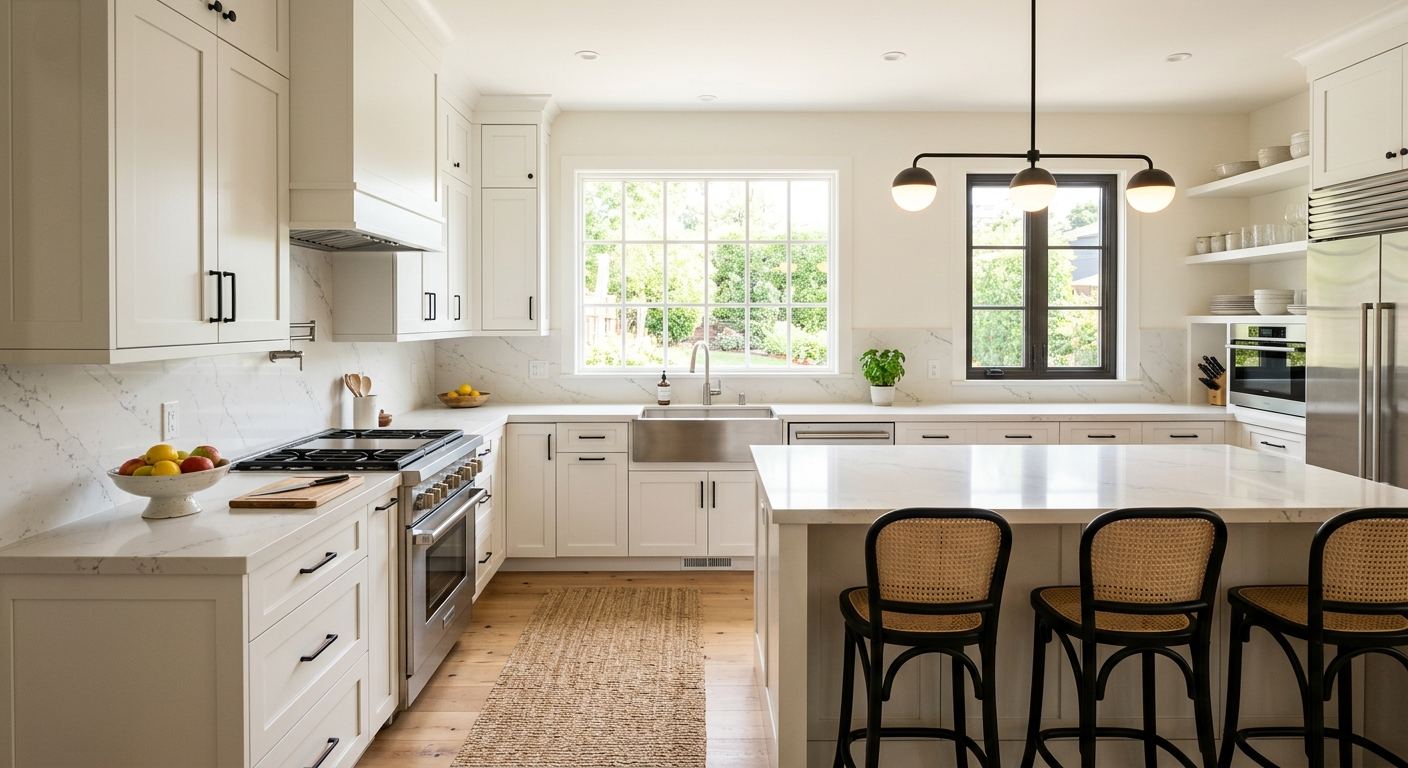
Kitchen renovation options and costs in Richfield
Richfield kitchen renovations usually start with what you can see—finishes, appliances, and layout—but the real drivers are cabinet and countertop choices, plus how much labour is needed in a busy Calgary-area trade market. With a 2021 population of 3,299 in Richfield (Statistics Canada, 2021 Census), many homeowners share a similar goal: improve resale appeal without disrupting life for months. At the same time, Calgary’s surrounding economic region tends to support higher finish expectations because household spending power is strong (Statistics Canada, 2021 Census), and buyers often look for kitchens that feel current—clean lines, durable surfaces, and good lighting. That’s why many projects in the Calgary economic region cluster in the mid five-figures for full redesigns, and can climb toward six figures when an island is added or walls are moved.
Alberta’s winter freeze–thaw cycles don’t directly “break” a kitchen, but they do influence how trades manage drying time, material handling, and site access during renovation seasons. More importantly, demand in the Calgary orbit can tighten scheduling—when availability is limited, project management, design time, and on-site labour can become a bigger share of your budget. In Richfield, trade demand is especially steady around the newer residential pockets near the county edge where homeowners tend to upgrade soon after occupancy.
To help you compare apples-to-apples, here are realistic renovation tiers and what they typically include—then you can match your scope to a budget.
| Renovation Tier |
What's Included |
Typical Duration |
Price Range |
| Cosmetic refresh (paint, hardware, new appliances only) |
Cabinet paint or repaint, new pulls/knobs, repaint walls/trim, appliance swap (no plumbing/gas move), basic caulking, touch-up finishes |
2–5 days |
$4,000–$12,000 |
| Mid-range full renovation (new cabinets, counters, sink, tile) |
New semi-custom cabinets, countertop (quartz popular), new sink and faucet, backsplash tile, flooring repairs/replacement as needed, plumbing connections (no major relocation) |
3–6 weeks |
$25,000–$65,000 |
| High-end full renovation (custom cabinets, stone counters, island) |
Fully custom cabinetry, premium stone/quartz, island buildout, enhanced lighting, upgraded backsplash (tile/stone), permit-based electrical/plumbing changes if moving services |
6–12 weeks |
$65,000–$120,000 |
| Cabinet refacing only (new doors + drawer fronts, same boxes) |
Refacing doors/drawer fronts, new hardware, repaint interior frames if needed, countertop disconnect/reconnect if required (varies), labour for clean installation |
1–3 weeks |
$8,000–$30,000 |
| Countertop swap only (laminate to quartz or stone) |
Removal of old top, install new quartz/stone, sink cut-out fit (as needed), basic sealing and caulking, backsplash rework only if required |
3–7 days |
$3,000–$12,000 |
| Backsplash tile installation only |
Surface prep, tile supply & installation (standard pattern), grout/seal where needed, caulking at edges, cleanup |
2–5 days |
$2,500–$8,000 |
Prices are estimates only and vary by project scope, site access and material selection.
What affects the price of kitchen renovation in Richfield
Even when two homeowners in the Calgary economic region request “the same kitchen,” quotes can swing by 30–50% because the real work hides in the details: cabinet construction, countertop complexity, electrical additions, and how existing walls and services were built. In higher-value Calgary-area pockets, homeowners typically prioritize durable surfaces—often quartz or natural stone—and semi-custom cabinetry because the renovation cost is more easily recovered on resale. In more modest markets, the budget-friendly combination of laminate counters and stock cabinets often wins out, and homeowners still get a strong refresh without taking on redesign-level costs. The climate doesn’t set the price in a direct way; trade demand, material lead times, and service changes do.
In Richfield, two practical examples show how scope changes can move your budget fast. First, if your kitchen was built with older plumbing runs, relocating a sink typically requires opening walls and adding labour for re-routing—this can push a “mid-range” job toward the higher end of the $25,000–$65,000 band. Second, if you add an island and want under-cabinet lighting or dedicated circuits, the electrical side can add measurable cost even when finishes stay mid-tier. Age of housing matters: older homes often need more demolition and patching before new cabinets sit perfectly level.
Material selection still matters more than weather. Upgrading from laminate to quartz or adding a full-height backsplash can raise costs, but it also aligns with what buyers expect in Calgary-area sales. When budgets stretch, the jump from a $65,000–$120,000 high-end scope usually comes from moving walls/services, upgrading millwork, and building an island that looks “custom” rather than just “larger.”
| Price Factor |
Why It Matters |
Cost Impact |
| Cabinet tier — stock vs. semi-custom vs. fully custom millwork |
Custom boxes, upgraded hardware, better finish quality, and more fitting for odd walls increase material and labour time |
Often the single biggest swing between mid-range and high-end; can move a project by tens of thousands |
| Countertop material — laminate vs. quartz vs. granite vs. stone |
Thickness, edge profiles, and seam/edge complexity drive fabrication; stone also adds sealing and heavier install logistics |
Laminate is typically lowest; quartz and natural stone commonly push costs into higher countertop bands |
| Layout change — wall removal, island add, plumbing/gas move |
Service relocation triggers demolition, inspection steps, and coordinated trades (plumbing, gas, electrical, carpentry) |
Can be the difference between “full refresh” budgets and redesign-level budgets |
| Appliance package tier — builder vs. mid-range vs. pro-grade |
Pro-grade units may require different clearances, electrical specs, ventilation, and matching finishes |
Can add thousands quickly depending on range, venting, and fridge style |
| Flooring — refinish existing vs. full replacement |
Cabinet removal and leveling can require matching floor transitions; subfloor condition affects prep cost |
Refinishing can keep flooring spend down; full replacement is a common add-on |
| Backsplash — ceramic tile vs. marble vs. full-height slab |
Higher-end materials increase both material price and labour for cuts, grout lines, and heavier installs |
Full-height and premium tile often land closer to the upper end of backsplash budgets |
| Electrical — new circuits for island, under-cabinet lighting |
Lighting plans require additional wiring runs and often a coordinated inspection |
Small upgrades add cost; major island electrical can significantly increase scope |
| Permit fees and licensed trade requirements |
When permits apply, you add admin time plus licensed-trade scheduling and inspections |
Not usually the biggest cost driver, but it raises the “hard” portion of the budget |
Permits & regulations in Alberta
In Alberta, simple cabinet and countertop swaps typically do not require a permit. If you’re keeping plumbing and gas where they are and you’re not changing the electrical load, many kitchen refresh scopes can be handled with standard trades work. However, Richfield homeowners should assume permits are likely when you change “services,” alter structural elements, or add major electrical scope.
Work that typically does require permits and licensed trades includes: moving plumbing supply or drain lines (for example, relocating a sink), relocating gas for a stove/range, adding or relocating a gas line, removing a load-bearing wall or making structural changes, and adding electrical circuits (for example, new power for an island or upgraded under-cabinet lighting tied into a new circuit). Gas work must be performed by a licensed gas fitter, and electrical work must be performed by a licensed electrician—both should be inspected where required by the permitting process.
Step-by-step verification you can do before you sign: (1) ask the contractor for their licence number(s) and the trade contacts they will use; (2) request a certificate of liability insurance showing they carry active coverage; (3) request evidence of coverage for their workers (commonly WSIB/WCB clearance documentation depending on trade/employer); (4) confirm who pulls permits for your specific scope in writing. Finally, ask to see the contractor’s insurance certificate and clearance letter before deposits are paid, not after you approve the schedule.
Always confirm permit responsibility in your contract—don’t rely on verbal “we’ll take care of it.”
Cabinets, countertops and layout decisions in Richfield
The three decisions that most affect your final kitchen in Richfield are: (1) cabinet tier (stock, semi-custom, or custom), (2) countertop material (laminate, quartz, granite, butcher block, or marble), and (3) whether you change layout (open-concept wall removal, island addition, or plumbing/gas relocation). These choices don’t just influence how the kitchen looks; they determine how much time trades spend adjusting to older framing, how many seams you’ll have in stone, and how many inspections are triggered.
On cabinets, stock is the fastest and usually the lowest cost because boxes are mass-produced and fitting is simpler. Semi-custom cabinets are the mid-range “sweet spot” in the Calgary resale market: they offer more sizes and better styling at a price that still fits many $25,000–$65,000 full renovations. Custom cabinets cost more, but they excel when your room has irregular walls, older soffits, or you want a tight, built-in island look. On countertops, laminate offers budget relief, but quartz or natural stone holds value better and typically feels more “premium” to buyers. Butcher block can work beautifully for warmth; it needs more maintenance and sealing, especially with Alberta’s active indoor humidity swings caused by winter heating.
Layout changes are where cost can become unpredictable regardless of finish tier. For example, if you add an island and keep all services in the same location, you may stay near the mid-range band; if you relocate plumbing or gas, you’re more likely to jump closer to the upper end of the market’s $65,000–$120,000 projects due to demolition, licensed trades coordination, and inspection steps. A practical dollar example: keeping the sink location can keep countertop and cabinet spend on track, while moving the sink often adds enough labour and patching that the budget can creep by several thousand dollars even before you upgrade to stone.
For most Richfield resale-focused homeowners, the most justified upgrade is aligning cabinetry and quartz with a layout that improves flow—without moving services unless the space gain is clearly worth the hassle.
| Option |
Durability |
Maintenance |
Best For |
Price Range |
| Stock cabinets (big-box) |
Solid for day-to-day use; limited customization for odd spaces |
Low; occasional hardware adjustments and refinishing as needed |
Fast refreshes and tighter budgets where layout stays mostly unchanged |
$8,000–$20,000 |
| Semi-custom cabinets (local dealer) |
Good build quality with better fit and finish options |
Low to moderate; protect against moisture near dishwasher/sink |
Most Richfield kitchens targeting resale-friendly upgrades |
$18,000–$40,000 |
| Custom cabinets (local millwork shop) |
Highest durability potential with precise fitting and specialty storage |
Low; durable finishes but still avoid standing water at the sink |
Heritage layouts, built-in islands, and buyers who want a “designed” look |
$35,000–$70,000+ |
| Laminate countertop |
Moderate; can chip at edges if impacted; heat requires care |
Low; avoid prolonged heat and protect from water at seams |
Cost-sensitive upgrades when you’re keeping a tight budget |
$3,000–$6,000 |
| Quartz engineered countertop |
Very durable; resists staining and daily wear well |
Low; wipe clean routinely; use trivets near hot items |
Most popular “looks-stone” choice that fits busy households |
$6,000–$12,000 |
| Granite / natural stone countertop |
High durability; unique patterns; can handle daily cooking well |
Moderate; sealing helps manage porosity depending on stone |
High-end kitchens where natural variation is a selling point |
$8,000–$16,000 |
| Butcher block countertop |
Durable if maintained; sensitive to standing water and heavy soaking |
Moderate; regular oil/maintenance plan recommended |
Warm, casual kitchens and homeowners who like prep-friendly surfaces |
$5,000–$12,000 |
| Marble countertop |
Beautiful but softer than quartz; can etch with acids |
Higher; needs careful cleaning and sealing discipline |
Statement kitchens where aesthetics outweigh heavy everyday cooking wear |
$10,000–$20,000+ |
How to choose a kitchen renovation contractor in Richfield
Choosing the right kitchen renovation contractor in Richfield is mostly about verifying trades, confirming the scope, and protecting your cash flow. In Alberta, start by verifying licensing: ask for the specific contractor licence and the names/licence numbers for any gas work (licensed gas fitter) and electrical work (licensed electrician). Next, request proof of liability insurance—if something is damaged in your home, you want coverage to be active. Finally, ask for WSIB/WCB coverage documentation or a current clearance letter showing the contractor’s workers are properly covered. Don’t accept screenshots from old documents; request current paperwork.
Then get 2–3 itemised written quotes. You want labour and materials broken down by cabinetry, countertops, demolition, plumbing/electrical allowances, flooring changes, tile/backsplash, disposal, and any permit administration. Avoid “one price” quotes that hide assumptions. Read the scope carefully for exclusions: what happens if the subfloor is out of level, who replaces damaged drywall, whether disposal is included, and whether your contractor is responsible for permit applications when services change. Warranty matters too—confirm workmanship warranty length, product/manufacturer warranties for cabinets and counters, and whether warranties transfer if you sell your home.
Payment schedule guidance: never pay more than 10–15% upfront. Use a holdback until completion or until punch-list items are done. Finally, insist on a written timeline with a start date and a realistic completion estimate.
- Ask for Alberta trade licence numbers and match them to the exact work in your scope.
- Request current liability insurance and confirm coverage limits.
- Confirm WSIB/WCB clearance/coverage for the contractor’s workers.
- Get 2–3 itemised quotes (no lump-sum “mystery numbers”).
- Verify permit responsibility in writing if you’re moving plumbing, gas, electrical, or load-bearing elements.
- Confirm disposal and dump fees are included (or listed as a separate line).
- Require lead-time estimates for cabinets and countertops and what happens if materials slip.
- Check who handles site protection and cleanup during demolition.
- Review warranty coverage for workmanship and products; ask whether it’s transferable.
- Use a payment schedule with 10–15% max upfront and a holdback until completion.
- Request a detailed construction schedule with key milestones (demo, rough-in, install, final).
- Make sure changes are priced in writing with change-order forms before work proceeds.
In Richfield, the biggest red flags I see are: (1) no itemised quote and vague “allowances” that can expand later, (2) refusal to provide proof of insurance/coverage, (3) unclear permit responsibility when moving sink/stove or adding electrical, (4) payment requests that front-load too much cash, and (5) no written schedule or warranty details.
Frequently asked questions — kitchen renovation in Richfield
How do I budget for a kitchen renovation?
In Richfield and the Calgary economic region, budget starts with your renovation tier and how much you change services. If you’re doing a cosmetic refresh, you can often keep it in the lower range (commonly around $4,000–$12,000), but full redesigns typically land mid five-figures to higher depending on stone and cabinetry. A practical approach is to separate “visible upgrades” (cabinets, counters, backsplash) from “hidden work” (plumbing/gas/electrical updates, subfloor repairs, framing adjustments). Even if your finishes are mid-range (for example a $25,000–$65,000 scope), layout moves can push costs higher because licensed trades, inspections, and demolition add labour. Since Alberta winter can affect site access and drying time, schedule your renovation thoughtfully and keep a contingency for delays and unexpected prep needs.
Can I move my kitchen sink or stove?
Yes, but in Alberta it’s not a “free” decision cost-wise because it usually involves permits and licensed trades. Moving a sink typically means rerouting drain and supply lines, which commonly requires opening walls and coordinating plumbing—expect that to affect both timeline and budget. Relocating a stove or cooking appliance that uses gas may require a licensed gas fitter and permit steps; venting and clearance details matter for safety. If you’re aiming to keep your project in the mid-range band (for example $25,000–$65,000), the easiest win is to keep plumbing/gas close to the existing locations and focus on cabinetry, quartz, and tile. For a full redesign closer to $65,000–$120,000, relocating services is where many homeowners see the biggest jump in labour and coordination costs. A contractor should confirm exactly what needs permits in your written scope before you sign.
What's the most cost-effective kitchen upgrade?
For most Richfield homeowners, the most cost-effective upgrade is often one of two paths: (1) cabinet upgrades that dramatically change the look without full replacement, or (2) countertop upgrades that immediately modernize the space. Cabinet refacing—new doors and drawer fronts over existing boxes—can deliver a big visual shift without the demolition and install time of full cabinet replacement; it often fits budgets around $8,000–$30,000 depending on complexity. Alternatively, a countertop swap (for example laminate to quartz) can be a clean upgrade when the cabinet layout is staying put; countertop-only projects often fall around $3,000–$12,000. If you want the best “value per square foot,” match the upgrade to what buyers notice first: cabinet fronts, countertop colour/pattern, and lighting. In Calgary-area resale, kitchens that look cohesive with quartz and good backsplash finishes usually show better than those that only repaint and leave dated surfaces.
Custom vs stock cabinets — is custom worth it?
Custom cabinets are worth it when you have a layout that stock can’t fit well or when you want a specific built-in look (like an island that ties into ceiling lines and specialty storage). In Richfield homes, older framing and occasional off-square walls can make “almost fitting” cabinet installs look off over time, and custom can solve that with better fitting and design flexibility. If your goal is speed and budget control, stock cabinets are usually the most economical option and work well when the room is straightforward. Semi-custom often hits the middle ground: more sizing options than stock, less cost than fully custom millwork. A typical way to think about value is whether you’re moving toward a full redesign budget—projects closer to $65,000–$120,000 are often where custom makes sense because the overall scope already includes more labour, upgraded countertops, and sometimes service changes. If you’re trying to stay near $25,000–$65,000, consider semi-custom and put the money into quartz and better lighting first.
How do I choose a kitchen contractor in Richfield?
Start with verification: in Alberta, ask the contractor for current proof of liability insurance and evidence of coverage/clearance (WSIB/WCB documentation). For work that involves gas or electricity, confirm the licensed gas fitter and licensed electrician who will perform the tasks. Next, get 2–3 itemised written quotes—look for separate lines for demolition, cabinetry, countertops, tile/backsplash, plumbing/electrical allowances, disposal, and any permit administration. A good contractor clearly explains what’s included and what’s excluded (for example, whether disposal is included and what happens if the subfloor needs patching). Confirm warranty terms: workmanship warranty length and manufacturer warranty for cabinets/counters, and whether warranties are transferable. Finally, protect your cash flow: keep deposits to around 10–15% upfront and hold back until completion. If your contractor can’t provide current paperwork or won’t itemise the quote, treat that as a major risk—especially when your scope could require permits due to plumbing, gas, or electrical changes.
What order do kitchen renovation steps happen in?
A typical kitchen renovation sequence in Alberta goes: (1) design/measurements and final selections (cabinets, counters, appliances), (2) demolition and site protection, (3) rough-ins for plumbing/electrical and any permit-required work, (4) inspections where required, (5) install cabinetry/box framing, (6) countertops fabrication/installation, (7) backsplash and flooring finishing, (8) install appliances and final trim, (9) final cleaning and a punch-list walkthrough. Keeping this order protects trades from rework—for example, cabinetry should be installed before countertops are templated. If you’re changing services like moving a sink or stove, rough-in timing and inspections can add days, which is why your contractor should provide a written schedule and confirm permit steps early. With Alberta winter and indoor heating, contractors also manage drying times and moisture control for drywall/patching, so rushing the sequence can affect paint and caulking quality.