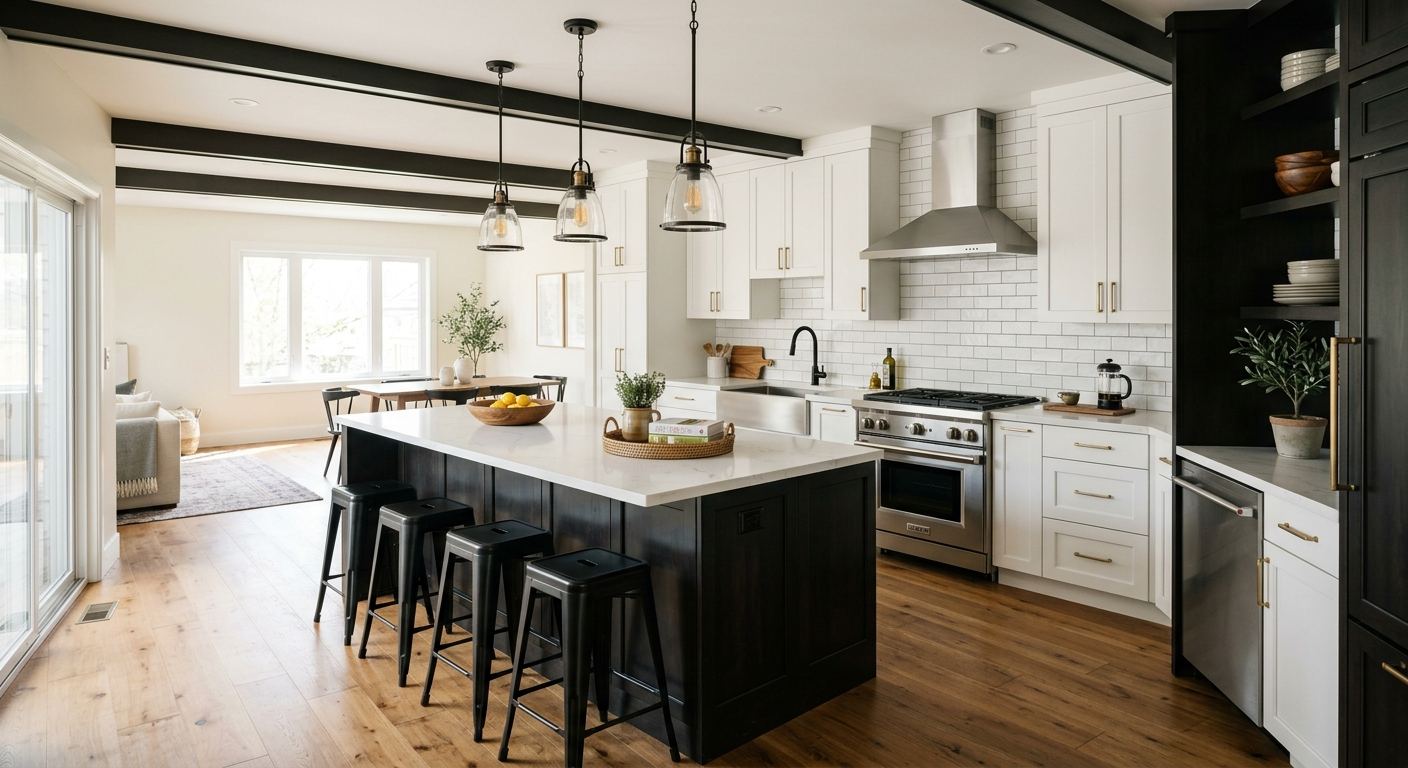
Kitchen renovation options and costs in Provost
Provost homeowners typically start their kitchen planning by matching renovation scope to today’s resale expectations and household budgets. With a median household income of $84,000 (Statistics Canada, 2021 Census), many families in Provost budget for targeted improvements rather than a full, layout-altering gut. At the same time, the market is influenced by the fact that many local homes are older—59.9% were built before 1981 (Statistics Canada, 2021 Census)—so renovations often involve tricky floor/trim transitions, dated plumbing runs, and electrical catch-up for modern ventilation and under-cabinet lighting.
In the Camrose–Drumheller economic region, pricing is shaped more by finish tier and cabinetry choices than by climate alone. The winter freeze-thaw cycles and long heating seasons don’t just affect the building envelope; they also impact installation conditions—work sequencing, subfloor preparation, and how long materials need to acclimatize (especially laminate and engineered surfaces). Contractors also see seasonal scheduling pressure, so mid-range full renovations and custom millwork projects may take longer to start during peak summer demand.
In Provost—particularly around the core residential areas near downtown—there’s strong demand for mid-range refreshes because many homeowners want a “move-in ready” kitchen without over-improving for resale. Below is a clear comparison of common renovation paths and the price bands homeowners use to compare quotes before you lock in scope.
| Renovation Tier |
What's Included |
Typical Duration |
Price Range |
| Cosmetic refresh (paint, hardware, new appliances only) |
Cabinet paint or restyle, new hardware/handles, paint touch-ups, appliance swap (no electrical/plumbing relocation), optional re-caulk and minor trim repair |
1–3 weeks |
$8,000–$18,000 |
| Mid-range full renovation (new cabinets, counters, sink, tile) |
New stock or semi-custom cabinets, new counters, sink and faucet, backsplash tile, flooring patching, basic lighting updates (no major layout change) |
4–8 weeks |
$30,000–$60,000 |
| High-end full renovation (custom cabinets, stone counters, island) |
Custom millwork, stone counters, island with seating, upgraded backsplash, ventilation/lighting upgrades, improved storage layout, disposal and sink refinishing as needed |
8–14 weeks |
$60,000–$80,000 |
| Cabinet refacing only (new doors + drawer fronts, same boxes) |
Replace doors/drawer fronts, new hardware, cabinet box preservation where possible, minor sanding/repair, new backsplash as an add-on if desired |
2–4 weeks |
$6,000–$18,000 |
| Countertop swap only (laminate to quartz or stone) |
Remove old counters, new quartz/stone install, undermount sink cut-outs, edge profile selection, caulking and basic backsplash touch-up |
1–2 weeks |
$6,500–$12,000 |
| Backsplash tile installation only |
Tile layout and install (ceramic/porcelain), grout/seal as required, edge trims, silicone/caulk at transitions |
3–7 days |
$1,500–$5,000 |
Prices are estimates only and vary by project scope, site access and material selection.
What affects the price of kitchen renovation in Provost
In Provost and across the Camrose–Drumheller economic region, you can easily see the same “kitchen refresh” priced 30–50% differently. The big drivers aren’t usually climate; they’re what homeowners choose to recover on resale—cabinet tier, countertop material, and whether you change the layout. Even with Alberta’s shared winter conditions, the market expectation in higher-income households is often a more durable, higher-clarity finish: quartz or stone counters and semi-custom cabinetry are commonly selected when buyers expect a modern look. With a median household income of $84,000 (Statistics Canada, 2021 Census), many projects land in the mid-range bands (for example, mid-range full renovations often price within the $30,000–$60,000 range), while more extensive custom work stretches toward $60,000–$80,000.
Older housing stock—59.9% of homes built before 1981 (Statistics Canada, 2021 Census)—also affects costs. You’ll often see additional subfloor prep, minor moisture corrections around exterior walls, and electrical updates for new lighting and ventilation. Laying tile over uneven old walls can take longer, and moving gas/plumbing routes through older framing can add labour regardless of finish tier.
Concrete examples from Provost: (1) swapping laminate for quartz can be comparatively straightforward, but only if the countertop supports and sink cut-outs are already compatible; otherwise expect added cabinet-top labour and template adjustments. (2) adding an island often increases cost more than homeowners expect because it triggers electrical (new circuits for outlets/lighting) and potentially plumbing or venting changes. (3) choosing full-height slab-style backsplashes and premium stone over ceramic tile raises material and install time, pushing you toward the upper end of the regional bands.
| Price Factor |
Why It Matters |
Cost Impact |
| Cabinet tier — stock vs. semi-custom vs. fully custom millwork |
Higher-tier cabinetry changes material quality, fit/finish, and custom sizing—often the largest single cost after demolition. |
Typically shifts a full project by roughly $10,000–$25,000 depending on scope |
| Countertop material — laminate vs. quartz vs. granite vs. stone |
Material cost plus fabrication complexity; stone may require different edge profiles and more labour for templating/handling. |
Often adds about $2,500–$12,000 compared with laminate, depending on thickness and edges |
| Layout change — wall removal, island add, plumbing/gas move |
Rework drives unpredictable labour: framing, venting, plumbing offsets, subfloor repairs, and re-patching finishes. |
Commonly moves projects up by $5,000–$20,000+ even with the same cabinet/finish tier |
| Appliance package tier — builder vs. mid-range vs. pro-grade |
Pro-grade appliances can require different electrical/venting specs and add longer lead times. |
Can swing costs by $1,500–$8,000+ |
| Flooring — refinish existing vs. full replacement |
In older Provost homes, existing flooring may be uneven or damaged during demo, increasing patching or full replacement. |
Usually impacts the job by $1,000–$6,000 |
| Backsplash — ceramic tile vs. marble vs. full-height slab |
Premium tile/stone needs more careful layout, sealing, and handling; full-height coverage increases material and time. |
Typically $1,500–$8,000 depending on coverage and materials |
| Electrical — new circuits for island, under-cabinet lighting |
Lighting and outlet requirements add licensed electrical labour and sometimes permit-related steps. |
Often $800–$4,500+ depending on complexity |
| Permit fees and licensed trade requirements |
Where work involves gas, significant electrical changes, or structural alterations, timelines and compliance steps add cost. |
May add $300–$2,500+ depending on scope |
Permits & regulations in Alberta
In Alberta, homeowners often hear “no permit” for straightforward kitchen replacements—and in many cases, that’s true. Cabinet and countertop swaps typically do not require permits because they’re considered like-for-like finish work. However, if you move plumbing supply or drain lines, relocate gas (including changing the location of a stove or modifying a gas range setup), remove a load-bearing wall, or add new electrical circuits (common with island outlets and under-cabinet lighting), permits and licensed trades are usually required.
Gas-related work must be done by a licensed gas fitter, and electrical work must be completed by a licensed electrician. Both trades typically require inspections after the work is complete. The key point for Provost homeowners is that you should confirm who pulls permits—contractors often handle it, but it must be clearly stated in the written contract.
Step-by-step, verify a contractor properly before signing: (1) Ask for proof of Alberta licence for the trades involved (gas fitting/electrical when applicable), and check the licence details through the appropriate online registry. (2) Request a current certificate of liability insurance and make sure it matches the scope (kitchen renovation includes demolition risk and material handling). (3) Ask for WSIB/WCB clearance where applicable to the contractor’s workers and subcontractors. (4) Keep the paperwork—licence, insurance certificate, and clearance letter—on file so there are no surprises if inspectors need documentation later.
Cabinets, countertops and layout decisions in Provost
Three decisions drive most of the real “cost vs value” outcome in a Provost kitchen renovation: (1) cabinet tier, (2) countertop material, and (3) whether you change the layout. Start with cabinets. Stock cabinets are the fastest and cheapest because sizing is standardized and installation is predictable. Semi-custom cabinets are the most popular mid-range choice: you get better storage planning and more flexible sizing while still keeping your budget closer to the $30,000–$60,000 full-renovation band. Custom cabinets deliver the best fit in older Provost layouts—helpful when ceilings or walls aren’t perfectly square—but they push projects toward the $60,000–$80,000 range.
Countertops should match both your maintenance comfort and how you use the kitchen in Alberta’s climate. In long winters, homes run drier indoors for heating; that can make caulking and adhesives behave differently around sinks and seams, so proper installation matters. Laminate is budget-friendly and durable for daily use, but quartz offers a more “set-and-forget” finish for families who cook often. Granite/natural stone looks premium and resists everyday wear, while butcher block adds warmth but needs more maintenance to protect against water exposure near the sink. Marble is beautiful but typically demands the most care (sealing and stain management).
Layout changes are where budgets often go sideways. Removing a wall or adding an island is justified when it clearly improves circulation and lets you create practical zones (prep, cooking, cleaning). A simple example: if you keep the sink location and avoid moving gas lines, you can often stay within a mid-range renovation budget; but if you add an island and relocate plumbing/gas, the electrical and compliance steps can erase savings from choosing stock cabinets.
| Option |
Durability |
Maintenance |
Best For |
Price Range |
| Stock cabinets (big-box) |
Good for everyday use; depends on finish and hardware quality |
Low; clean with standard non-abrasives |
Budget-focused remodels and quicker turnarounds |
$6,000–$14,000 |
| Semi-custom cabinets (local dealer) |
Very good; improved options for storage and sizing |
Low to moderate; keep hinges and slides maintained |
Most Provost homeowners aiming for mid-range resale appeal |
$14,000–$30,000 |
| Custom cabinets (local millwork shop) |
Excellent; best fit and stronger built-in storage planning |
Low; longevity depends on hardware and finish |
Challenging layouts and “built for your life” kitchens |
$30,000–$45,000+ |
| Laminate countertop |
Good; can chip at edges if impacts occur |
Low; avoid standing water at seams |
Keeping costs accessible and still upgrading the look |
$2,500–$5,000 |
| Quartz engineered countertop |
Very good; resists stains and everyday wear |
Low; clean with normal household products |
Families who want durability with a modern appearance |
$5,500–$10,000 |
| Granite / natural stone countertop |
Excellent; strong surface with natural character |
Moderate; sealing schedule depends on the specific stone |
Premium look without as much surface “plastic” feel |
$7,000–$12,000 |
| Butcher block countertop |
Good; susceptible to scratches and water exposure |
Moderate; requires periodic oiling and careful wet protection |
Warm aesthetic for active cooking spaces |
$4,500–$8,000 |
| Marble countertop |
Good to very good; can etch/stain with acidic spills |
Higher; sealing and careful cleaning are important |
Statement kitchens where appearance outweighs low-maintenance needs |
$8,000–$12,000+ |
How to choose a kitchen renovation contractor in Provost
Choosing the right contractor in Provost is less about flashy photos and more about proof. First, verify Alberta licensing where it applies: if your scope includes gas work or new electrical circuits, confirm the trades are licensed and working under appropriate compliance. Ask for a certificate of liability insurance showing active coverage, then request evidence of WSIB/WCB coverage or clearance documentation for their workers. You should be able to view copies before the first payment and again if subcontractors change mid-project.
Next, get 2–3 itemised written quotes that separate labour and materials. Avoid “one line” lump sums—require details for demolition, cabinet install, countertop templating/fab, tile set/backsplash prep, electrical/ventilation allowances, and disposal. Clarify exclusions up front: is permit pulling included, who provides dumpster/disposal, and what happens if the subfloor is worse than expected after demo? A good contractor will include a realistic allowance for hidden conditions and explain how change orders are calculated.
Warranty and payment structure matter. Ask for the workmanship warranty length (how long they stand behind install details) and whether product warranties from cabinet/countertop suppliers are included and transferable. For payment, never accept a plan with more than about 10–15% upfront. Hold back remaining funds until key milestones are complete. Finally, ensure you have a start date and a completion estimate in writing, plus a clear schedule for ordering cabinets and countertops to reduce downtime.
- Request licence/registration details for the applicable trades before work starts.
- Confirm liability insurance certificate is current and matches the project dates.
- Get WSIB/WCB clearance documentation for workers involved.
- Use itemised quotes: labour vs materials vs allowances.
- Require a written demolition/disposal plan (dumpster, transport, tipping fees).
- Confirm whether permit fees and inspections are included or billed separately.
- Make sure electrical scope is clear (island outlets, lighting, vent fan controls).
- Ask who orders cabinets/counters and who pays for delays due to ordering errors.
- Check warranty terms in writing: workmanship duration and coverage limits.
- Confirm product warranty transferability for future homeowners.
- Keep payment schedule milestone-based, with a small upfront deposit only.
- Get a timeline with key dependencies: templating, fabrication lead times, inspection dates.
In Provost, red flags I see often include: vague scopes (“we’ll handle it” without line items), quotes that don’t list who is responsible for permits, workmanship warranty that’s shorter than the industry norm or not stated in writing, payment schedules with large upfront deposits, and contractors who won’t provide insurance/WSIB/WCB clearance documentation before you commit.
Frequently asked questions — kitchen renovation in Provost
How do I budget for a kitchen renovation?
For budgeting in Provost (and the wider Camrose–Drumheller region), start by choosing your tier: cosmetic refreshes usually stay the most accessible, while mid-range full renos are the most common. If you’re updating cabinets and counters without heavy layout changes, many homeowners plan around the $30,000–$60,000 band. If you’re doing custom cabinetry, adding an island, and selecting premium stone, budgets often move toward $60,000–$80,000. Next, decide early whether you’re changing plumbing/gas or electrical—layout changes are where costs jump and timelines extend. Because many Provost homes are older (59.9% built before 1981, Statistics Canada, 2021 Census), set aside a contingency for subfloor/trim surprises after demo, even with good contractors.
Can I move my kitchen sink or stove?
Yes, you can move a sink or stove in Alberta, but whether it’s expensive depends on what’s being moved and what runs through the walls and floors. Moving a sink usually involves plumbing supply and drain changes, which typically requires permitted work and licensed plumbing trades. Moving a stove is different: if it’s gas, relocation must be done by a licensed gas fitter and often includes ventilation and inspector sign-off. In older Provost homes, routing new lines can mean additional framing and subfloor patching, so the “same cabinets, new location” option can cost substantially more than keeping the existing rough-in locations. If you want to manage budget, ask your contractor to price two scenarios: “like-for-like location” versus “relocate,” so you can see the true premium.
What's the most cost-effective kitchen upgrade?
In Provost, the most cost-effective upgrade is usually one that changes the look with minimal demolition. Cabinet refacing (new doors and drawer fronts on existing boxes) is often the best value when the cabinet boxes are solid, because it avoids a full gut. Another strong option is a countertop swap—especially moving from older laminate to quartz—because it modernizes the entire kitchen visually without rebuilding cabinets. For many homeowners, a backsplash upgrade is also relatively affordable and high-impact, particularly when paired with fresh hardware and upgraded lighting. If you’re starting from a basic layout and want impact fast, focus on cabinets + counters first, then backsplash and appliances. A full refresh can look like a bigger renovation without landing in the full $30,000–$60,000 range.
Custom vs stock cabinets — is custom worth it?
Custom cabinets are worth it when your Provost kitchen layout is challenging (out-of-square walls, awkward corners, or a strong storage plan you can’t achieve with standard sizes). Stock cabinets are usually the most cost-effective and fastest, especially if your goal is to refresh finishes while keeping the original footprint. Semi-custom is often the best compromise for most households—enough flexibility to improve storage and fit while keeping you closer to mid-range renovation budgets. A helpful rule of thumb: if your project is already near the mid-range $30,000–$60,000 band, spending the extra money on fully custom millwork can push you into the upper-cost tier, especially when combined with an island or plumbing/gas relocation.
How do I choose a kitchen contractor in Provost?
Choose a contractor by verifying compliance, not by trusting marketing. Ask for a copy of their liability insurance and evidence of WSIB/WCB coverage or clearance for workers. For jobs involving gas or electrical changes, confirm the relevant licensed trades are properly authorized and that the contractor will manage inspections where required. Next, require 2–3 itemised quotes with labour/material breakdowns—especially for demolition, cabinetry installation, countertop templating/fab, tile prep and disposal. Make sure the scope states whether permit pulls are included and who is responsible for any design adjustments if hidden conditions are discovered during demo. Finally, compare warranty terms: confirm workmanship warranty length, product warranty coverage, and whether warranties are transferable if you sell. If a contractor won’t provide insurance/clearance paperwork, treat that as a serious red flag.
What order do kitchen renovation steps happen in?
A typical order for a kitchen renovation in Provost starts with measurement and layout confirmation, then demolition and rough-in (plumbing/electrical/ventilation) where needed. After rough-in, the contractor handles subfloor repairs, then install cabinets on a level foundation. Countertops typically require templating after cabinets are set, so that the fit at seams and sink cut-outs is accurate. Next comes backsplash installation and grout/finish details, followed by flooring finishing (if it was patched or replaced), appliance hookup, and final electrical/lighting checks. The last phase is trim/caulk/paint touch-ups and final walkthrough. If you’re doing a countertop-only upgrade, the order is simpler: remove old counters, template for new material, install counters, then complete backsplash/caulking. Keeping the order correct reduces rework and avoids delays that can push the project beyond the expected window.