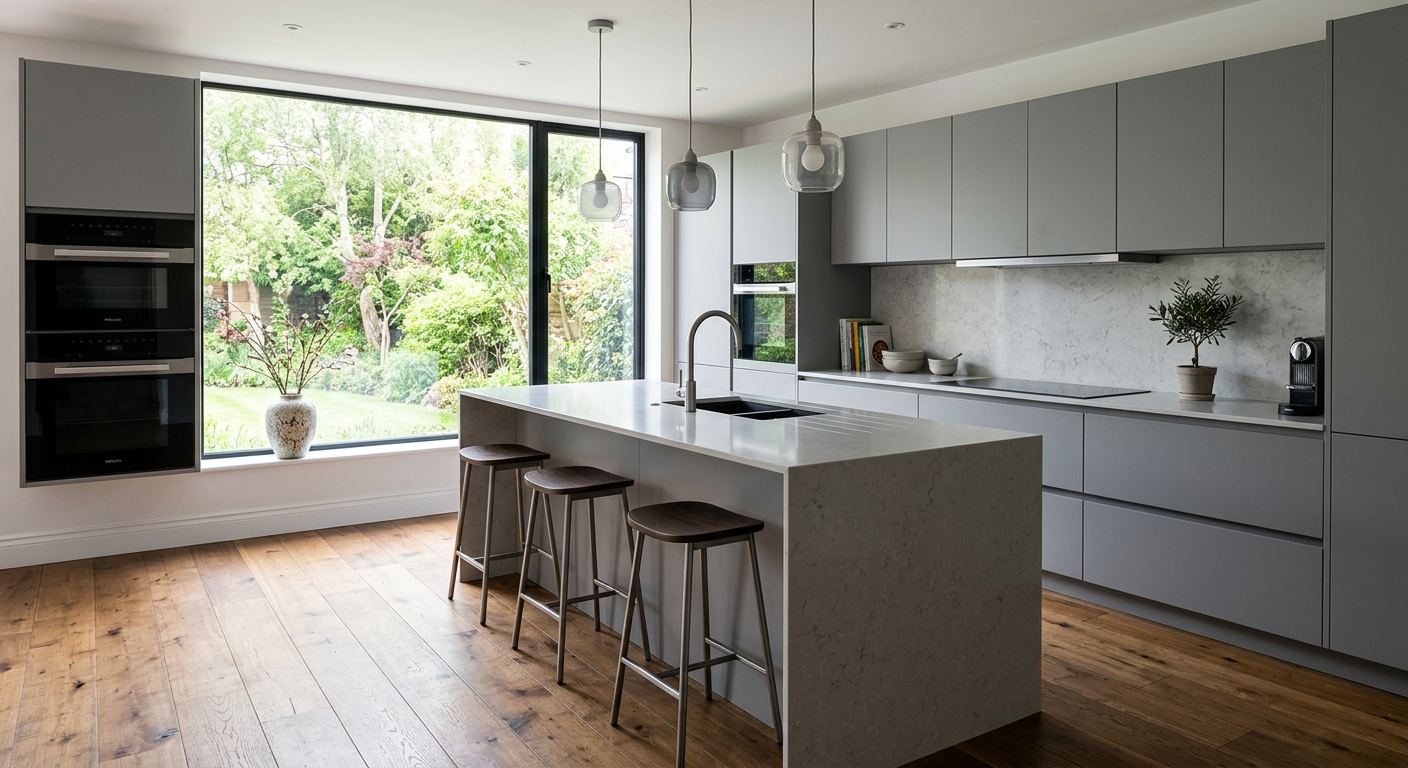
Kitchen renovation options and costs in Wainwright
Kitchen renovations in Wainwright usually start with one key reality: the community has a lot of older housing stock. With 47.3% of homes built before 1981 (Statistics Canada, 2021 Census), many kitchens were designed around smaller footprints, older electrical runs, and standard wall framing—so “simple” upgrades can uncover wiring or subfloor issues that weren’t visible during quoting. At the same time, Wainwright households are often in a position to budget comfortably; the median household income is $84,000 (Statistics Canada, 2021 Census), which helps explain why many homeowners choose mid-range finishes instead of only budget refreshes.
In the Camrose–Drumheller economic region, pricing tracks more closely to what homeowners can realistically recoup at resale than to climate alone. Alberta’s winters and summer humidity swings also matter for installation details: laminate edges, caulking lines, and adhesive cure times all benefit from tight scheduling and good ventilation. Contractor availability is strongest for straightforward cosmetic and cabinet installs; for full gut renovations with layout changes, you’ll typically book further ahead—especially around the Wainwright area where trades are in steady demand for family homes and rental turnover.
Below are common renovation tiers homeowners compare when they’re deciding between keeping costs closer to resale norms or investing in custom millwork and higher-end counters. Use the table as a planning baseline, then expect final pricing to align with your exact scope and material selections.
| Renovation Tier |
What's Included |
Typical Duration |
Price Range |
| Cosmetic refresh (paint, hardware, new appliances only) |
Surface prep and paint, new cabinet hardware, appliance swap (no plumbing/gas relocation), minor caulking/touch-ups |
3–7 days |
$3,000 – $12,000 |
| Mid-range full renovation (new cabinets, counters, sink, tile) |
New cabinetry (stock to semi-custom), countertop (laminate or quartz), new sink and taps, backsplash tile, tile flooring or touch-up, standard layout |
3–5 weeks |
$30,000 – $60,000 |
| High-end full renovation (custom cabinets, stone counters, island) |
Custom cabinetry, quartz/stone counters, island (often with lighting), upgraded backsplash (tile feature or full-height), flooring replacement, major layout adjustments |
5–9 weeks |
$60,000 – $80,000 |
| Cabinet refacing only (new doors + drawer fronts, same boxes) |
Refacing system, new doors/drawer fronts, updated hardware, careful cabinet box alignment, selective trim work |
1–3 weeks |
$6,000 – $18,000 |
| Countertop swap only (laminate to quartz or stone) |
Remove existing countertop, template and fabrication, install new countertop, sink cut-out adjustments (if needed), basic sealing |
1–2 weeks |
$2,500 – $12,000 |
| Backsplash tile installation only |
Tile supply allowance (ceramic), surface prep, tile install to typical kitchen height, grout and caulking, cleanup |
4–7 days |
$1,500 – $8,000 |
Prices are estimates only and vary by project scope, site access and material selection.
What affects the price of kitchen renovation in Wainwright
In Wainwright, two quotes for what looks like the “same” kitchen can differ by 30–50% because the labour-to-material ratio changes depending on cabinet tier, countertop choice, and whether the renovation is purely cosmetic or includes service moves. In the Camrose–Drumheller market, homeowners often decide their finish tier based on what they can credibly recover at resale. When households are renovating homes in higher-value pockets of the region, the default becomes quartz or stone counters and semi-custom cabinetry because those upgrades sell more easily. In more modest markets, laminate and stock cabinets keep the renovation closer to a reasonable payback—especially when the home is older (like many built before 1981), where buyers expect practical value over big structural changes.
Layout work adds the most uncertainty regardless of finish level. Removing a wall, adding an island, or moving a gas line typically triggers new framing, electrical runs, plumbing/gas permits, and extra subfloor repairs—those are the items that can push a project from, say, the $30,000–$60,000 mid-range band toward the $60,000–$80,000 high-end band. In Wainwright specifically, seasonal temperature swings can also affect installation sequencing: adhesives and sealants need appropriate cure conditions, and older homes may require more prep work on uneven floors before cabinets set true.
Concrete examples from common Wainwright scenarios: (1) installing an island often means adding circuits for under-cabinet or pendant lighting and potentially new receptacles, which increases electrical scope; (2) upgrading from laminate to quartz may require new sink cut-outs and under-support adjustments, adding day-by-day shop and install time; (3) replacing tile flooring after water-damage checks can uncover rotted subfloor, which changes demolition and repair costs quickly.
| Price Factor |
Why It Matters |
Cost Impact |
| Cabinet tier — stock vs. semi-custom vs. fully custom millwork |
Higher tiers have more options (heights, storage, soft-close hardware, custom sizes) and usually more labour in measuring and finishing. |
Can shift the project by $10,000–$30,000+ on full reno scopes |
| Countertop material — laminate vs. quartz vs. granite vs. stone |
Material price, thickness, fabrication complexity, and install labour all change—plus weight affects structural checks for islands. |
Typically $2,500–$12,000 just for the countertop install scope |
| Layout change — wall removal, island add, plumbing/gas move |
These tasks introduce framing, new vents/courts, permits, and trade coordination; they also uncover hidden wiring. |
Often the biggest unpredictable swing; $5,000–$25,000+ possible |
| Appliance package tier — builder vs. mid-range vs. pro-grade |
Pro-grade models can require different electrical needs, higher-spec ventilation, and more precise fit. |
Can move the budget by $1,500–$8,000+ |
| Flooring — refinish existing vs. full replacement |
If you keep existing flooring, you reduce demo and waste; if you replace, you’re paying for subfloor prep and matching thresholds. |
Often $2,000–$10,000 depending on condition and finish |
| Backsplash — ceramic tile vs. marble vs. full-height slab |
Full-height systems and natural stone increase material cost and require tighter surface flatness. |
Typical backsplash spend $1,500–$8,000 (higher with premium stone) |
| Electrical — new circuits for island, under-cabinet lighting |
Added circuits, re-routing, and lighting upgrades add licensed electrician time and inspection steps. |
Commonly adds $800–$5,000+ depending on scope |
| Permit fees and licensed trade requirements |
When plumbing, gas, or structural changes are involved, you’ll need permits and licensed trades—raising coordination and inspection time. |
Can add $500–$3,000+ plus scheduling lead time |
Permits & regulations in Alberta
In Alberta, a straightforward cabinet and countertop swap typically does not require a permit. If you’re only replacing cabinets in place, changing the countertop, updating the backsplash within the existing footprint, or swapping appliances without moving plumbing or gas connections, most homeowners can proceed without pulling permits. However, Wainwright homeowners should plan for permits and licensed trades when the job changes a building system.
Work that typically DOES require permits and licensed trades includes: moving plumbing supply or drain lines (sink or dishwasher relocation), relocating a gas stove or modifying a gas range/hood connection, removing a load-bearing wall (or making structural changes that affect beams/headers), and adding electrical circuits (common with island receptacles and under-cabinet lighting upgrades). Gas work must be performed by a licensed gas fitter, and electrical work must be done by a licensed electrician, with inspections completed before walls are closed.
To verify a contractor in Wainwright step-by-step, ask for (1) their Alberta licence information (via the applicable provincial online registry), (2) a certificate of liability insurance naming you as the owner/insured where appropriate, and (3) confirmation of WCB/WSIB coverage. Then check the paperwork: insist the certificates include policy dates and the correct business name. Finally, confirm in the written contract who is responsible for permit pulling—don’t rely on verbal assurances.
Cabinets, countertops and layout decisions in Wainwright
The three most consequential decisions in a Wainwright kitchen renovation are cabinet tier, countertop material, and whether you change the layout. Start with cabinets. Stock cabinets are the fastest and cheapest because they’re pre-built and easier to fit into older kitchen openings. Semi-custom (often the most popular mid-range) balances price with better storage options and more finish choices—an important point when your house is older and buyers still want practical function. Custom cabinets create the best fit and highest storage value, but they cost more and can extend timelines due to shop fabrication.
Next is the countertop material. Laminate gives good looks for less money and works well in a limited budget; it’s generally easiest to update later. Quartz is popular in Wainwright because it resists staining and handles daily use well, but it needs correct support and careful sealing at transitions. Granite/natural stone offers a premium, unique look, while butcher block brings warmth and repairability—but requires more maintenance around moisture. Marble is high-style and beautiful, but it needs more care and can be less forgiving for heavy use.
Finally, layout. If you’re removing a wall for open concept or adding an island, you’re paying for more than demolition—you’re paying for electrical, plumbing/gas coordination and often structural checks. Those costs are justified when you gain usable storage, better work flow, or real seating space that changes how the household lives at home. For example, upgrading from laminate to quartz might add a few thousand dollars in a countertop swap band (often $2,500–$12,000), and that upgrade is usually easier to justify than major re-plumbing, which can push a mid-range plan toward the upper full-renovation band ($60,000–$80,000).
| Option |
Durability |
Maintenance |
Best For |
Price Range |
| Stock cabinets (big-box) |
Good day-to-day strength, limited custom sizing |
Low; keep hinges and slides adjusted, avoid excessive moisture at base |
Speed, budget control, straightforward installs |
$6,000 – $18,000 |
| Semi-custom cabinets (local dealer) |
Very strong; better internal storage options and finishes |
Low to moderate; wipe clean and check soft-close components |
Most Wainwright mid-range renovations |
$18,000 – $35,000 |
| Custom cabinets (local millwork shop) |
Highest quality fit and hardware options |
Low; long-life finishes if properly sealed and maintained |
Irregular spaces, storage goals, premium resale expectations |
$35,000 – $55,000+ |
| Laminate countertop |
Solid for daily use; less heat and impact resistance than stone |
Low; use trivets and avoid prolonged standing water on seams |
Value-focused projects aiming to stay mid-band |
$2,500 – $6,500 |
| Quartz engineered countertop |
High durability; resistant to staining and everyday wear |
Low; regular cleaning and prompt wipe-downs |
Families who want a “set it and forget it” surface |
$5,500 – $10,500 |
| Granite / natural stone countertop |
Very durable; natural variations and edge toughness |
Moderate; periodic sealing and careful stain management |
Premium look with a natural, high-end feel |
$7,000 – $12,000 |
| Butcher block countertop |
Durable when maintained; can show scratches and water marks |
Higher; regular oiling and protective habits near sink |
Warm, casual style and easy surface repairs |
$4,000 – $8,500 |
| Marble countertop |
Premium appearance; softer than quartz and more prone to etching |
Moderate to high; sealing and gentle cleaners are essential |
Low-to-medium traffic kitchens and statement upgrades |
$8,000 – $12,500 |
How to choose a kitchen renovation contractor in Wainwright
Choosing a contractor in Wainwright is less about who has the lowest price and more about who can build your kitchen to code, schedule it realistically, and document what you’re paying for. Start with Alberta licensing and coverage. Ask for proof of the contractor’s business licence/registration (where applicable), their liability insurance certificate (with policy dates and the correct legal name), and confirmation of WCB/WSIB coverage. For trade-specific work, require the electrician’s and gas fitter’s licences/credentials as well—especially if you’re adding island circuits or touching gas connections.
Then get 2–3 itemised written quotes. Insist the quote breaks down labour and materials separately (cabinet supply vs. install, countertop supply vs. fabrication/install, tile, disposal, electrical scope). Avoid “one-line” lump sums unless the scope is perfectly defined. Read the exclusions: is drywall patching included, is disposal included, is permit pulling included, and who coordinates inspections?
Warranty matters in kitchens because failures often show up after the dust settles. Ask for the workmanship warranty length (how long the installer covers labour), what the product warranty covers (manufacturer defects), and whether warranties are transferable if you sell the home. On payment schedule, keep the upfront deposit around 10–15% and use a holdback until completion/close-out paperwork. For timeline, don’t accept a verbal start date—get a written start date and completion estimate, including fabrication lead times for cabinets and countertops.
- Request current insurance certificate (liability) before work starts.
- Confirm WCB/WSIB coverage and ask for proof.
- Verify licensed trades for electrical and gas work (licence credentials on request).
- Get 2–3 itemised quotes with labour/material breakdown, not just totals.
- Confirm whether demo, disposal, and site protection (tarps/plastics) are included.
- Ask who pulls permits and who schedules inspections if plumbing/gas/electrical scope triggers them.
- Check cabinet measurements: verify the contractor templates before ordering.
- Confirm flooring transitions and subfloor repairs are included in writing if needed.
- Ask for a detailed backsplash scope (tile height, niche/feature handling, grout allowance).
- Review warranty length for labour and confirm manufacturer warranty terms for counters/cabinets.
- Use a payment schedule with a holdback until final walkthrough and punch list completion.
- Ensure the quote includes lead-time assumptions for countertops and cabinet fabrication.
Red flags I see in Wainwright kitchens: (1) quotes that won’t itemise labour and materials; (2) promises of “no permits needed” even when plumbing/gas/electrical is moving; (3) vague timelines with no allowance for countertop fabrication; (4) refusal to provide insurance/WCB/WSIB documentation; and (5) pushing large deposits beyond 10–15% without a clear progress schedule.
Frequently asked questions — kitchen renovation in Wainwright
How much does a kitchen renovation cost in Wainwright?
In Wainwright, the most common pricing ranges align with a full kitchen budget of about $30,000–$80,000 depending on finish tier and whether you keep the layout simple. A mid-range full renovation (new cabinets, counters, sink, and tile) often lands in the $30,000–$60,000 band, while custom cabinetry and stone counters with an island can push toward $60,000–$80,000. If you’re trying to refresh without a gut, a cabinet refacing-only scope commonly sits around $6,000–$18,000, and a countertop-only swap (laminate to quartz or stone) can be roughly $2,500–$12,000. Exact pricing depends heavily on cabinetry choices, electrical/plumbing moves, and how much demo uncovers in older homes.
How long does a kitchen renovation take in Wainwright?
Timing in Alberta kitchen renovations is usually driven by lead times for cabinets and countertop fabrication, plus scheduling windows for licensed trades. Cosmetic updates (paint, hardware, new appliances only) typically take about 3–7 days. A mid-range full renovation often runs 3–5 weeks, while high-end projects with custom millwork and island builds commonly take 5–9 weeks. If you’re doing refacing only, expect about 1–3 weeks. For countertop swaps only, most kitchens can be done in 1–2 weeks once templating and fabrication are scheduled. Older Wainwright homes built before 1981 can add a few days if subfloor repairs, electrical adjustments, or framing straightening are discovered during demo.
Quartz vs granite countertops — which is better?
Quartz is often the best “family kitchen” choice for Wainwright because it’s engineered for consistent performance: it’s generally resistant to staining and holds up well to everyday use with relatively low maintenance. Granite/natural stone can be excellent too, and many homeowners choose it for the unique look and premium feel, but it usually requires periodic sealing and careful cleaning to manage staining risk over time. If you’re comparing costs, granite and other natural stone typically sit at the higher end of countertop install scopes (often closer to $7,000–$12,000), while quartz commonly fits the mid-to-upper quartz band (often around $5,500–$10,500). The “best” choice depends on your maintenance comfort and whether you want a consistent pattern or a one-of-a-kind surface.
Should I reface or replace my cabinets?
Refacing is usually worth considering when the existing cabinet boxes are solid, well-aligned, and not water-damaged—common in older kitchens when the wear is mostly cosmetic. In that case, refacing can keep costs much lower than a full replacement, often in the $6,000–$18,000 range, and it’s typically faster than a gut. Replacing makes more sense when boxes are damaged, the layout is frustrating, you need new storage configurations, or the kitchen’s size requires custom solutions. If you’re already spending toward a mid-range full renovation ($30,000–$60,000), full replacement can be easier to bundle with new counters, tile, and electrical updates. A contractor should assess hinges, box condition, and moisture exposure before you decide.
Do I need a permit for a kitchen renovation in Alberta?
In Alberta, many cabinet and countertop swaps do not require permits if you’re keeping plumbing and gas connections in place and you’re not changing structure. However, you typically do need permits and licensed trades when you move plumbing supply/drain lines, relocate gas appliances or modify gas connections, remove a load-bearing wall, or add electrical circuits (like island receptacles or new lighting runs). Gas work must be completed by a licensed gas fitter, and electrical by a licensed electrician, with inspections required. For Wainwright homeowners, the key is to confirm permit responsibility in writing with your contractor before work begins, and then verify coverage and credentials (licence proof, liability insurance, and WCB/WSIB).
What's the ROI on a kitchen renovation?
ROI depends on what you improve, not just how much you spend. In the Camrose–Drumheller region, homeowners often aim to match expected resale finishes rather than chasing the most expensive upgrades. A kitchen renovation can be highly value-supportive because it’s a core buyer decision, but the return is strongest when the work aligns with local resale norms and the home’s condition. Practically, mid-range projects (roughly $30,000–$60,000 for new cabinets/counters/sink/tile) tend to offer more predictable value than chasing high-end stone and custom millwork in homes that buyers expect to keep affordable. If your scope includes major layout changes and services moves, that cost can be recouped when it meaningfully improves flow and storage. Your best ROI typically comes from pairing durable finishes (often quartz rather than lower-tier surfaces) with a layout buyers actually want.