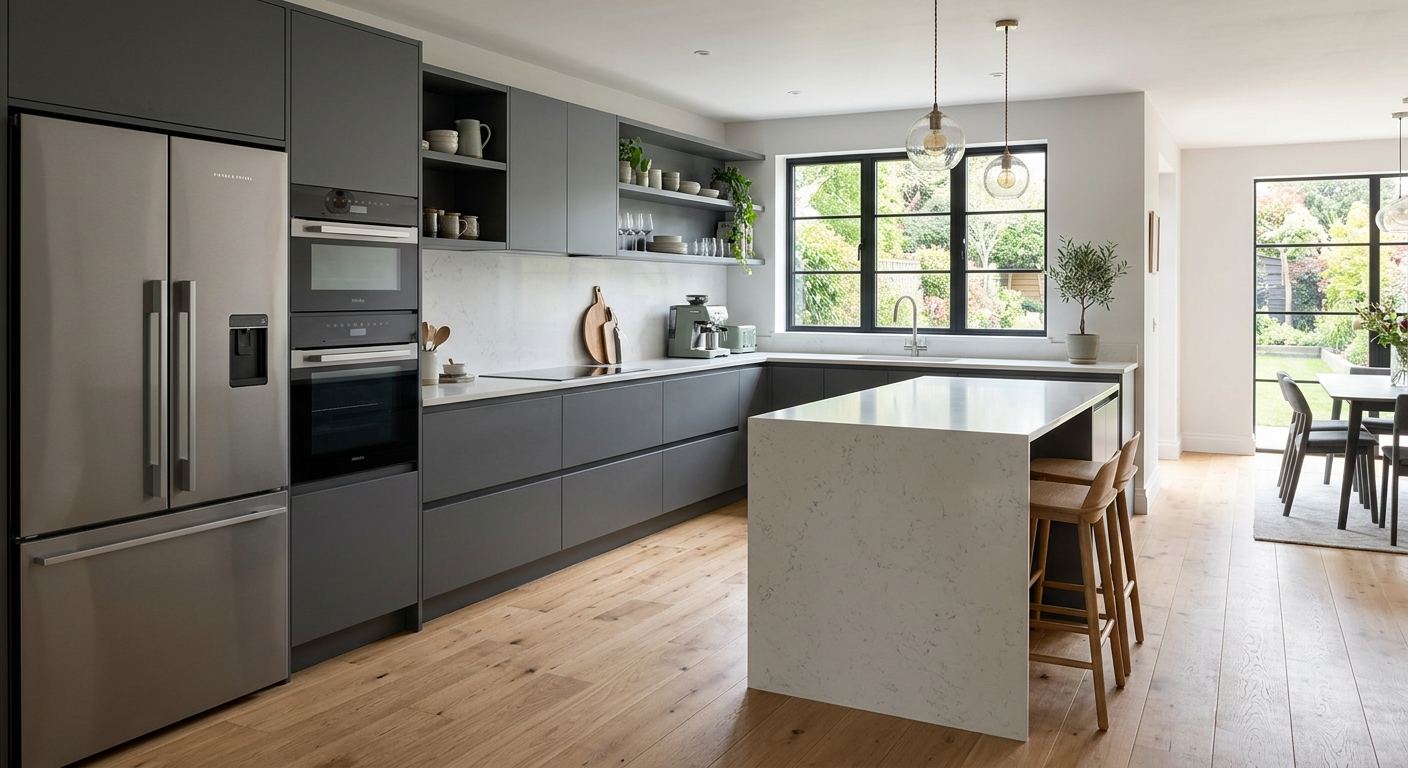
Kitchen renovation options and costs in Abbottsfield
Kitchen renovation planning in Abbottsfield, Alberta usually starts with a simple question: are you refreshing the look or changing how the room works? With Abbottsfield’s small population (1,775 residents in 2021) and Calgary’s broader demand for trades, most quotes move quickly once you confirm materials and the cabinet tier. Because the Calgary economic region generally ties spending to local household purchasing power, homeowners often choose finishes that match the expected resale value—this is less about weather performance and more about how “premium” the kitchen appears to buyers.
In practice, Calgary-area kitchen budgets track closely to home values and household incomes, so higher-value properties commonly budget 10–15% of home value for a refresh and up to 20–25% for a full redesign. That demand pattern pushes many projects toward quartz or natural stone counters and semi-custom or custom cabinetry, which raises average project cost versus laminate and stock boxes.
Calgary’s climate does still influence what you should buy, but it’s indirect: strong seasonal temperature swings and basement/mechanical-room dryness can affect adhesives, sealants, and the long-term stability of cabinet installation details. Availability matters too—when the construction market is busy, labour and scheduling can shift by several weeks, which changes “staging” and interim protection costs. In Abbottsfield, trade availability and call-backs tend to be especially strong where homeowners are clustered in established residential pockets near the downtown corridor, because crews can stack jobs without driving across the city twice.
Below is a quick way to compare the typical renovation tiers homeowners ask for, before we get into what drives your quote.
| Renovation Tier |
What's Included |
Typical Duration |
Price Range |
| Cosmetic refresh (paint, hardware, new appliances only) |
Cabinet painting or touch-up, new hardware, faucet swap, appliance package (no cabinetry or major counter change) |
3–7 days (plus appliance lead time) |
$3,000–$12,000 |
| Mid-range full renovation (new cabinets, counters, sink, tile) |
New semi-custom cabinets, countertop replacement, sink + faucet, backsplash tile, flooring refinishing or selective replacement |
2–4 weeks |
$25,000–$55,000 |
| High-end full renovation (custom cabinets, stone counters, island) |
Custom cabinetry, quartz or natural stone counters, island (electrical +/or lighting), upgraded backsplash (tile or slab look), appliance + lighting upgrades |
4–8 weeks |
$60,000–$110,000 |
| Cabinet refacing only (new doors + drawer fronts, same boxes) |
Door/drawer-front replacement, new trims, hardware, touch-ups; counters usually remain unless you add a swap |
1–2 weeks |
$8,000–$35,000 |
| Countertop swap only (laminate to quartz or stone) |
Remove old surface, install new countertop, seam/edge finishing, basic sink cut-out and faucet re-use (if compatible) |
3–7 days |
$3,000–$12,000 |
| Backsplash tile installation only |
Surface prep, tile setting and grouting, caulking at edges, clean-up; grout sealing where applicable |
3–6 days |
$2,500–$8,000 |
Prices are estimates only and vary by project scope, site access and material selection.
What affects the price of kitchen renovation in Abbottsfield
Two homeowners can receive quotes for “the same kitchen” in Calgary, but see differences of 30–50% once you look past the finishes. In Alberta, the biggest quote drivers are usually cabinet tier, countertop choice, and how much plumbing/gas/electrical work is required—not the local weather. Calgary’s strong construction market also supports higher trade rates (often about $90–$140 per hour for skilled labour), so labour-intensive elements like layout changes and millwork take a larger share of the budget than many people expect.
Local home values and incomes shape the typical finish tier far more than climate. In higher-value Calgary-region neighbourhoods, homeowners default to quartz or natural stone counters and semi-custom cabinetry because the renovation cost is easier to justify on resale. In more modest markets, laminate and stock cabinets dominate because they deliver a refresh at a lower up-front cost. That’s why you’ll often see projects cluster in the mid five-figures for full renovations (for example, around $25,000–$55,000 for a mid-range scope) and climb toward six figures when layouts change or when you choose premium stone and custom millwork.
Layout changes add the most unpredictable cost regardless of finish level. Examples in Abbottsfield: (1) adding an island typically means new electrical circuits and potentially revised venting/access panels, which can raise labour and inspection coordination; (2) moving a sink often forces drain rerouting and plumbing labour; (3) relocating a gas cooktop or adjusting a range hood duct path adds licensed gas and HVAC coordination costs. Also, if your kitchen is in an older home stock with out-of-date rough-ins, opening walls for new cabinet backing or tile substrate can uncover bring-up-to-standard work that wasn’t visible during the initial walkthrough.
So while Abbottsfield’s seasonal swings won’t directly “add” dollars the way a moved plumbing line does, they can affect install methods and material conditioning. The reliable way to manage budget risk is to decide early whether you’re keeping the footprint or paying for a true redesign.
| Price Factor |
Why It Matters |
Cost Impact |
| Cabinet tier — stock vs. semi-custom vs. fully custom millwork |
Determines fit, door style options, internal organization, and install time |
Often + $10,000 moving from stock to semi-custom; + $20,000+ toward fully custom in many full renovations |
| Countertop material — laminate vs. quartz vs. granite vs. stone |
Material cost and complexity (edges, seams, thickness) drive labour and slab handling |
Laminate keeps it lower (commonly closer to the $3,000–$12,000 countertop band); premium stone can push toward the top end of that range and beyond for islands |
| Layout change — wall removal, island add, plumbing/gas move |
Requires carpentry changes, licensed trades, inspections, and rework allowances |
Frequently the largest jump factor; can shift a project from the $25,000–$55,000 tier to $60,000–$110,000 territory |
| Appliance package tier — builder vs. mid-range vs. pro-grade |
Impacts install clearances, electrical/venting requirements, and integration features |
Can add several thousand to the budget; pro-grade packages also increase lead-time planning costs |
| Flooring — refinish existing vs. full replacement |
Matching existing material is often harder than replacing end-to-end |
Refinish reduces demo/disposal; full replacement adds material + install and usually more time on site |
| Backsplash — ceramic tile vs. marble vs. full-height slab |
Premium stone and full-height installs increase setting time and risk of cut/waste |
Ceramic is typically mid-band (around $2,500–$8,000); premium stone can push higher within that range |
| Electrical — new circuits for island, under-cabinet lighting |
Lighting and outlet changes require licensed work and coordination |
Often adds cost unpredictably when islands or major appliance upgrades are planned |
| Permit fees and licensed trade requirements |
Permits and inspections affect scheduling and add administrative cost |
Can add a few hundred to over a thousand depending on scope, and must be built into labour time |
Permits & regulations in Alberta
In Alberta, swapping cabinets or changing countertops typically does not trigger permits, because you’re replacing finishes rather than changing services. However, permits and licensed trades are usually required when you move plumbing supply or drain lines, relocate a gas stove/cooktop or adjust gas venting and range hood connections, remove a load-bearing wall, or add new electrical circuits (for example, outlets and lighting for an island). In practical terms for homeowners in Abbottsfield, the “permit question” usually comes down to whether your renovation touches the utilities behind the walls and ceilings, or impacts structural support.
Here’s a homeowner-friendly step-by-step verification approach before you sign a contract:
- Ask the contractor which portions require permits and which do not, and confirm who pulls them.
- Confirm a licensed gas fitter is assigned for any gas relocation or modification; Alberta gas work must be done by a licensed professional.
- Confirm a licensed electrician is assigned for new circuits, island receptacles, and under-cabinet lighting tied to updated wiring.
- Request Certificates of Insurance (liability coverage) and verify the coverage is current and includes renovation work.
- Ask for proof of workers’ compensation coverage (WSIB/WCB) for the crew; insist on documentation before work starts.
- For licences, verify using the appropriate provincial online licensing registry and match the business/person name exactly.
- Keep copies of clearance letters or inspection sign-offs provided after electrical/gas work.
Finally, always ensure permit responsibility is written into your contract (not just “handled by the contractor”). That detail prevents surprise costs and delays once demolition begins.
Cabinets, countertops and layout decisions in Abbottsfield
In an Abbottsfield kitchen renovation, the three most consequential decisions are cabinet tier, countertop material, and layout changes. First, cabinet tier controls your budget and the end result: stock cabinets are the fastest and cheapest path, semi-custom is usually the best balance for most Calgary-region resale expectations, and fully custom millwork is the highest cost but gives the best fit for unusual corners, ceiling heights, and appliance layouts. Second, countertop material affects day-to-day use. Laminate can look great at a lower price, but it’s more sensitive to heat and can wear at seams; quartz engineered tops are popular because they’re durable and low maintenance; natural stone like granite and marble are premium but have different care needs.
Third, layout decisions often determine whether the project stays in the mid five-figures or climbs toward six figures. Keeping plumbing in place typically keeps cost controllable. Adding an island is the most common upgrade, but it can justify its cost when it improves workflow (clearances, seating, and prep space) and when you’re also planning electrical and lighting. Open-concept wall removal can add value, but it’s inherently riskier because it involves structure, permits, and trade coordination.
To make this real with dollars: if you’re choosing between $25,000–$55,000 for a mid-range full renovation and pushing into $60,000–$110,000 territory, a typical pivot is choosing quartz plus a semi-custom cabinet package while keeping the footprint. But if you add an island and move sink plumbing, the hidden plumbing/electrical work and added install time are what justify (or force) the higher tier—finishes alone don’t usually explain the jump.
Even with Abbottsfield’s climate variability, buyers generally don’t pay for “weather resistance” in the kitchen. They pay for consistent detailing, clean lines, and a kitchen that looks current when viewed quickly during a showing—so prioritize layout and finish coordination first.
| Option |
Durability |
Maintenance |
Best For |
Price Range |
| Stock cabinets (big-box) |
Good for standard dimensions; durability depends on door/box construction |
Routine cleaning; less flexibility for non-standard layouts |
Fast timelines and tighter budgets |
$8,000–$20,000 |
| Semi-custom cabinets (local dealer) |
Very durable with better hardware options and more sizing choices |
Simple cleaning; upgradeable interiors |
Most mid-range full renovations aiming for resale appeal |
$15,000–$40,000 |
| Custom cabinets (local millwork shop) |
Highest build consistency for your exact space and needs |
Routine care; best fit reduces stress points and gaps |
Unusual layouts, ceiling-height detailing, and premium finishes |
$30,000–$70,000 |
| Laminate countertop |
Resistant to stains but can be vulnerable at seams and to heat |
Easy daily cleaning; avoid hot pans directly and protect seams |
Budget-friendly refreshes where you keep the layout |
$3,000–$7,000 |
| Quartz engineered countertop |
Highly durable, resistant to everyday wear and moderate impacts |
Low maintenance; no sealing typically required |
Most homeowners seeking “premium look” without heavy upkeep |
$5,000–$12,000 |
| Granite / natural stone countertop |
Very durable; performance varies by finish and stone type |
Usually benefits from periodic sealing depending on stone |
Premium projects with a natural-vein design goal |
$7,000–$18,000 |
| Butcher block countertop |
Durable but can scratch and needs attention to moisture/heat |
Oil and care routine; protect from prolonged wetness |
Warm, character-driven kitchens and light-use households |
$4,000–$10,000 |
| Marble countertop |
Premium look; more sensitive to etching/staining than quartz |
Requires careful cleaning and sealing mindset |
High-end visual impact where homeowners want statement stone |
$9,000–$22,000 |
How to choose a kitchen renovation contractor in Abbottsfield
Choosing the right contractor in Abbottsfield is mostly about verification and clarity. In Alberta, confirm licensing, liability insurance, and workers’ compensation coverage before any work begins. Licensing checks should cover any specialty trade you’re relying on—especially gas fitting and electrical—since those scopes must be performed by appropriately licensed professionals. Ask for (1) your contractor’s and key trade partners’ licence details via the provincial online registries, (2) a current Certificate of Liability Insurance, and (3) WSIB/WCB coverage proof for the workforce. If a contractor can’t produce documents promptly, that’s usually a red flag.
Next, request 2–3 itemised, written quotes rather than a single lump sum. You want a breakdown that separates labour from materials, and line-items for what you’re actually buying: cabinet packages, countertop supply and installation, tile and grout type, electrical and plumbing scopes, and disposal. Carefully read the scope exclusions too—examples include permit pulling, waste removal, drywall repair, appliance installation, and what happens if walls require additional substrate for tile.
Warranty matters. Look for a workmanship warranty length in writing and ask whether product warranties are transferable if you sell your home. For payment scheduling, never pay more than about 10–15% upfront; hold back a portion until key milestones are complete. Finally, insist on a start date and completion estimate in writing, including a realistic window for countertop lead times and appliance delivery.
- Confirm which permits are required and who pulls them (and cost responsibility).
- Verify gas and electrical scopes are assigned to licensed trades.
- Ask for insurance and WSIB/WCB documentation before signing.
- Demand itemised quotes (labour + materials), not “allowances” only.
- Check whether demolition, disposal and hauling are included.
- Confirm who handles drywall/plaster patching for tile and backsplash lines.
- Clarify countertop template timing and measurement responsibility.
- Review warranty terms: workmanship vs. manufacturer product coverage.
- Confirm payment schedule: max 10–15% upfront, holdback until milestones.
- Get timeline details including start date, inspection windows, and final walk-through.
- Ask how change orders are priced (pre-agreed hourly rate or fixed unit costs).
- Request a site-protection plan (tarps/plastic, dust control, floor protection).
Red flags in Abbottsfield kitchen renovations include: refusing to provide a written scope or itemised quote, quoting unusually low compared to the local mid five-figure full renovation range without explaining scope gaps, “verbal-only” promises about permits or licensed trades, missing insurance/WSIB/WCB documentation, and demanding large upfront payments without a signed contract and schedule.
Frequently asked questions — kitchen renovation in Abbottsfield
How do I choose a kitchen contractor in Abbottsfield?
Start by verifying Alberta licensing and coverage. Ask for the contractor’s liability Certificate of Insurance, proof of WSIB/WCB coverage, and confirmation that any gas and electrical work is assigned to licensed professionals. Then get 2–3 itemised quotes so you can compare apples-to-apples: cabinet tier, countertop type, tile scope, electrical/light allowances, and whether disposal and permit pulling are included. If one quote is far lower than the local typical full-renovation band (often $25,000–$55,000 for mid-range scopes), request a written scope explanation—usually it’s missing items. Finally, insist on a clear start/completion timeline and a workmanship warranty in writing.
What order do kitchen renovation steps happen in?
In Abbottsfield (and across Alberta), the usual sequence is: (1) measurements and final selections, (2) demolition and site protection, (3) framing/drywall repairs as needed, (4) rough-ins for electrical/plumbing/gas if your layout changes, (5) licensed inspections, (6) cabinet installation, (7) countertop templating and then countertop install, (8) backsplash and flooring work, and (9) trim, hardware, caulking/finishing, and final cleanup. Appliance delivery timing matters; it’s best to align appliance install after countertop and cabinet fit are complete. If your project is a refresh (like a cosmetic update plus appliance swaps), the schedule is shorter and usually avoids many inspection-driven delays.
Can I live at home during a kitchen renovation in Abbottsfield?
Often yes, but it depends on how invasive your plan is. If you’re doing a cosmetic refresh or limited work such as backsplash tile installation, you can usually keep using the kitchen in some form with a temporary setup. For mid-range full renovations (commonly $25,000–$55,000), many homeowners can remain in the home by using a temporary kitchenette in an adjacent area and keeping essentials accessible. For high-end redesigns, especially with wall removal and island additions, living on-site becomes harder due to dust control, staggered trade work, and longer timelines. Your contractor should provide a dust-control plan and a clear day-by-day schedule so you know when water, power, or access might be disrupted.
Should I renovate my kitchen before selling in Abbottsfield?
Usually, yes—if your kitchen is clearly outdated or functionally inefficient and you’re renovating to match what buyers expect at your price point. Calgary-region buyers often respond to modern cabinet fronts, durable countertops, and cohesive lighting. A refresh can help curb appeal, while a mid-range full renovation can make the home feel “move-in ready.” That said, the best ROI depends on your starting condition and whether you’re changing the footprint. If you’re considering a major layout change, ensure the cost aligns with likely resale value and that finish choices (like quartz versus laminate) match the neighbourhood’s buyer expectations. Also consider the disruption period—aim for a timeline that lets you stage the home soon after the final backsplash and paint touch-ups are complete.
What's the most popular kitchen style in Abbottsfield right now?
In Abbottsfield, the most requested style tends to be a modern transitional look: shaker-style cabinet doors, clean-line hardware, and brighter, neutral palettes that photograph well for showings. Finish choices often pair semi-custom cabinetry with quartz counters because it gives a premium, consistent surface without the maintenance concerns some natural stones require. Many homeowners also add under-cabinet lighting to make work areas feel brighter during long Alberta winters. If you’re aiming for “premium” impact, island seating and a statement backsplash are common, but the most popular result is usually cohesive and practical rather than overly ornate. Your contractor can help you pick a cabinet colour and countertop pattern that won’t date quickly.
How do I know if I need to update my kitchen plumbing in Abbottsfield?
You usually don’t need to replace everything, but you do need to assess condition once demolition opens the walls. Look for signs like slow drains, persistent leaks around shutoffs, corrosion at supply lines, or outdated rough-ins that don’t match current shutoff placement. If your renovation involves moving a sink, changing the dishwasher location, or reconfiguring where the water supply and drain tie-ins land, plumbing updates are more likely to be necessary for proper alignment and code-compliant connections. In Abbottsfield, older home stock can mean rough-ins are less accessible; once cabinets are removed, it’s common to find the plumbing needs adjustments even if major replacement isn’t required. A reputable plumber should include recommendations in writing after they inspect what’s behind the existing cabinetry.