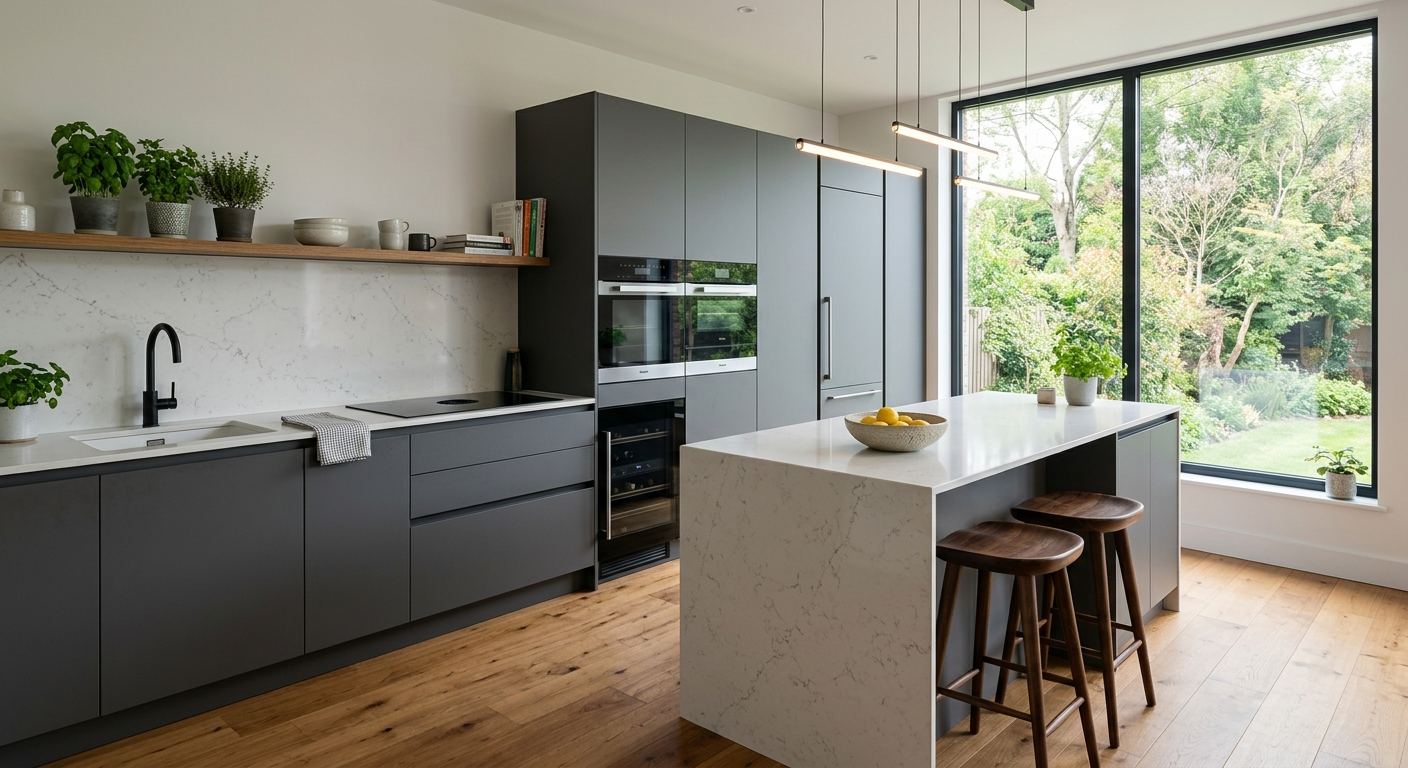
Kitchen renovation options and costs in Calder
In Calder, Alberta, the right kitchen renovation option usually comes down to how much you want to change—finishes only, a mid-level refresh, or a full redesign. Calgary’s wider economic region supports a strong housing market, and even Calder homeowners tend to choose upgrades that look current to future buyers; with a total population of 3,995 in Calder (Statistics Canada, 2021 Census), most projects also compete for a limited pool of trades. In the Calgary economic region, kitchen budgets often track to home value expectations: higher-value properties tend to justify quartz or natural stone and semi-custom cabinetry because that spend is easier to recover on resale. (Statistics Canada, 2021 Census)
Cost in this part of Southern Alberta is shaped more by market-driven finish expectations and trade availability than by “weather damage” alone. Alberta’s busy construction cycle keeps labour in demand—skilled kitchen trades in Calgary commonly run around 90–140 per hour—so labour, design, and project management can become a significant share of your total budget. That’s why two homeowners in the Calgary economic region can receive quotes that differ by 30–50% even for similar layouts: one buyer is targeting a mid-range refresh, while the other is moving walls, adding an island, or upgrading to premium stone and integrated lighting.
In Calder, trade demand is especially steady for updates tied to resale-prep and open-concept conversions, including work in established residential pockets like the Calder rural residential edge where contractors often coordinate deliveries and staging around driveways. With that context, the table below compares common renovation tiers and what you can realistically expect for duration and pricing.
| Renovation Tier |
What's Included |
Typical Duration |
Price Range |
| Cosmetic refresh (paint, hardware, new appliances only) |
Cabinet hardware swap, paint, appliance replacement, minor caulking and trim touch-ups (no cabinet box changes) |
3–7 days |
$12,000–$25,000 |
| Mid-range full renovation (new cabinets, counters, sink, tile) |
New semi-custom or quality stock cabinets, countertop replacement (solid surface/quartz), new sink and faucet, backsplash tile, basic plumbing tie-ins, flooring repairs/patching |
2–4 weeks |
$35,000–$65,000 |
| High-end full renovation (custom cabinets, stone counters, island) |
Custom cabinetry, premium stone (granite or upgraded natural stone), island build, upgraded lighting (often under-cabinet LED), expanded backsplash, appliance package coordination, potential layout/plumbing changes |
4–8 weeks |
$75,000–$120,000 |
| Cabinet refacing only (new doors + drawer fronts, same boxes) |
Refacing materials and hardware, door/drawer replacement, optional new countertop edge profile, backsplash adjustments for interface |
1–3 weeks |
$18,000–$35,000 |
| Countertop swap only (laminate to quartz or stone) |
Remove old counters, new engineered slab install, sink cut-out coordination, seam/edge detailing, basic backsplash caulking updates |
2–5 days |
$4,500–$12,000 |
| Backsplash tile installation only |
Tile layout and installation, trim/joint detailing, removal and reinstallation of minor sections as needed |
4–7 days |
$2,500–$8,000 |
Prices are estimates only and vary by project scope, site access and material selection.
What affects the price of kitchen renovation in Calder
Homeowners in Calder often notice that “the same kitchen” can come back with very different quotes across the Calgary economic region—and sometimes even across neighbouring communities. That spread is typically driven by finish tiers and scope, not by Calder’s climate. In this market, it’s common to see 30–50% variation because contractors price (1) materials to match resale expectations and (2) labour time for details that buyers care about, like cabinet quality, countertop thickness/edge profiles, and integrated lighting. In higher-value pockets of the broader Calgary region, homeowners more often default to quartz or stone and semi-custom cabinetry; in more modest projects, laminate and stock cabinets help keep the budget closer to the lower end of the bands.
Local home value and household income determine what “looks appropriate” to buyers after a renovation. Where premium finishes are the norm, a full kitchen can land in the mid five-figures to reach $100,000 depending on layout changes and stone selection. Even if your counters alone would fit the $3,000–$12,000 countertop band, upgrading to quartz with a detailed edge and coordinated backsplash can quickly push you into the mid-band full-renovation budget when you account for install time and cabinet refinishing alignment. Layout changes are the biggest wildcard: removing a wall, adding an island, or moving plumbing/gas adds labour, permits, and trades scheduling regardless of finish level.
In Calder, two practical examples that commonly raise costs are (1) older kitchen plumbing runs that don’t align neatly with a new island location, and (2) delivery and staging constraints around existing driveways and narrow service paths. On the flip side, jobs often come in lower when homeowners choose like-for-like cabinet sizing and keep the sink position, limiting plumbing moves and electrical rework—helpful when you’re trying to stay near the $25,000–$100,000 full-renovation range without expanding scope.
| Price Factor |
Why It Matters |
Cost Impact |
| Cabinet tier — stock vs. semi-custom vs. fully custom millwork |
Tier affects box quality, door styles, interior storage, lead times, and install labour |
Typically shifts budgets by about 20–45% |
| Countertop material — laminate vs. quartz vs. granite vs. stone |
Material cost and install complexity (seams, edge profiles, weight) drive price |
Often moves the project by $3,000–$20,000 |
| Layout change — wall removal, island add, plumbing/gas move |
Triggers additional carpentry, electrical, plumbing/gas coordination, and longer schedules |
Commonly adds $8,000–$35,000+ |
| Appliance package tier — builder vs. mid-range vs. pro-grade |
Power/venting requirements and install time vary by model and features |
Can add $2,000–$15,000+ |
| Flooring — refinish existing vs. full replacement |
Matching undercuts, transitions, and subfloor preparation affect labour |
Often $1,500–$8,000 |
| Backsplash — ceramic tile vs. marble vs. full-height slab |
More premium surfaces increase cutting waste, labour time, and material handling |
Typically $2,500–$8,000+ |
| Electrical — new circuits for island, under-cabinet lighting |
New outlets, lighting, and dedicated circuits require certified electricians |
Often $800–$5,000+ |
| Permit fees and licensed trade requirements |
Gas/electrical/plumbing changes require permits and inspections in Alberta |
Can add $500–$3,000+ depending on scope |
Permits & regulations in Alberta
In Alberta, many kitchen updates can be done without permits, but the moment you change core building services, you’re in permit territory. Cabinet and countertop swaps generally do not require a permit when you’re keeping existing connections and locations. However, if you move plumbing supply or drain lines, relocate a gas stove or change a gas range hood that vents with gas, or add/relocate electrical circuits (for example, wiring for an island and under-cabinet lighting beyond simple swaps), you’ll need permits and the work must be completed by appropriately licensed trades. If you’re removing a load-bearing wall or changing the structure, expect additional approvals and engineering/inspection steps.
For a Calder homeowner, the practical approach is to verify three things before signing: licence, insurance, and worker protection coverage. Step-by-step, first ask your contractor for their Alberta licence details (for the trades performing gas or electrical work, the licence must match the scope). Next, request a current certificate of insurance (liability) showing the effective dates and coverage. Finally, confirm Worker’s Compensation coverage (WCB/WSIB) documentation for the contractor and crews—don’t accept “we’re covered” without paperwork.
Where to look: check the trade licence information through provincial online licence lookups for applicable trades; for insurance, review the certificate directly; and for WCB/WSIB, ask for the clearance letter or coverage confirmation. Most disputes come from scope creep—so confirm in writing what permits the contractor will pull (and who pays), before work starts.
Cabinets, countertops and layout decisions in Calder
When you renovate a kitchen in Calder, three decisions drive both your final cost and how well the kitchen sells later: cabinet tier, countertop material, and whether you change the layout. For cabinetry, stock units are typically the fastest and lowest-cost option, semi-custom is the most popular mid-range choice (better storage layouts without fully bespoke pricing), and custom cabinets are best when you’re chasing a unique plan, ceiling-to-floor details, or hard-to-fit spaces. For counters, laminate is budget-friendly but needs careful protection around heat and cuts; quartz is a strong daily-driver in family kitchens; granite/natural stone gives premium looks but can involve extra care; butcher block adds warmth but is more maintenance-focused; and marble is luxurious yet more sensitive to etching and staining.
Layout is where Calder homeowners often overspend—or save—depending on resale expectations. Open-concept wall removal and island additions can add real functionality, but they’re justified when you gain clear traffic flow and more seating/storage. If you’re staying within the typical full kitchen band, you can often improve value by keeping the sink in roughly the same footprint and upgrading cabinets and quartz counters; that keeps plumbing disruption limited. As a concrete example, if your plan to add an island forces a plumbing and electrical move, you might add $8,000–$15,000+ to your budget—meaning the project can easily move from a mid-range target like $35,000–$65,000 toward a higher-end outcome. If you instead design an island that aligns with existing utilities, you may stay closer to the mid-band while still achieving the “new kitchen” feel.
Calgary-area buyer expectations generally lean toward clean lines, durable surfaces, and practical lighting, so choose finishes that look modern but are realistic for Alberta daily use—cabinet hardware quality and quartz durability matter more than chasing climate-driven “freeze-thaw” effects inside a kitchen.
| Option |
Durability |
Maintenance |
Best For |
Price Range |
| Stock cabinets (big-box) |
Good for everyday use; limited custom fit |
Low; straightforward hardware and wipe-down |
Budget-conscious refreshes and faster timelines |
$8,000–$18,000 |
| Semi-custom cabinets (local dealer) |
Very good build quality; better interior organization |
Low; regular cleaning and occasional hinge checks |
Most Calder homeowners aiming for resale-ready storage |
$18,000–$35,000 |
| Custom cabinets (local millwork shop) |
Excellent; tailored fit and premium hardware options |
Low-to-moderate; depends on finish and detailing |
Unique layouts, ceiling heights, and premium look targets |
$35,000–$65,000+ |
| Laminate countertop |
Moderate; can chip at seams and scratch with abuse |
Low; use cutting boards and avoid heat directly |
Entry budgets and cosmetic-driven renovations |
$3,000–$6,000 |
| Quartz engineered countertop |
High; consistent, scratch-resistant surface |
Low; wipe clean, no sealing required |
Busy households wanting a durable “set and forget” counter |
$6,500–$12,000 |
| Granite / natural stone countertop |
High; tough surface with natural variation |
Moderate; may need periodic sealing and careful stain control |
Premium aesthetics and buyers who value natural stone |
$9,000–$20,000+ |
| Butcher block countertop |
Moderate; resists with care but can mark over time |
Higher; regular oiling and protection from water |
Chef-style use and warm, casual kitchen designs |
$4,500–$10,000 |
| Marble countertop |
Moderate; beautiful but can etch or stain with acids |
Higher; requires careful cleaning and protection |
Low-impact entertaining kitchens and premium showpiece projects |
$10,000–$25,000+ |
How to choose a kitchen renovation contractor in Calder
Choosing the right contractor in Calder, Alberta starts with proof—not promises. First, verify the contractor’s Alberta compliance and coverage: for licence-related checks, ask for the trade credentials that match the work you’re doing (especially gas and electrical). Review a current certificate of liability insurance (with the contractor’s name and effective dates). Then confirm worker protection coverage such as WCB/WSIB—request the clearance letter or coverage confirmation so you’re not left holding the risk if someone is injured. If they can’t provide documents quickly, that’s a major quality and safety signal.
Next, get 2–3 itemised written quotes. A solid quote breaks labour and materials apart (cabinet supply, countertop install, electrical rough-in, tile labour, disposal/hauling), rather than bundling everything into a single number. Read the scope carefully for exclusions: does demolition include dust control? Is permit pulling included? Is disposal/haul-away included? Are you paying separately for protected flooring and site protection? Clarify exactly who handles scheduling for countertops and cabinet lead times.
Warranty matters too. Ask for the workmanship warranty length and what it covers (for example, caulking rework, cabinet alignment, and tile grout issues). Confirm whether product/manufacturer warranties are provided and whether they transfer to you. Finally, payment schedule should be conservative: never pay more than 10–15% upfront, then tie further payments to milestones; use a holdback until completion and final walk-through.
- Ask for the contractor’s Alberta licence details and match them to your exact scope (gas/electrical/plumbing work).
- Request a current certificate of liability insurance and review the effective dates.
- Confirm WCB/WSIB coverage with a clearance letter or coverage confirmation.
- Get 2–3 itemised quotes with labour + materials breakdown, not lump sums.
- Confirm whether permits are required for your scope and who pulls them.
- Verify disposal/hauling is included (demolition debris and packaging).
- Ask for start date and estimated completion time in writing.
- Confirm product lead times for cabinets and countertops and what triggers delays.
- Check demolition scope: what’s included (floor protection, dust control, appliance disconnects).
- Review warranty terms for workmanship and whether they are in the contract.
- Use milestone-based payments and hold back at completion.
- Demand colour/finish selections and measurement sign-off before ordering custom items.
Concrete red flags to watch for in Calder: (1) a quote with no itemisation and no line-by-line scope; (2) vague timelines like “about a month” without start/completion dates; (3) reluctance to provide insurance or WCB/WSIB documentation; (4) payment requests that exceed 10–15% upfront; and (5) no written warranty or unclear responsibility for defects like uneven cabinet reveals or tile cracking.
Frequently asked questions — kitchen renovation in Calder
How do I get accurate kitchen renovation quotes in Calder?
To get accurate quotes in Calder, start by making your scope unambiguous: what stays put (sink location, plumbing/gas points, existing electrical), what changes (cabinet style, countertop material, backsplash coverage), and whether you’re adding an island. The more you can provide—measurements, photos, and your must-haves—the less your contractor has to guess. Ask for 2–3 itemised quotes that separate labour from materials and specify inclusions like demolition, disposal, permit pulling (if needed), and site protection. In this market, finish choices can move the job from a mid-range full renovation into premium territory quickly; for example, a mid-range renovation often clusters around $35,000–$65,000 depending on cabinetry and quartz selection. Also request an allowance for appliances and tile, because substitutions can shift totals.
What's the best countertop material for a busy Calder kitchen?
For most busy Calder households, quartz is the practical “best all-rounder” because it handles daily wear well and doesn’t need sealing like many natural stones. Quartz also holds up nicely to typical kitchen routines—food prep, frequent cleaning, and the occasional hot pan situation (still use trivets). If your priority is a low-maintenance surface that stays looking consistent for resale, quartz usually outperforms laminate and is more forgiving than marble. Marble is stunning but can etch from acidic spills (lemon, vinegar), and butcher block requires regular oiling to keep it protected. If you’re comparing budgets, quartz countertop installs often land in the $6,500–$12,000 band, while laminate typically fits more tightly in the lower end of countertop swaps. For the best value, pair quartz with a durable cabinet tier (semi-custom or better) and plan your backsplash so transitions look seamless.
How do I add an island to my Calder kitchen?
Adding an island is mostly a layout and utilities problem, not just cabinetry. First, decide where the island will sit relative to traffic flow—so doors and drawers don’t snag—and then check whether you can keep existing plumbing/electrical routes. In many Calgary-area kitchens, islands succeed when they align with the current sink zone or run electrical along a planned path, limiting the need for new circuits. If you must move plumbing or gas, permits and licensed trades become part of the scope, and that can affect schedule and cost. To stay budget-controlled, ask your contractor to provide two options: a “utilities-friendly” island design and a “full relocation” design. If you avoid utility relocation, you may be able to stay closer to the mid-range full renovation band like $35,000–$65,000; if you relocate plumbing/gas and add new circuits, costs commonly push higher even with the same countertop material.
How much does a kitchen renovation cost in Calder?
In Calder, kitchen renovation costs typically land within the broader Calgary economic region’s price bands because cabinetry and countertop products are sourced and installed through the same supply chain. A full kitchen renovation often falls between $25,000–$100,000, depending on whether you’re doing a cosmetic refresh, a mid-range full renovation, or a high-end redesign with layout changes and premium stone. Cabinet installation or refacing alone can range from about $8,000–$35,000 (depending on tier and scope), while countertop installation is commonly $3,000–$12,000. Backsplash and tile installations typically land around $2,500–$8,000. The biggest swing factor is usually layout change (moving plumbing/gas or adding circuits), because it adds trades time and permits—more than climate effects do.
How long does a kitchen renovation take in Calder?
Typical durations in Calder depend on how much you’re changing and how quickly cabinets and countertops arrive. A cosmetic refresh (paint, hardware, new appliances only) often takes about 3–7 days. A mid-range full renovation is commonly 2–4 weeks when selections are made early and utilities remain in the same general locations. High-end full renovations with custom cabinets, stone counters, and an island typically take 4–8 weeks, especially if you’re changing the layout, moving plumbing/gas, or adding electrical for island lighting. Delays usually come from lead times (custom millwork or slab ordering), inspections, and when demolition reveals surprises such as older subfloor issues behind flooring or outdated electrical runs. To keep timelines tight, confirm selections early, schedule inspections promptly when required, and ensure the contract includes what happens if deliveries slip.
Quartz vs granite countertops — which is better?
Quartz is usually the better choice for most Calder households because it’s consistent in appearance, low maintenance, and resists staining and scratching better than many natural stone experiences—especially if you want “easy clean” durability. Granite is also durable and can look exceptional with natural veining, but it may require sealing and it can be more sensitive to certain stains depending on the stone. If you prefer a uniform look and don’t want to manage upkeep, quartz is the safer daily-use pick. If your goal is maximum natural variation and you’re willing to follow stone-care routines, granite can be worth it. In price terms, quartz countertop installs often fall in the $6,500–$12,000 band, while granite/natural stone commonly increases the total, often starting higher (commonly $9,000–$20,000+) depending on slab selection and the complexity of cuts and seams.